
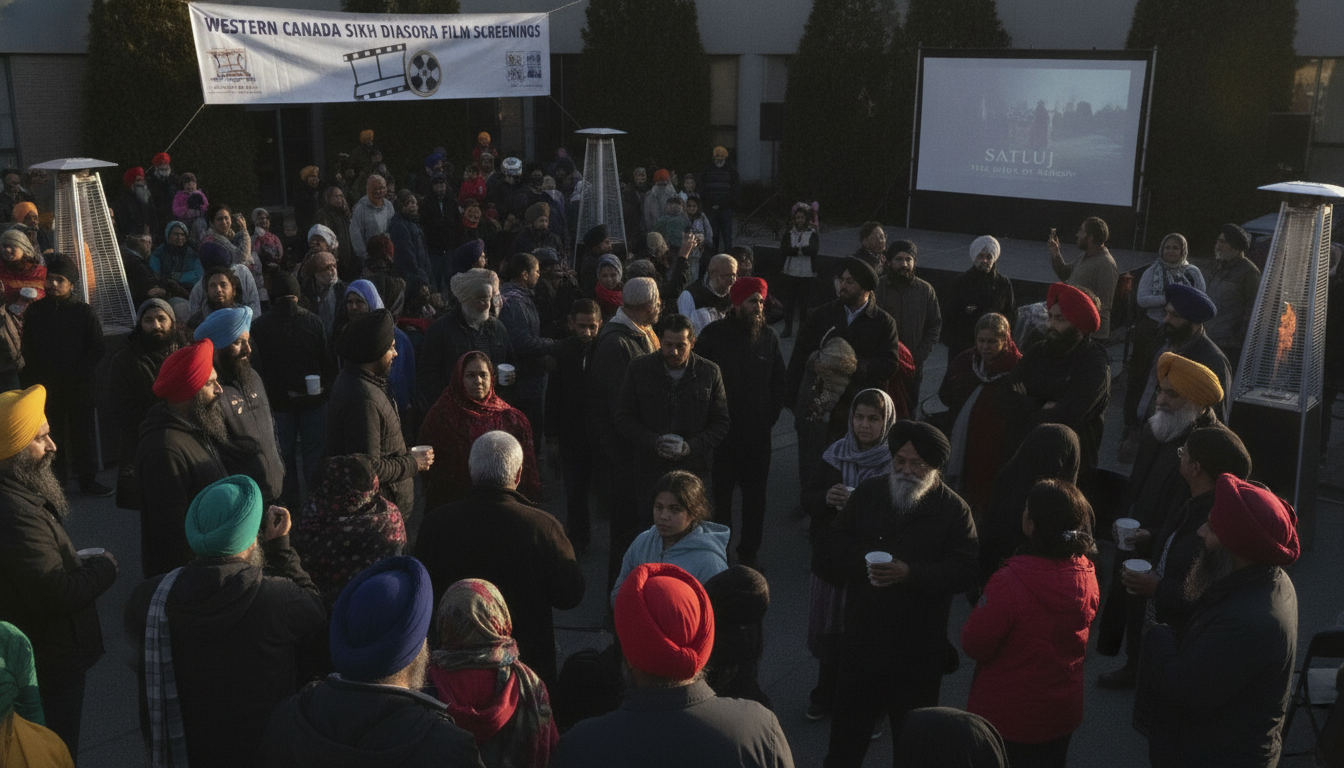
Banned Indian film Satluj draws packed community screenings across Canada’s Sikh diaspora
Satluj, about human-rights campaigner Jaswant Singh Khalra, was banned in India and is drawing large community screenings across Canada’s Sikh diaspora.
Satluj, a dramatization of the life and work of Jaswant Singh Khalra, has been quietly finding audiences in Canadian Sikh communities after being pulled from Indian streaming platforms. The film, starring Punjabi superstar Diljit Dosanjh, was released on ZEE5 on July 3 and removed by Indian authorities within 48 hours, prompting members of the diaspora to arrange independent showings. Community organizers in cities from Surrey to Edmonton say the film’s subject matter and the ban have intensified interest and attendance at screenings.
ZEE5 release and swift government removal
Producers released Satluj directly on the digital platform ZEE5 to bypass the usual Central Board of Film Certification process in India. The move followed debates over the film’s content and a prior festival withdrawal in 2023 when it screened under the title Punjab ’95. Less than two days after its online debut, Indian officials ordered the title removed from the service, citing security concerns to national outlets.
Indian authorities and some media described the decision as a precaution against material that could inflame regional tensions, while critics and festival programmers had earlier called the film “potentially incendiary.” The rapid takedown has not stopped copies from circulating online or community groups from arranging public showings abroad.
The story at the film’s centre: Jaswant Singh Khalra
Satluj dramatizes the investigation led by Khalra, a bank manager turned human-rights activist who documented alleged extrajudicial killings and secret cremations of unidentified bodies in Punjab during the 1990s. Khalra’s work claimed thousands of unaccounted deaths were being concealed, and his findings prompted legal action and international attention before his own abduction and killing in 1995.
The film aims to trace Khalra’s efforts to expose what he described as systemic abuses, and the personal risks he assumed in pursuing documentation and testimony. For many viewers in the diaspora, his life story resonates as both a human-rights narrative and a chapter in recent Punjabi history.
Allegations, investigations and the legal aftermath
Khalra’s original reporting alleged that a large number of unidentified bodies were forcibly cremated by state actors, a claim that led to investigations and later prosecutions. Independent inquiries and court cases in the years that followed produced convictions of some police officers, though questions remain for activists and legal observers about accountability and the full scale of abuses.
The film’s depiction of those events revisits judicial records and witness accounts that have long been contested in India’s public discourse. That contested history is central to why the film has generated strong reactions both from authorities and from communities that feel the story has been marginalized.
Scholarly and journalistic perspectives on the controversy
Academic and media analysts say Satluj’s narrative challenges official accounts of the 1980s and 1990s insurgency in Punjab, a period that remains politically sensitive in New Delhi. Mathieu Boisvert, director of UQAM’s Centre for South Asian Studies, describes the film as touching on a “foundational myth” that conflicts with the nationalist narrative advanced by India’s ruling party.
Independent journalists like Gurpreet Singh have disputed the government’s security rationale, calling the ban a form of disinformation designed to obscure uncomfortable institutional truths. Those competing frames — national security versus human-rights exposure — underpin the contentious response to the film.
Community screenings and turnout in Canada
Despite the online ban, pirated and transferred copies of Satluj have spread through diaspora networks, leading to a wave of grassroots screenings. In Surrey, organizers booked a high school and the Gurdwara Nanaksar for projected showings that are expected to draw hundreds of attendees, while separate events have been scheduled in Edmonton and other Ontario and British Columbia centres.
Organizers say the showings are framed as civic acts of remembrance and education rather than partisan events. Amrinder Singh, who represents a temple committee, said screening the film is a way to honour victims and to discuss human-rights issues connected to the Punjabi community’s history.
Political reaction and broader diaspora resonance
Elected officials in Canada have noted the paradox that censorship abroad can amplify interest at home. Randeep Sarai, the federal secretary of state for international development, told reporters that Canadian norms favour free expression and that efforts to ban films often make them more sought after. He and other community leaders emphasize that the screenings are taking place in a free-speech context and are intended to prompt community discussion.
Khalra’s historical ties to Canada — including family links to the Komagata Maru episode and his own visits to raise concerns — add to the film’s resonance among Canadian Sikhs. For many viewers, the story is both a transnational human-rights case and part of a longer narrative about migration, discrimination and memory.
The release, removal and subsequent diaspora screenings of Satluj have reopened debates about how contested histories are represented and who gets to decide what reaches public view. Community organizers in Canada say the film will continue to be shown and debated in local halls and gurdwaras as audiences weigh its portrayal of events against other accounts.
