
Palestinian municipal elections proceed amid war and low enthusiasm
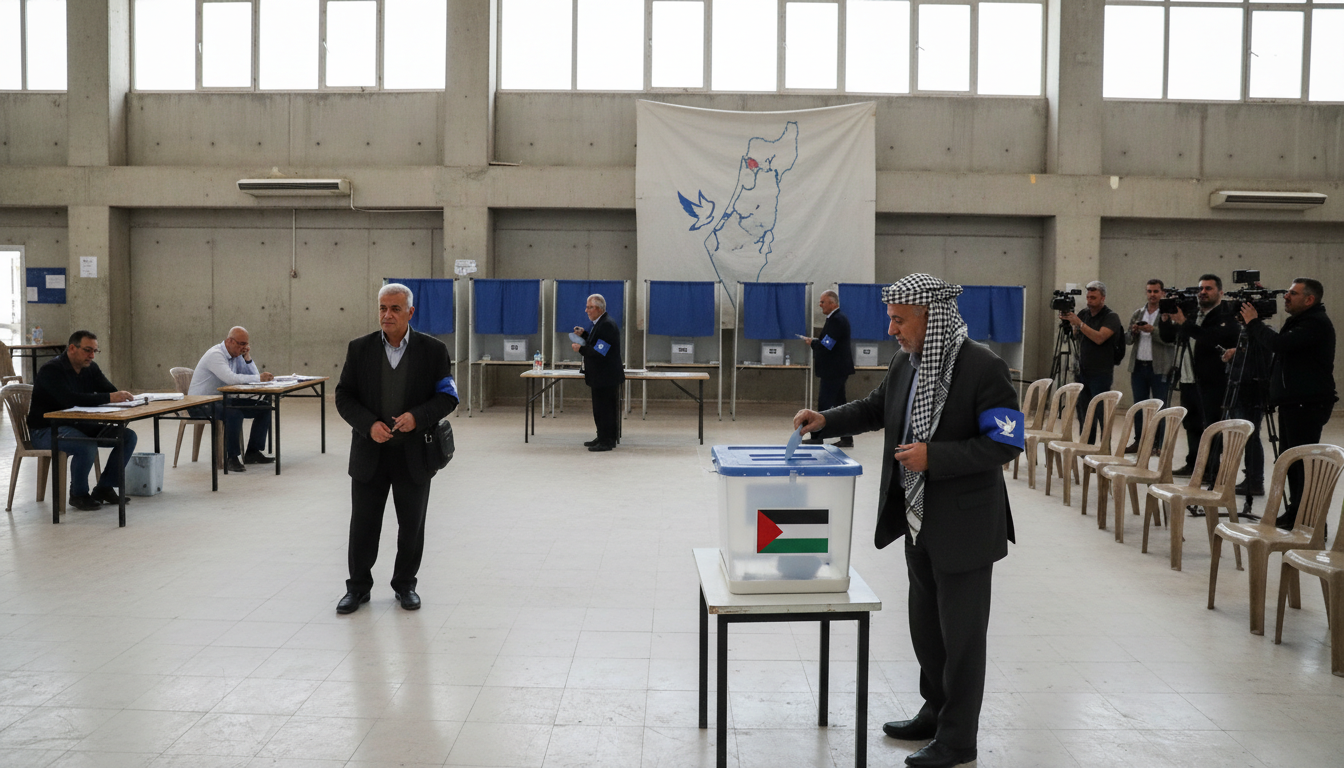
Palestinian municipal elections on April 25, 2026 in the West Bank and Deir al-Balah recorded mixed turnout and limited competition as voters sought local services amid the wider Gaza war.
The first municipal votes since the Gaza war began were held on April 25, 2026, with the Central Elections Commission reporting roughly 1.5 million registered voters in the occupied West Bank and about 70,000 in Deir al‑Balah, central Gaza. The Palestinian municipal elections were framed by voters as choices about water, roads and basic services even as the larger conflict shaped turnout and candidate lists.
Voting held amid war and disillusion
Turnout was uneven, the commission announced, with 53.4 percent participation in the West Bank and 22.7 percent in Deir al‑Balah. Organizers and voters described the mood at polling stations as subdued, reflecting war fatigue and constrained political options.
Many residents said their motivation was practical rather than political, seeking officials who could improve daily life under difficult conditions. Observers noted that the vote was one of the few functioning exercises of local democracy in Palestinian territories since national-level elections were last held in 2006.
Turnout and voter figures
The Central Elections Commission in Ramallah published the participation figures after polls closed, comparing the West Bank rate to 53.7 percent in 2022. Election officials emphasized the logistical challenges of organizing voting in a time of mass displacement and restricted movement in parts of Gaza.
In Deir al‑Balah, turnout was markedly lower, a result election officials and voters linked to displacement, shortages and the heavy toll of the conflict. Despite those obstacles, polling took place in centers where displaced families and local residents were able to cast ballots.
Political landscape: Fatah and independents dominate
Most candidate lists were aligned with Fatah, the party of President Mahmoud Abbas, or ran as independents; no lists openly affiliated with Hamas stood for office in the contested areas. Election rules and the political context in parts of the territories limited the ability of some hopefuls to register or campaign.
Reports from several towns said potential candidates were prevented from standing, including claims that members of lists were detained during the registration period. In at least one municipality a single list was uncontested, and local officials say a woman is expected to lead the city for the first time there.
Local priorities drive voters
Voters repeatedly cited immediate municipal responsibilities—water supply, sanitation and road repairs—as central to their decisions at the ballot box. In Jericho and other West Bank localities, women’s participation was visible at polling stations, underlining the local stakes for service delivery and community life.
For residents of Gaza, where many remain displaced and face severe shortages, the vote carried symbolic weight as an assertion of normalcy and the will to live despite the destruction around them. Young voters and displaced families described the election as an opportunity to choose leaders focused on relief and reconstruction.
Security concerns and settler violence shape demand for change
In parts of the West Bank, escalating violence and settler attacks have become a central concern for voters choosing municipal leaders. Local residents told reporters they wanted new faces ready to defend community rights and press for protection against incursions and attacks.
Municipal councils themselves have limited powers and no legislative authority, but they control essential services that affect everyday life. For many voters, the elections represented a pragmatic attempt to secure municipal management and local advocacy even if national politics remain frozen.
Political stakes for the Palestinian Authority and donors
With no presidential or legislative elections since 2006, municipal bodies remain one of the few functioning democratic institutions under the Palestinian Authority. International donors have increasingly conditioned assistance on visible governance reforms, and local election outcomes are likely to factor into funding and reform discussions.
Analysts say the Authority sees the Deir al‑Balah contest as a barometer of its influence in Gaza in the absence of recent public opinion data. The results will also shape local capacity for service delivery, an area closely watched by both aid agencies and municipal officials.
The municipal elections of April 25, 2026 offer a narrow but concrete test of local governance amid a protracted conflict, with voters focused on immediate needs while broader political divisions constrain choice. Results now being tallied will determine which local leaders inherit responsibility for services in communities grappling with displacement, shortages and security challenges.
