
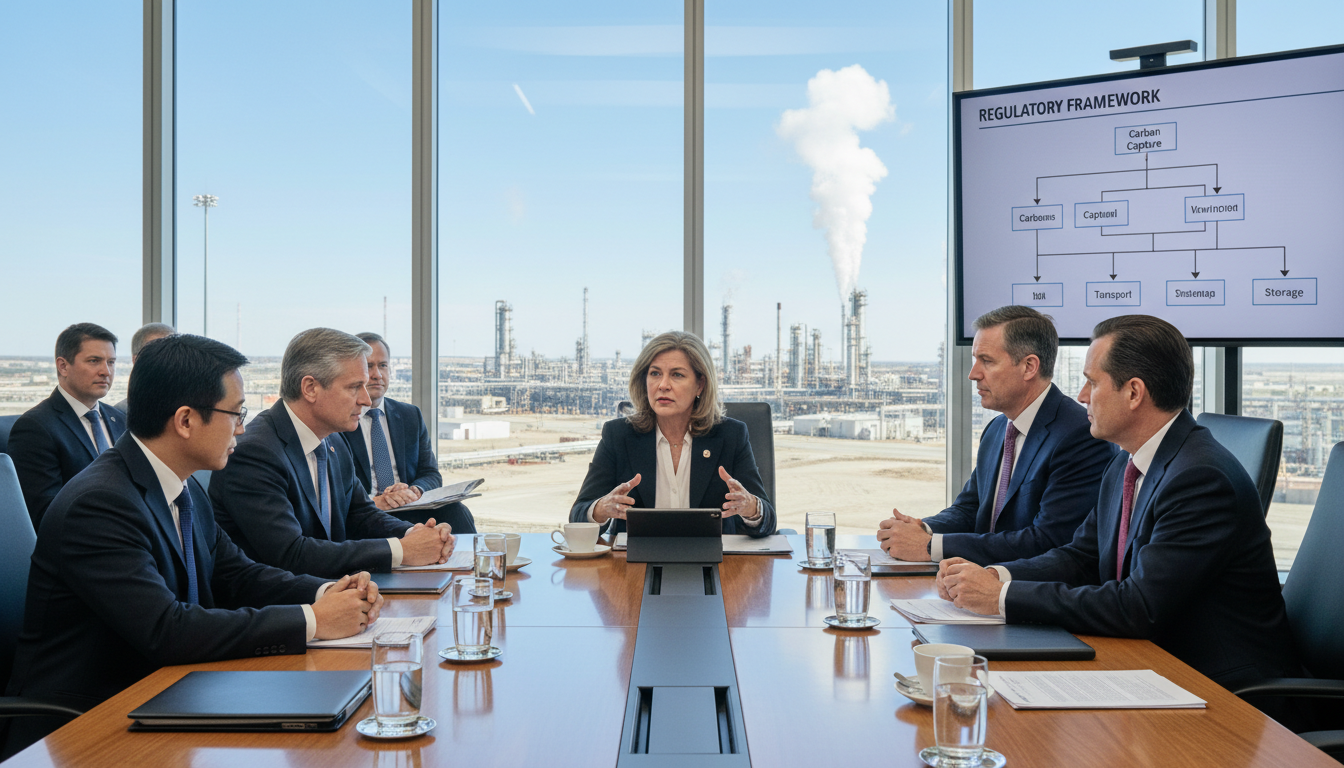
Alberta oilsands push for Pathways carbon capture project as MOU talks stall
Alberta oilsands firms push to advance the $20-billion Pathways carbon capture project, seeking regulatory, fiscal and environmental clarity amid federal-provincial MOU talks.
Industry leaders confirm commitment to Pathways
Murray Edwards, executive chair of Canadian Natural Resources, told reporters the oilsands sector remains committed to the Pathways carbon capture project and wants to see it proceed. He said companies have already spent substantial sums on pre-engineering, feasibility work and field studies to prepare the programme. Edwards stressed that industry support is contingent on clear environmental, regulatory and fiscal rules that make the project economically viable.
Industry executives have been meeting regularly to coordinate their approach and to press governments for certainty, according to company statements and interviews. Members of the Oil Sands Alliance, including Canadian Natural Resources, Suncor, Imperial and Cenovus, back Pathways as a large-scale decarbonization option for northern Alberta. Despite those commitments, the alliance has not made a final investment decision.
Pipeline link and the November memorandum of understanding
The Pathways project became central to broader federal-provincial negotiations after a memorandum of understanding signed in November 2025 tied support for a new West Coast oil pipeline to a major carbon capture initiative in Alberta. Under that framework, the federal government agreed to back Alberta’s bid for roughly a million-barrel-per-day export capacity if it is paired with a decarbonization plan such as Pathways. Governments and industry agreed in principle to pursue complementary deals on carbon pricing and project advancement.
Two side agreements outlined in the MOU carried an April 1 deadline but were not concluded on schedule. One would raise Alberta’s industrial carbon price under the TIER system to an effective $130 per tonne, and the other would formalize a government-industry pact to accelerate Pathways. Negotiators are still working through details, and officials say more time is required to reconcile competing priorities.
Sticking points: carbon price, credits and competitiveness
A central impasse in talks is the role and timing of a higher industrial carbon price. Alberta agreed to increase the effective TIER rate to $130 per tonne, up from $95, but the mechanics and timetable for reaching that level remain unresolved. Industry leaders warn that an abrupt hike or additional levies could dampen investment, while environmental groups argue that stronger pricing is essential to drive emissions reductions.
Cenovus’s chief executive has said sector discussions have been too narrowly focused on climate policy, arguing that policy uncertainty undermines competitiveness. Conversely, critics such as Greenpeace Canada have called Pathways a delay tactic, saying oil producers have not demonstrated genuine intent to reduce long-term emissions absent stronger rules. The debate centers on whether incentives and tax credits now on the table will be sufficient to mobilize the private capital Pathways requires.
Costs, incentives and the scale of investment
Companies involved estimate Pathways would require roughly $20 billion in capital to build, while a new West Coast pipeline could add $30 billion to $35 billion, putting combined upfront costs above $50 billion. Advocates for growth point to additional investment needed to raise production to fill new export capacity — potentially another $50 billion to $60 billion in initial capital — and ongoing maintenance spending of several billion dollars a year thereafter.
Governments have proposed financial support measures to bridge the economics. Alberta is offering a 12 per cent grant for carbon capture projects, and Ottawa has outlined an investment tax credit that could cover up to half of qualifying capital expenses. Pathways members say these incentives are helpful but that a clear, integrated policy pathway is necessary before committing to final investment decisions.
Political timetable and urgent negotiations
Negotiators are racing to finalize the outstanding elements of the MOU amid a compressed political schedule. Prime Minister Mark Carney and Alberta Premier Danielle Smith are due to meet in Ottawa on Friday, May 8, 2026, to discuss the file and pressing energy issues. Insiders say a breakthrough on carbon pricing and project terms could come within days or weeks if leaders agree on trade-offs.
Officials from both levels of government continue to balance economic development goals with emissions commitments, while industry seeks assurances that public supports will be durable and predictable. The absence of firm deadlines for reaching the higher TIER price has added to investor uncertainty and complicated planning for long-lead infrastructure projects.
Environmental groups and public scrutiny intensify
Environmental organizations are intensifying scrutiny of Pathways and the broader bargain linking pipelines to carbon capture. Critics argue that carbon capture alone will not be sufficient unless coupled with deep reductions in fossil fuel demand and transparent accounting for emissions. They also warn that offset markets and credit trading could weaken the impact of higher nominal carbon prices if not tightly regulated.
Supporters counter that Pathways would demonstrate large-scale industrial decarbonization capability and protect thousands of jobs tied to oil and gas communities. They point to potential long-term emissions reductions from capturing and permanently storing CO2 from oilsands operations as part of a transition strategy.
For now, the Pathways carbon capture project remains in a holding pattern: industry has signaled willingness to invest, but governments and producers have yet to lock in the fiscal, regulatory and environmental frameworks that would let a multi-billion-dollar decision move forward. The outcome of the May 8, 2026 federal‑provincial discussions will be watched closely by investors, unions, climate groups and communities across Alberta as all parties assess whether a deal can be stitched together to advance both infrastructure and decarbonization goals.
