
Hantavirus outbreak: MV Hondius docks off Tenerife as WHO-led evacuation begins
MV Hondius docks off Tenerife after a hantavirus outbreak; WHO-led testing and a staged evacuation are under way as Spain prepares repatriation of passengers.
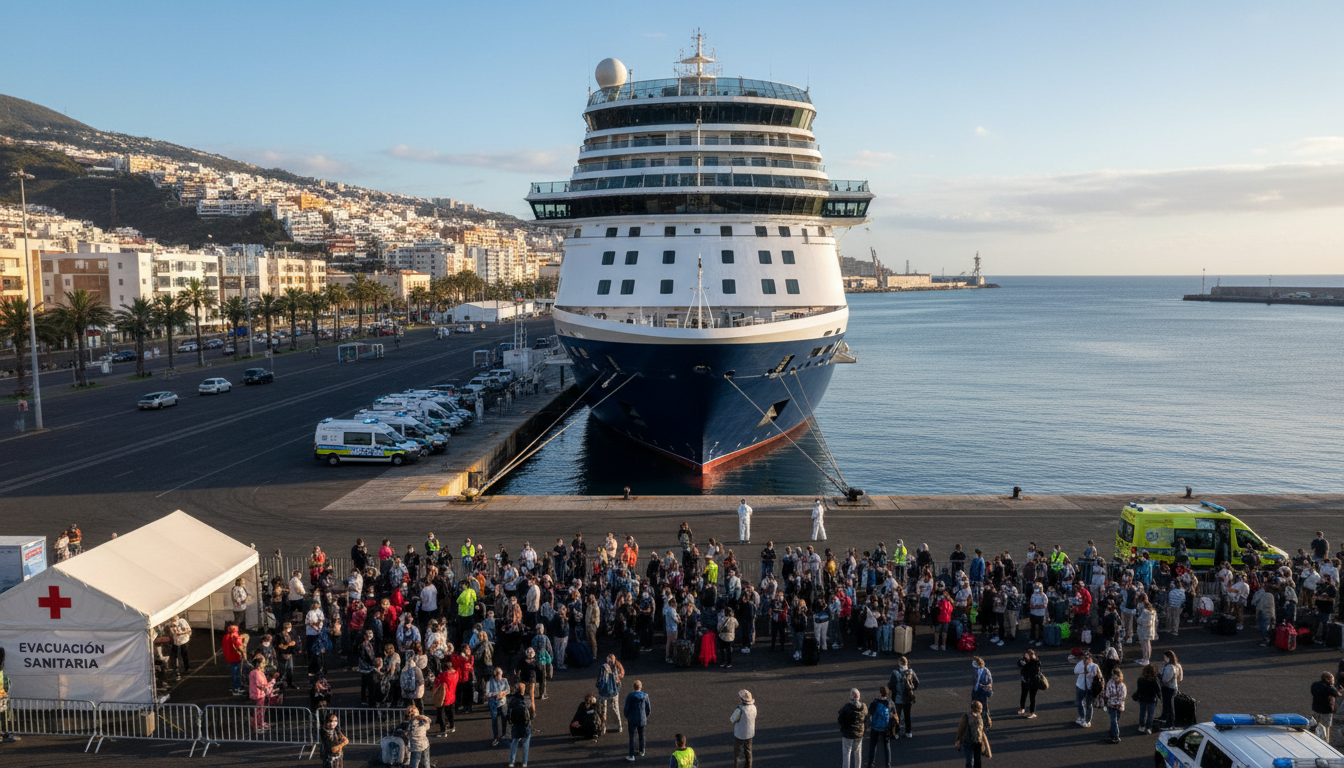
The cruise ship MV Hondius arrived off the Port of Granadilla in Tenerife on Sunday, May 10, 2026, after a hantavirus outbreak on board that left at least eight people ill and three dead. Spanish authorities, the World Health Organization and European public health officials coordinated to manage testing and a phased evacuation of passengers deemed high-risk contacts. The vessel, flying the Dutch flag, was escorted into position by a Civil Guard patrol as island authorities prepared to transfer people to shore.
Ship arrival and immediate response
Early on May 10 the MV Hondius was recorded near Granadilla and held position while Spanish health teams and national security services finalized transfer protocols. The decision to route the ship to Tenerife followed requests from the WHO and the European Union for Spain to oversee the disembarkation and medical evaluation of passengers.
Spanish officials said sealed vehicles would move groups directly from small boats to the island’s airport for repatriation flights, and that thirty crew members would remain aboard to sail the vessel to the Netherlands for disinfection.
WHO reports cases and fatalities
The World Health Organization confirmed at least eight people on board fell ill in the outbreak, with three deaths among those cases—a Dutch couple and a German national. WHO said six infections were laboratory-confirmed as hantavirus, with two additional suspected cases under investigation.
European and global health agencies classified all passengers as high-risk contacts as a precaution while public health teams conducted rapid scientific assessments and contact tracing measures.
Testing, transport and staged disembarkation
Spanish health authorities said passengers would be tested for symptoms while still at sea and then brought ashore in small boats for further screening on land. Officials planned a staggered disembarkation beginning between 7:30 a.m. and 8:30 a.m. local time, with Spanish nationals scheduled to leave first and other nationalities following in groups.
After testing and confirmation of clinical status, sealed buses would transport passengers to Tenerife South Airport, about a ten-minute drive, for direct flights home or to designated quarantine facilities in their countries of residence.
WHO leadership and Spanish ministers present on site
WHO Director-General Tedros Adhanom Ghebreyesus traveled to Tenerife to coordinate the response with Spain’s interior and health ministers and the minister for territorial policy. Speaking in an open letter to residents of Tenerife, Tedros stressed that “this is not another Covid,” seeking to reassure local communities about the assessed level of public risk.
Maria Van Kerkhove, WHO’s director for epidemic and pandemic preparedness and prevention, emphasized that while everyone on the ship would be treated as a high-risk contact, the immediate risk to the general population in the Canary Islands remained low based on current evidence.
Local life and precautions in Granadilla de Abona
Despite the ship’s arrival, observers in Granadilla de Abona reported normal daily activity on Sunday, with residents continuing to shop and visit cafés as officials completed health operations. Local authorities maintained visible security and health measures around the port, while providing information to residents and visitors about the evacuation plan.
Spanish officials stressed that hygiene protocols and controlled transport routes would be enforced to minimize any contact between passengers leaving the ship and the wider island population.
International tracing and flights linked to the voyage
The MV Hondius sailed from Ushuaia, Argentina, on April 1 and called at several ports en route, including a stop at Tristan da Cunha on April 15 and passage to Cape Verde before heading to Tenerife. Health authorities in multiple countries have been tracing passengers who disembarked earlier and anyone they may have contacted since leaving the ship.
A passenger who had been removed from a Johannesburg-to-Netherlands flight on April 25 after showing illness later died in hospital, and authorities said a flight attendant who had contact with an infected passenger tested negative for hantavirus. Singapore reported negative tests for two residents who were on the cruise, though both remain in quarantine, and British officials noted a suspected case on remote Tristan da Cunha is being evaluated.
The coordinated effort by WHO, the European Centre for Disease Prevention and Control and national public health agencies reflects the priority given to rapid testing, international repatriation and containment measures while investigations continue into the source and transmission dynamics of the outbreak.
Final paragraph: Health teams on Tenerife continued evaluations and logistical preparations through Sunday evening, with repatriation flights set to carry passengers back to their countries after testing; authorities urged calm while investigations and contact tracing proceed to clarify how the hantavirus outbreak unfolded aboard the MV Hondius.
