
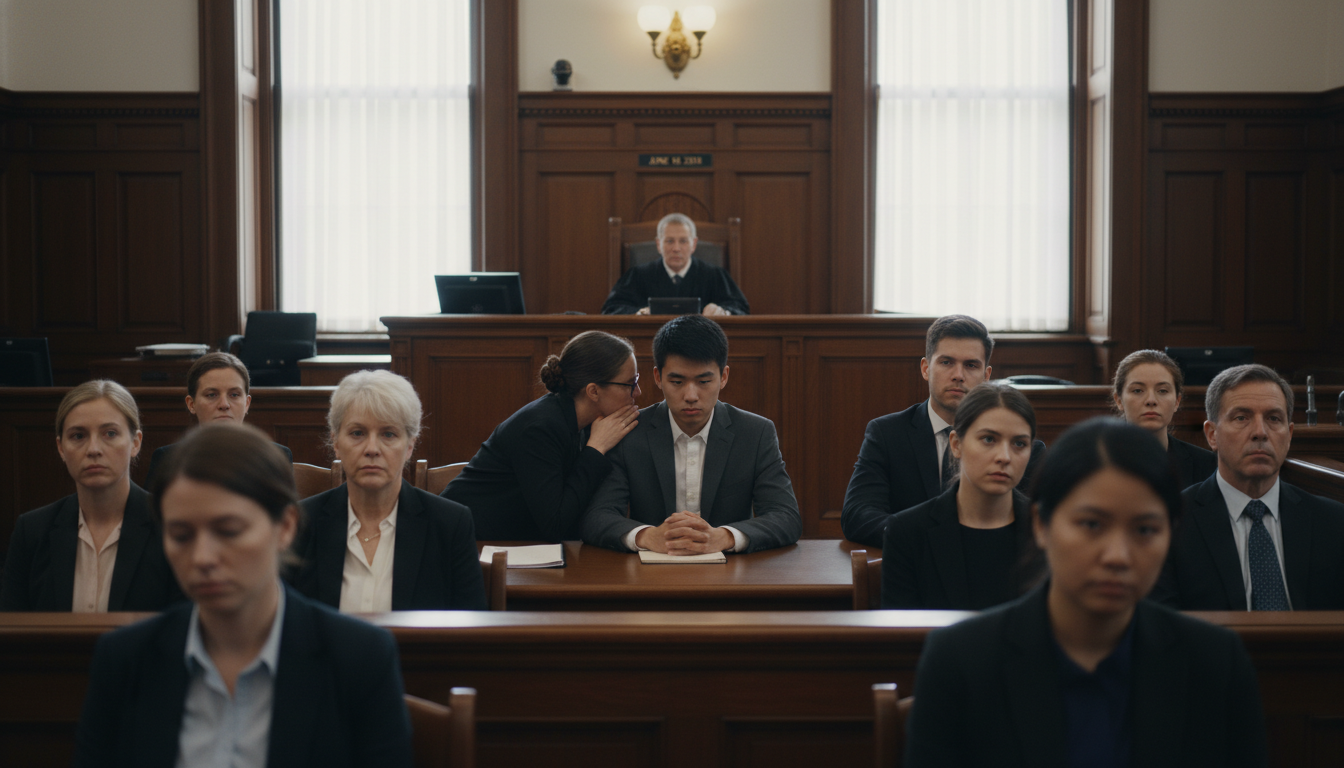
Alex Xu trial: Jury enters third day of deliberations in Calgary over mother’s 2023 death
Alex Xu trial: Jurors entered day three of deliberations in Calgary on May 13, 2026, to decide whether Xu had intent in his mother’s June 30, 2023 killing.
Jurors in Calgary entered the third day of deliberations Wednesday in the trial of 23-year-old Alex (Aixin) Xu, who faces a second-degree murder charge in the death of his mother, Alice (Jingying) Ai. The jury was tasked with determining whether Xu possessed the requisite intent for murder when he struck his mother with a rock on June 30, 2023. Final arguments were heard before the Court of King’s Bench and jurors began deliberations after directions from Justice Robert Armstrong.
Jury directs focus to intent
The 12-member jury was instructed to focus on a single legal question: did Xu form the intent to commit murder at the time he attacked his mother. Deliberations began Monday after closing submissions by defence counsel Dale Fedorchuk and Crown prosecutor Vicki Faulkner. The Crown argued intent was present and that evidence supports a murder conviction, while the defence contended that extreme drug intoxication prevented the mental state required for murder.
Jurors viewed a range of evidence during the trial and were asked to apply the legal standard for second-degree murder, including whether Xu’s actions showed a conscious decision to kill rather than a loss of control or impaired perception. The judge’s instructions guided jurors on how to weigh testimony and assess whether any available defenses, such as intoxication lowering culpability to manslaughter, were established.
Timeline of events from June 29–30, 2023
Crown evidence places the fatal incident in the early hours of June 30, 2023, after Xu had been taken to hospital by his parents following the consumption of two LSD tabs the previous evening. The family arrived at an emergency department near Foothills Medical Centre, where staff treated Xu for a severe reaction tied to the drugs.
At some point Xu left the emergency room and his mother followed him across the street to a row of nearby residences. It was between two houses, across from the hospital, that investigators say Xu bludgeoned his mother with a rock, causing fatal head trauma. Police were later shown a body-worn camera recording in which the accused directed officers to the location of the body.
Xu’s testimony: hallucination and fear
Xu took the witness stand and described experiencing intense hallucinations and a breakdown of his ability to distinguish reality from fantasy after taking LSD. He described seeing his mother’s face as grotesquely distorted and compared the perception to imagery from a graphic Japanese horror series, saying he reacted out of visceral terror.
He told the court he struck out in panic after an encounter in which his mother grabbed his arm, and that the subsequent strikes felt unreal to him at the time. Defence counsel argued this testimony supports a finding that Xu lacked the specific intent to kill, framing the blows as the result of a drug-induced psychosis that impaired his capacity to form murderous intent.
Crown’s case: motive and credibility challenged
The Crown disputes that the accused’s account is an honest portrayal of events and urged jurors to view Xu’s testimony as a constructed narrative to avoid responsibility. Prosecutor Vicki Faulkner argued that the evidence points to an act driven by anger toward his mother rather than an involuntary reaction to hallucinations.
Faulkner highlighted inconsistencies she says exist in the accused’s recounting and urged jurors to weigh admissions and actions — including his movements after the attack and statements to police — as indicative of culpability. The Crown further suggested that intoxication did not so undermine Xu’s faculties as to negate intent, and that even impaired individuals can form the necessary mental state for murder.
Evidence presented to the jury
Throughout the trial jurors were shown police body-worn camera footage, witness accounts and medical records outlining Xu’s presentation at the hospital on the morning of June 30. Forensic evidence describing the nature of the head injuries and blood spatter was entered to establish the force and sequence of blows that proved fatal.
Medical testimony also addressed the effects of LSD and whether the drug can produce the level of disassociation described by Xu. Experts for both sides gave differing perspectives on intoxication, perception and the ability to form criminal intent while under the influence, leaving jurors to resolve scientific disputes alongside testimonial credibility.
Potential verdicts and what comes next
If the jury finds Xu had the necessary intent, a verdict of second-degree murder could be returned and would carry a mandatory prison sentence determined at sentencing. Alternately, jurors could conclude intoxication diminished his culpability and opt for a manslaughter conviction, a finding that carries different sentencing considerations under Canadian law.
Deliberations entered their third day on Wednesday, May 13, 2026, with jurors continuing to review the evidence and legal instructions in private. Once the jury reaches a unanimous decision, it will be announced in court, after which the next legal steps — including potential sentencing or appeal processes — would follow based on the outcome.
The trial has drawn attention in Calgary for its complex mix of psychiatric, toxicological and legal questions, centered on whether a drug-induced state can negate criminal intent in a case that resulted in the death of a family member.
