
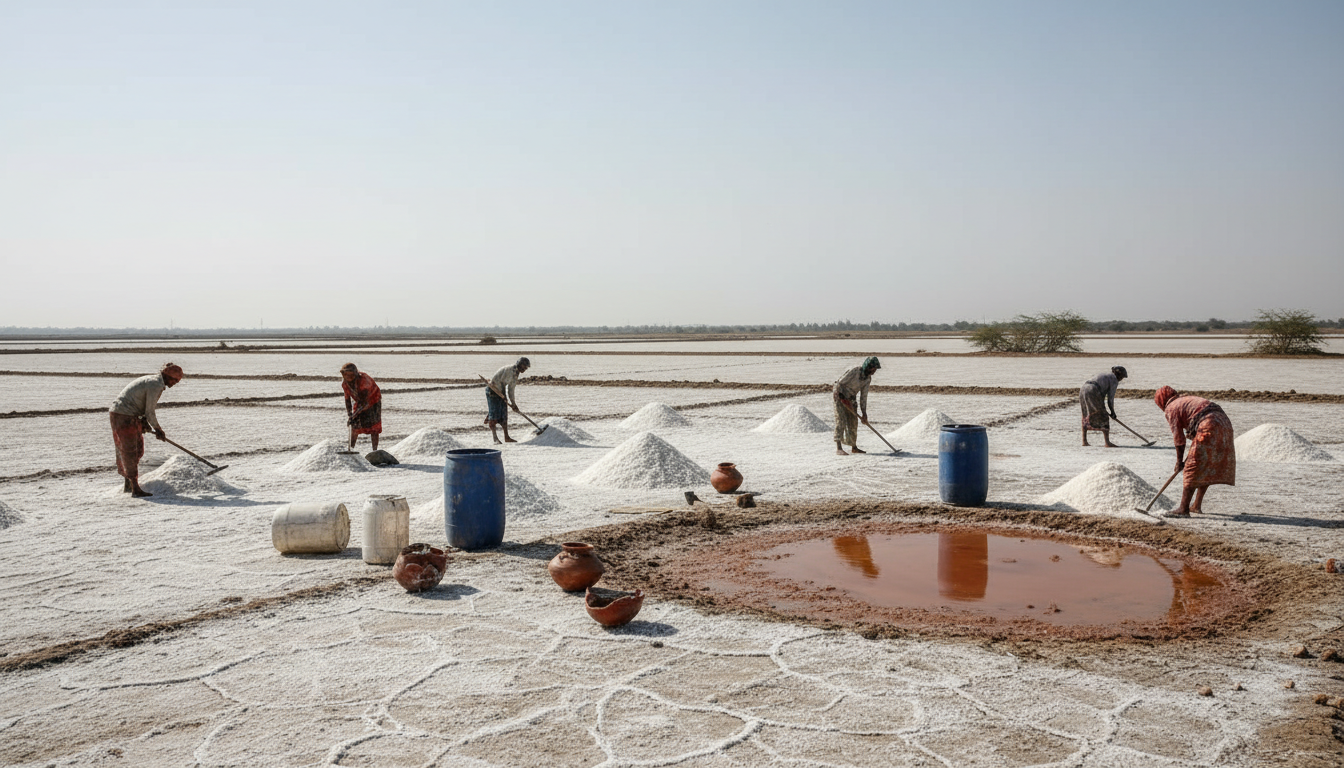
Gujarat salt workers face extreme heat, scarce water and longer seasons in Little Rann of Kutch
Gujarat salt workers endure extreme heat and scarce water in the Little Rann of Kutch as longer seasons and dehydration raise serious health and livelihood risks.
India’s seasonal salt workforce is confronting intensifying heat and worsening living conditions in the Little Rann of Kutch, where tens of thousands of labourers spend months on exposed salt flats to harvest the country’s largest share of salt. Up to 50,000 seasonal workers migrate to remote pans each year, living in makeshift shelters without reliable electricity or healthcare while daily temperatures routinely top 45°C. With water deliveries infrequent and work extending deeper into the hottest months, health risks and economic vulnerability for these communities are rising.
Heat and scale in the Little Rann of Kutch
The shallow evaporation pans of the Little Rann of Kutch sit in one of India’s harshest microclimates, producing a substantial proportion of the nation’s salt output. Summers there frequently climb past 45°C and can reach 47–48°C, creating near-unlivable conditions for those who work outdoors all day. The region’s arid winds and long, hot afternoons are ideal for crystallisation but exact a heavy human toll.
Seasonal migration is vast in scale, with families relocating for roughly eight months to follow harvest cycles. The remoteness of the flats — and the absence of permanent infrastructure — concentrates risk: shelter, water and medical care are all thinly available despite the industry’s economic importance.
Working conditions: shelter, water and day-to-day routines
On the pans, workers construct crude shelters from sticks, coarse cloth and locally available materials to block the sun and allow some airflow. These improvised huts offer limited protection from heat and dust, and there is no formal electricity to run fans or refrigerators. Daily life revolves around sheltering from the midday sun and fitting strenuous tasks into cooler hours.
Water access is chronically limited; some communities report deliveries of potable water only once every 25 days, forcing people to ration for drinking and washing. Salt production itself requires constant attention — saline water is pumped into pans, left to evaporate and then manually raked and piled — so labour is physically demanding even when temperatures moderate.
Longer seasons driven by cheaper solar pumps
A shift from diesel to solar-powered pumps has reduced fuel costs for many producers but also lengthened the working season, allowing salt extraction to continue deeper into April and beyond. The change makes production more economical but has the unintended consequence of exposing workers to the peak heat window. Tasks that once wound down with cooler weather now persist into hotter months.
Meanwhile, the India Meteorological Department has warned of an above-normal number of heatwave days for parts of the country, including Gujarat, increasing the likelihood that workers will face more frequent and intense heat episodes. The combination of longer seasons and a hotter climate raises questions about the sustainability of current labour practices.
Health impacts: dehydration, heat stress and kidney risk
Workers report common symptoms of heat stress — fatigue, dizziness and nausea — which, left unchecked, can progress to heatstroke and organ failure. Observational studies in salt pan communities have recorded high levels of dehydration and physiological markers consistent with heat-related strain. Early signs of kidney dysfunction have also been noted, suggesting repeated exposure to extreme heat and inadequate hydration may have long-term health consequences.
The dry environment complicates typical cooling strategies. Some workers rely on staggered work hours and makeshift cooling techniques, while others use traditional methods such as wrapped bottles to chill drinking water by evaporation. These practices provide some relief but are insufficient as systemic responses to rising temperatures and prolonged labour demands.
Economic pressures and disaster losses
The work is low-paid and precarious. Many families earn only modest profits for months of labour, and a single weather event can wipe out those gains. Recent dust storms have destroyed salt stockpiles worth substantial sums for harvesting households, turning an already fragile profit into a loss. For many migrants, the choice to return each year is more about survival than preference.
Lack of alternative livelihoods compounds the problem. Workers cite no access to land, livestock or other steady income sources, leaving them dependent on the seasonal salt economy despite the physical risks it entails. That dependency perpetuates a cycle in which health and economic insecurity reinforce one another.
Advocates call for immediate workplace protections and services
Researchers, labour advocates and local observers urge targeted interventions to reduce heat exposure and improve workers’ resilience. Measures recommended include reliable and more frequent water supplies, shaded rest areas, scheduled work-rest cycles, emergency medical access and heat-safety training for employers and crews. Simple infrastructure and logistical changes could cut immediate risks and reduce the incidence of severe heat-related illness.
Longer-term approaches being discussed by stakeholders include stricter occupational safety standards for outdoor industries, community health monitoring, and contingency plans for weather-related losses. Any effective response will need coordination between producers, local authorities and health services to ensure protections reach the most vulnerable.
The experience of salt pan communities in Gujarat highlights the collision of traditional livelihoods with a warming climate and evolving technology. Without practical protections and economic alternatives, Gujarat salt workers will continue to shoulder disproportionate risk while producing a commodity essential to the national market.
