
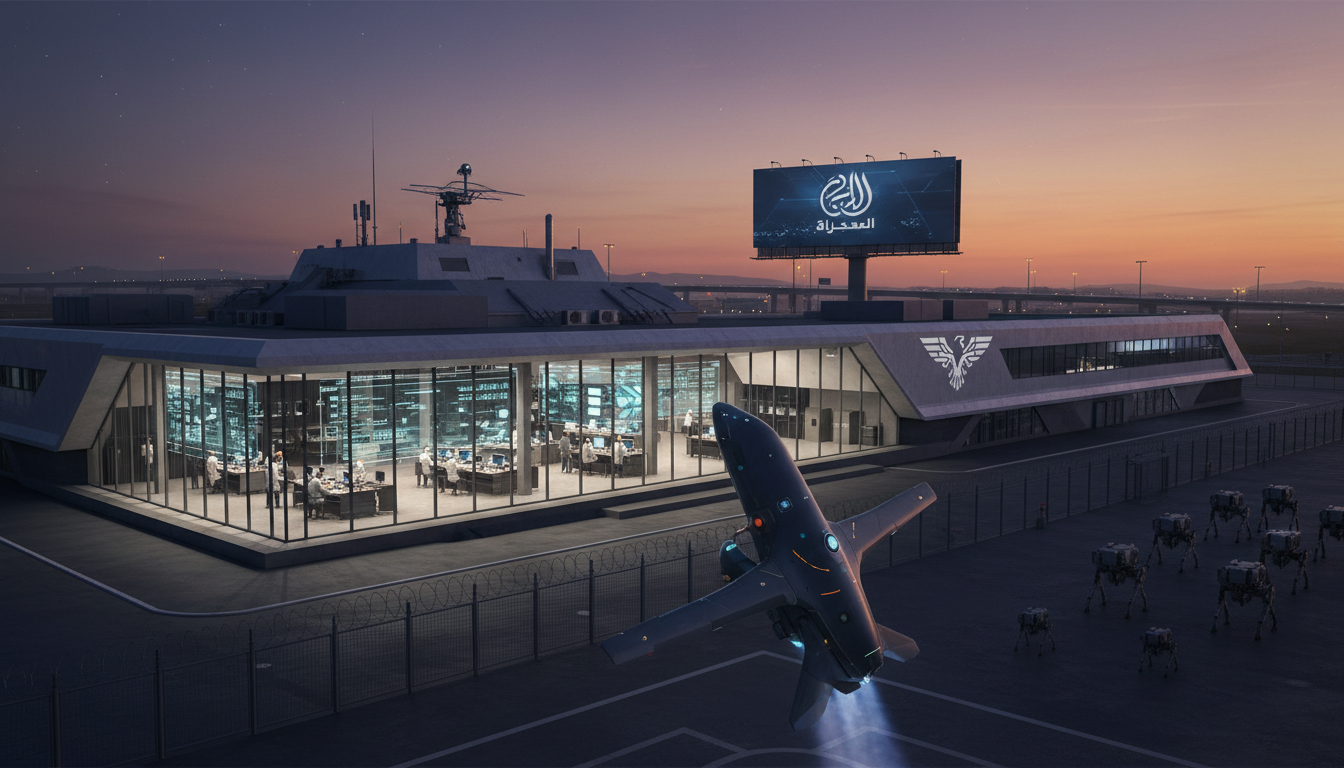
Military-tech complex under scrutiny as AI-guided weapons spread
Investigative series reveals how the military-tech complex is reshaping warfare as tech firms sell AI-guided weapons, raising escalation and oversight concerns.
The rise of a military-tech complex is reshaping how states and private companies approach modern conflict, a new investigative series released on May 13, 2026 says. Tech giants and defense startups are marketing AI-guided systems as "smart" and "surgical," while critics warn the technology accelerates escalation and weakens oversight. The series traces commercial ties, government contracts and financial incentives that have helped build a lucrative market for advanced autonomous and semi-autonomous weapons.
Tech firms move into autonomous weapons markets
Major technology companies and emerging startups have increasingly adapted commercial AI for battlefield use, pitching precision and reduced collateral damage as selling points. Firms such as Palantir and Anduril, alongside parts of larger technology ecosystems, now offer software and hardware intended to identify, track and engage targets with greater speed than human operators. These offerings are often framed as force-multipliers for militaries but also create new vectors for rapid decision-making in combat.
Industry leaders argue improved sensors, analytics and automation can protect soldiers and civilians by reducing errors caused by human fatigue or limited situational awareness. Yet analysts caution that faster target recognition and engagement cycles can outpace policy controls and increase the chance of mistakes or unintended escalation during crises. The transition from selling cloud services and analytics to supplying weapons-capable systems marks a notable shift in corporate focus and public scrutiny.
Big money follows conflict and procurement
Investment flows and government procurement have fueled rapid development and deployment of military-grade AI systems, drawing venture capital and private equity into defence-adjacent markets. Contracts from national militaries and classified procurement channels provide reliable revenue streams for companies that can demonstrate battlefield utility. That steady demand, combined with the prospect of global export markets, has intensified competition and sped product development.
Analysts note the financial incentives can skew priorities toward short-term deployability rather than long-term safety testing or compliance with international law. Startups under pressure to demonstrate performance for investors may accept operational risks that established contractors would traditionally mitigate through longer testing cycles. This alignment of capital and conflict raises questions about how commercial pressures shape the architecture and governance of lethal systems.
AI guidance heightens escalation and instability risks
The introduction of AI-guided weapons alters the tempo of military operations by reducing human reaction times and enabling more complex targeting decisions at machine speed. Experts warn such acceleration can create instability in tense encounters, where misinterpretation or technical failure could produce rapid, hard-to-control escalation. Autonomous targeting that relies on opaque algorithms also complicates post-incident investigations and accountability.
Military doctrine that integrates automated decision aids must grapple with how to maintain human judgment in the loop when milliseconds matter. Opponents and allies alike may respond to perceived advantages by deploying similar technologies, driving an arms-race dynamic across geopolitical fault lines. The cumulative effect is a strategic environment where the threshold for armed confrontation could be inadvertently lowered.
Opaque contracts, data access and civilian safety concerns
Procurement practices for advanced systems frequently involve classified elements and limited public oversight, leaving questions about how algorithms are tested and validated. Many contracts grant vendors access to sensitive datasets and operational environments, which can accelerate product refinement but also obscure potential biases or failure modes. Civil society groups and some legal experts argue that insufficient transparency undermines public trust and impedes accountability when harm occurs.
There are also concerns about dual-use applications and the repurposing of civilian data to train combat systems, which can entangle commercial privacy issues with battlefield ethics. Without clearer contractual terms, independent audits or public reporting requirements, it remains difficult to assess whether safety protocols meet internationally accepted standards for distinction and proportionality.
Regulatory and ethical gaps at national and international levels
National regulatory frameworks have struggled to keep pace with rapid technical change, and international law has yet to provide a unified approach to autonomous weapons and AI in warfare. While some states and multilateral bodies are debating limits or moratoria, concrete treaty action remains limited and uneven. The result is a patchwork of oversight regimes that companies can navigate selectively depending on jurisdiction and procurement transparency.
Legal scholars emphasize the need for harmonized testing standards, clearer chains of responsibility, and mechanisms to verify compliance with humanitarian law. Civil society organizations are pressing for stronger export controls and binding standards for human control over lethal functions. Policymakers face the twin challenge of preserving legitimate defence needs while preventing novel technologies from eroding protections for civilians.
Investigative series maps networks and consequences
The five-part investigative series led by Ali Rae documents how technological, financial and political networks have matured into a powerful military-tech ecosystem. The reporting connects product marketing, procurement choices and investor behavior to broader dynamics of militarism, suggesting that the incentives built into the system favor rapid deployment over measured oversight. The series highlights concrete cases where AI-enabled systems were promoted as precise and safe even as experts flagged untested failure modes.
By tracing relationships between firms, funders and government agencies, the investigation seeks to show how policy gaps and commercial priorities interact to shape the frontline reality of modern wars. It also amplifies voices from the defence community, legal experts and human rights advocates who call for stronger controls and public scrutiny before adoption becomes irreversible.
The emergence of a distinct military-tech complex presents policymakers with urgent choices: enact binding transparency and testing standards, clarify legal responsibility for automated decisions, and ensure that civilian protection remains central to procurement and deployment decisions. Without such measures, the rapid spread of AI-guided systems risks transforming conflict dynamics in ways that are difficult to control and costly to reverse.
