
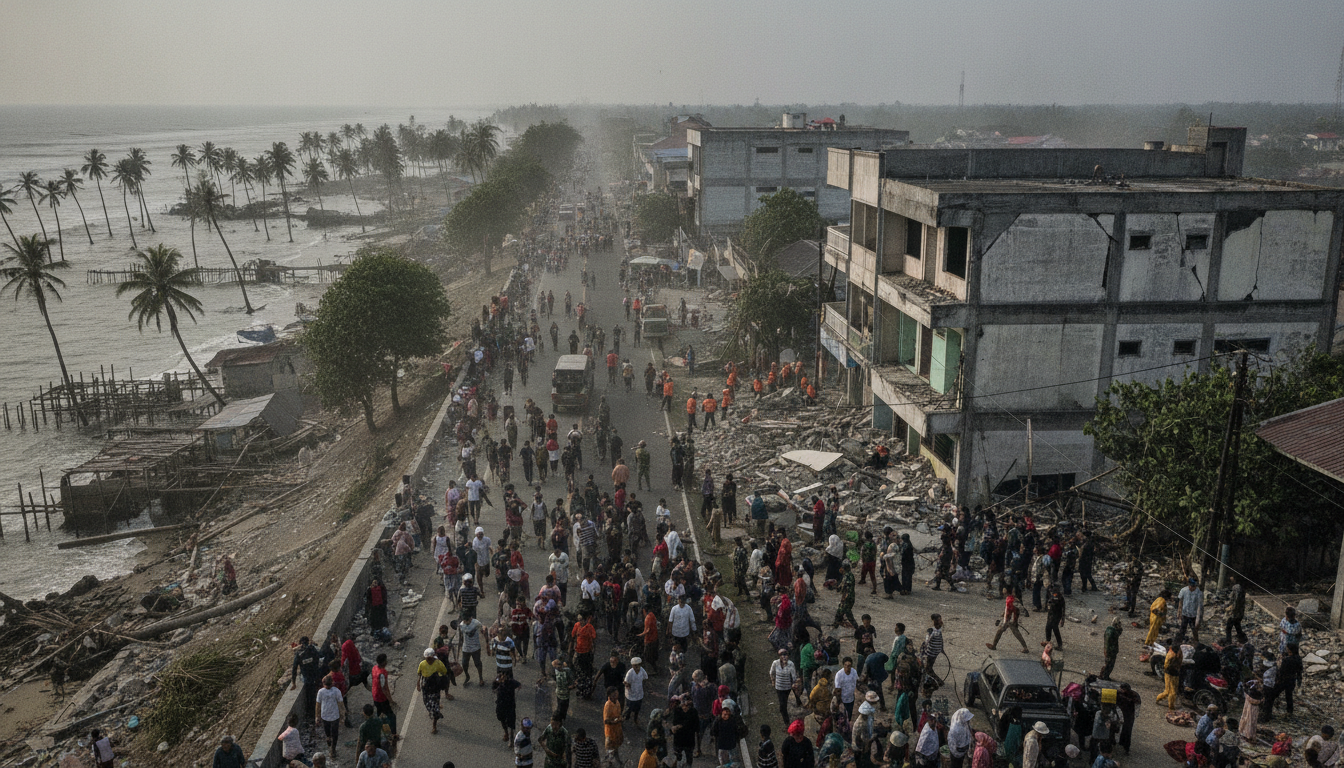
7.7-magnitude earthquake strikes eastern Indonesia, killing at least 38 as coastal residents flee
A powerful 7.7-magnitude earthquake struck eastern Indonesia early Saturday, killing at least 38 people and prompting thousands along coastal areas to evacuate amid fears of a tsunami. The quake, centered north of the island of Flores, produced strong shaking, building collapses and multiple aftershocks that compounded concerns for communities in Nusa Tenggara and Sulawesi.
Death toll and injuries
The national disaster agency confirmed 38 fatalities and reported two people seriously injured and 11 with minor injuries following the quake. Officials also said roughly 2,000 residents evacuated on their own, and rescue teams were still verifying numbers in hard-hit localities.
A preliminary toll released earlier had been lower, reflecting the fluid situation as emergency crews reached isolated villages. Authorities warned that the count could change as search and rescue operations proceed and communications are restored to damaged areas.
Epicentre, timing and aftershocks
Seismic monitors located the epicentre at a shallow depth north of Flores, about 68 kilometres from the town of Ende, which contributed to the intense surface shaking. The main tremor occurred at 5:58 a.m. local time and was followed by several significant aftershocks, including one measured at magnitude 6.1.
Shallow earthquakes often produce stronger ground motion near populated coasts, increasing the risk of structural damage and landslides. Seismologists continue to monitor the region for further activity as communities assess damage.
Tsunami alert, evacuation orders and sea-level monitoring
Authorities issued an initial tsunami warning for parts of the eastern archipelago, predicting possible wave heights of between half a metre and three metres for provinces including East and West Nusa Tenggara and South Sulawesi. That alert was later lifted, but officials said they would keep a close watch on sea levels.
Emergency coordinators had urged residents along low-lying coasts to move inland or seek higher ground immediately. Local leaders and disaster officials emphasized early self-evacuation, noting that rapid departures likely reduced casualties in some villages.
Damage to buildings and public facilities
Images and on-the-ground reports showed sections of façades and walls collapsing in coastal towns, and residents described cracked masonry and debris-strewn streets. In some places entire building fronts were blown out, leaving homes and businesses structurally unsafe.
Hospital staff reported patients fleeing treatment areas as tremors rattled wards, with medical personnel scrambling to account for staff and patients. Damage to infrastructure and access routes complicated initial relief efforts and increased the need for aerial support to reach remote communities.
Search, rescue and government response
The national disaster agency mobilized aircraft and equipment to support search and rescue, preparing two helicopters and a fixed-wing plane to assist operations and transport supplies. Teams were dispatched to assess damage, deliver emergency aid and coordinate with local authorities on evacuation and sheltering.
Meteorology and geophysics officials said monitoring stations remained active to detect sea-level changes and additional seismic events. Government bodies pledged to maintain surveillance of coastal areas and to accelerate relief if aftershocks or secondary hazards such as landslides worsen the situation.
Historical context and seismic risk in Indonesia
Indonesia lies along the Pacific Ring of Fire and regularly experiences significant seismic and volcanic activity, which has produced deadly events in past decades. Notable recent disasters include the 2018 earthquake and subsequent tsunami that devastated Palu and killed thousands, and major quakes that caused heavy casualties on Lombok and Sumbawa that same year.
The 2004 magnitude-9.1 earthquake off Sumatra generated one of the worst tsunamis in modern history, causing more than 170,000 deaths in Indonesia and tens of thousands across neighbouring countries. That history has driven ongoing investments in early-warning systems, public education and preparedness, though challenges remain in reaching remote islands quickly.
Relief agencies and local authorities said humanitarian assistance and damage assessments will continue through the coming days as crews work to reach isolated communities and restore services. The situation remains fluid, and officials cautioned that the full human and material cost of the quake will only become clear after comprehensive field surveys and communications are reestablished.
