
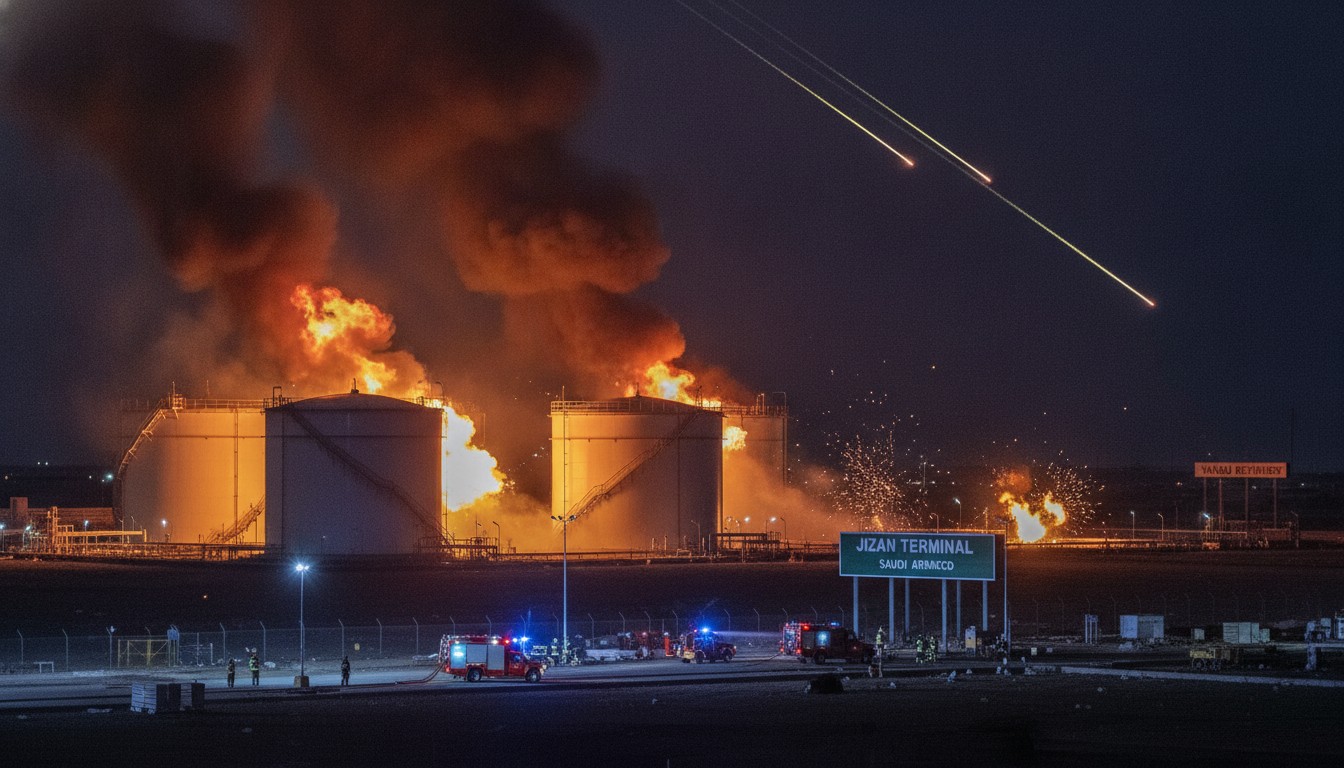
Houthis attack Saudi Aramco sites in Jizan and Yanbu, escalating Red Sea strikes
Houthis attack Saudi Aramco sites: missile and drone strikes claimed on Aramco facilities in Jizan and Yanbu, raising Red Sea security and oil market concerns.
The Houthis on Saturday, July 25, 2026, claimed missile and drone strikes on Saudi Aramco installations at Jizan and Yanbu, in what officials described as retaliation for recent Saudi air strikes. The attacks, which the group said targeted coastal oil facilities along the Red Sea, mark a notable intensification on a new front of the wider Middle East conflict.
Houthis Claim Missile and Drone Strikes
The Houthi military spokesman said the group launched a coordinated attack using missiles and unmanned aerial vehicles against Aramco sites at Jizan, near the Yemeni–Saudi border, and at Yanbu, farther north on the Red Sea coast. A video attributed to the group and verified by media outlets showed plumes of black smoke rising from one refinery complex.
Houthi statements warned of further escalation "in the coming hours and days" if strikes against Yemeni territory continue, underscoring the group’s linkage to broader Iranian regional strategy. The claims come after renewed hostilities that resumed on July 13, 2026, following a four-year ceasefire between Riyadh and the rebels.
Saudi and Allied Air Defenses Intervene
Saudi authorities initially issued civil alerts for both Jizan and Yanbu before later lifting them, and Riyadh has not released a full public account of damage or casualties. Greek air forces, which operate a defense system on behalf of Saudi Arabia, reported intercepting and downing two missiles and a drone approaching Yanbu.
The interception of incoming projectiles highlights the expanding role of allied air defenses in protecting critical infrastructure on the Red Sea coast. Officials did not immediately confirm whether all incoming threats were neutralized or if any ordnance struck ground targets.
Targets, Casualties and Local Impact
Houthi media and statements reported two people injured and said telecommunications installations and a naval base were among the sites hit. Visual material circulating online and reviewed by international news organizations showed smoke over refinery areas, though independent verification of the full extent of damage is still pending.
Residents near targeted sites described explosions and a sudden escalation that shattered weeks of relative calm in parts of the Arabian Peninsula. Humanitarian and commercial concerns are rising as the conflict footprint expands beyond southern Yemen into vital coastal infrastructure.
Shipping Routes and Oil Market Effects
The strikes occurred in a strategic maritime corridor that has become more sensitive since other chokepoints, notably the Strait of Hormuz, have been contested in recent months. The Houthi announcement earlier in the week that it would block Saudi vessels in the Red Sea and Gulf of Aden has added to anxiety among shippers and energy markets.
Oil benchmarks briefly climbed back above US$100 this week amid fears of supply disruption before retreating, reflecting market sensitivity to attacks on production and export facilities. Analysts warn that sustained attacks on coastal energy assets or shipping could prompt rerouting, insurance hikes and higher costs for refined products.
Recent Escalation After Truce Collapse
The renewed exchanges trace to a dispute over airspace and a controversial flight to Sanaa that Tehran sent without the usual approvals, which Riyadh said violated longstanding practice. Saudi strikes on Sanaa airport and subsequent attacks in Hodeida have been cited by the Houthis as justification for their cross-border operations.
Since July 7, when hostilities intensified after the collapse of an agreement reached in mid-June, the conflict has widened, drawing in proxy dynamics and raising the prospect of more sustained confrontation across the Gulf and Red Sea. Military spokespeople for the Saudi-led coalition said they had struck Houthi military sites in response to attacks on commercial vessels earlier in the week.
International Responses and Threats
Responses from global capitals have been uneven but pointed. Greece’s reported interceptions underscore allied defensive cooperation, while statements from U.S. political figures have included warnings of potential major military reprisals. Iranian activity in recent weeks has also shaped calculations, with Tehran striking allied targets in the region in retaliation for U.S. strikes earlier this year.
Former U.S. presidential comments this week signaled that diplomacy remains on the table even as military options are discussed, raising the possibility of both rapid escalation and last-minute de-escalatory moves. The international community has publicly expressed concern over any disruption to commercial shipping and civilian infrastructure in the Red Sea corridor.
The strikes on Aramco facilities at Jizan and Yanbu further complicate a region already strained by competing strategic priorities, and they underline how a localized conflict in Yemen can quickly reverberate through global energy markets and maritime security.
