
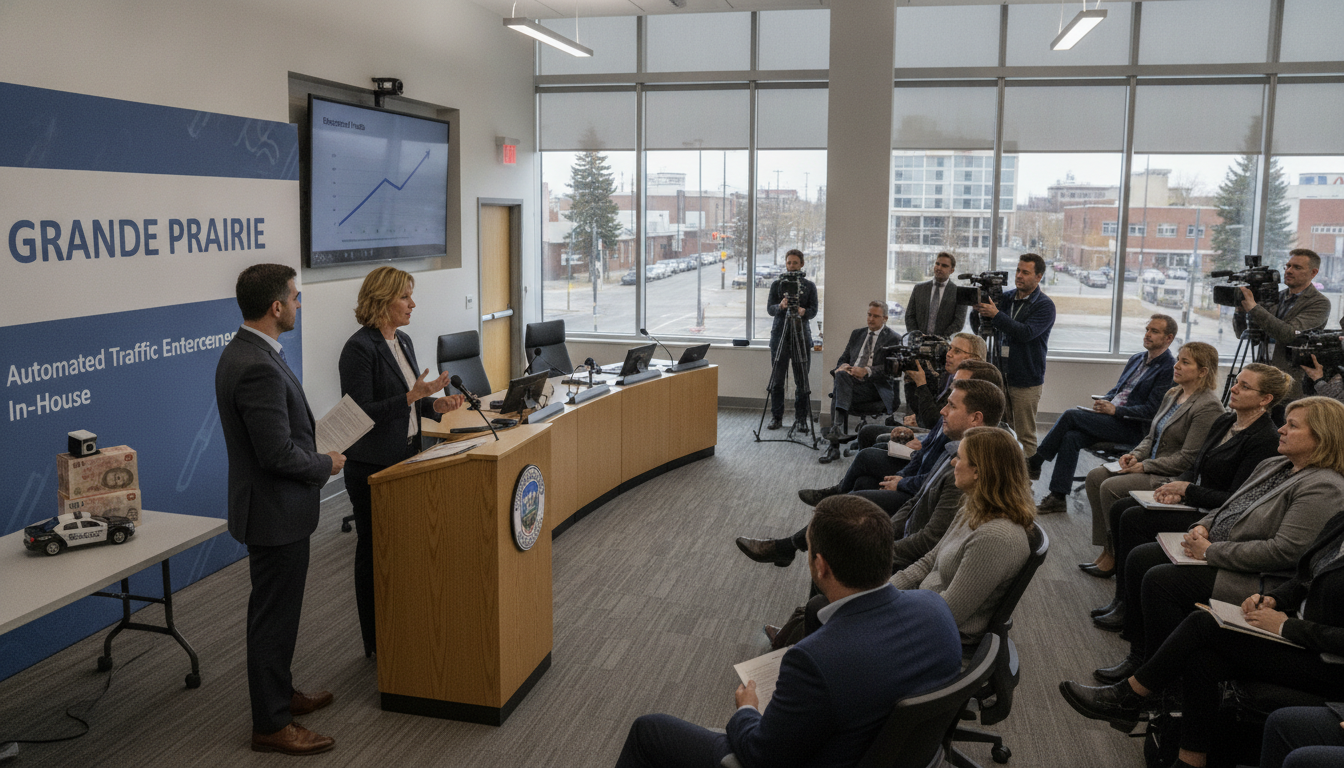
Grande Prairie brings automated traffic enforcement in-house, redirects contractor fees to city
Grande Prairie moves automated traffic enforcement in-house, shifting contractor fees to the city and prioritizing photo radar in school and construction zones.
Grande Prairie has relaunched its automated traffic enforcement program under the city’s enforcement services branch, bringing photo radar operations in-house and redirecting fees formerly paid to an outside contractor back into municipal budgets. The decision aligns with the Grande Prairie Enforcement Service’s stated goal of matching camera deployment and management to the city’s current safety priorities. Officials say the change ends more than two decades of relying on third-party firms to operate intersection and speed cameras. The transition comes as municipalities across Alberta respond to provincial limits on where and how automated cameras may be used.
Grande Prairie assumes control of ATE program
Grande Prairie’s move transfers operational responsibility for automated traffic enforcement (ATE) from private contractors to the municipal enforcement unit. City officials and the Grande Prairie Enforcement Service have argued that internal oversight allows for more consistent application of safety priorities and clearer local accountability. The in-house unit will be responsible for camera placement, maintenance and data reporting previously managed by outside firms. Bringing management closer to municipal decision-makers is intended to streamline enforcement practices with community road-safety plans.
Financial redistribution and municipal revenue
The change also alters how revenue generated by the ATE system is allocated, with a larger share remaining under municipal control. The city’s 2026 traffic safety plan records $833,691.55 in fines tied to the automatic camera system and lists distributions that include victim surcharges, provincial payments, amounts previously paid to Global Traffic Group and municipal receipts. Earlier years show larger gross collections: $1.9 million in 2024 and multimillion-dollar totals in 2022 and 2023, with each stakeholder historically receiving a portion of the proceeds. City officials say redirecting contractor fees into the municipal treasury will allow more local investment in road-safety initiatives and program oversight.
Provincial limits cut camera network
The relaunch follows a province-wide review that significantly reduced the number of approved camera sites and restricted where photo radar may be used. Alberta trimmed the network from roughly 2,200 sites to about 650 locations focused primarily on school and playground zones. Provincial rules also banned automated enforcement on provincial-numbered highways, major ring roads and several urban bypass routes, and limited mobile units to school, playground and active construction zones. Those changes forced municipalities to reassess where cameras can lawfully operate and to make the strongest possible case for priority sites.
Municipal audits and site prioritization
Faced with a capped number of approved sites, Grande Prairie and other Alberta municipalities audited their systems to identify locations that most clearly met provincial criteria. City reports emphasize that requests for camera sites were framed as safety measures rather than revenue-seeking actions. Grande Prairie’s submissions pointed to patterns of speed-related incidents and collision risks at prioritized intersections, playgrounds and school approaches. The municipal audit process aimed to preserve coverage in the areas officials judged to have the greatest potential for reducing injuries and protecting vulnerable road users.
Safety trends and collision patterns
Local traffic data cited by the enforcement service suggests the ATE program contributed to measurable reductions in speeding and some severe injuries at monitored intersections. Grande Prairie’s traffic-safety reports include motor-vehicle collisions, injury counts and speeding statistics, and officials say year-over-year comparisons have shown improvements in targeted locations. The 2025 results, including recorded violations in school and playground zones, were described by the city as validation of the technology’s role within broader traffic-safety efforts. At the same time, municipalities have pointed to secondary effects such as sudden braking and rear-end collisions as consequences that require complementary enforcement and education strategies.
Operational oversight and next deployments
With cameras now operated internally, Grande Prairie says it will exercise tighter oversight over schedules, deployment priorities and public reporting. The enforcement service has signaled an intent to publish regular traffic-safety updates and to use collected data to guide placement and timing decisions within the limits set by the province. The shift away from percentage-based contractor fees removes a longstanding commercial arrangement and gives the city more direct control over how revenue is re-invested. Officials also note that the program’s future deployments will be shaped by provincial rules and ongoing municipal assessments of high-risk locations.
Grande Prairie’s relaunch of the automated traffic enforcement program represents a notable municipal response to recent provincial policy changes, combining a push for local control with an emphasis on protecting schoolchildren, playground users and construction-zone workers. The enforcement service says it will continue to monitor collision trends and fine outcomes and report results in future traffic-safety documents as the city seeks to balance enforcement, education and infrastructure measures.
