
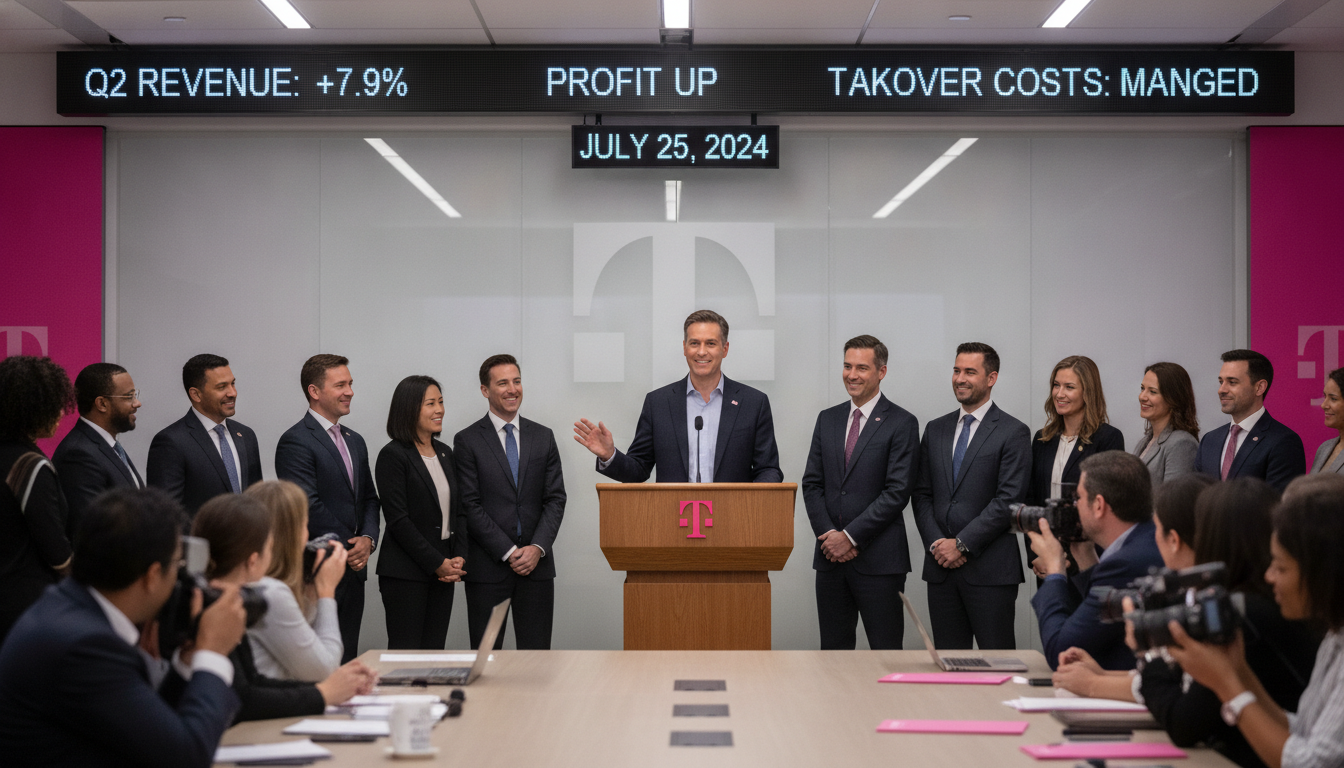
T-Mobile US Q2 results: Revenue up 7.9% to $22.79B, net income rises to $3.24B despite acquisition costs
T-Mobile US Q2 results: revenue climbed 7.9% to $22.79 billion and net income reached $3.24 billion, outpacing profit forecasts even as US Cellular acquisition costs pressured margins.
Strong quarterly headline figures
T-Mobile US reported second-quarter results showing revenue growth of 7.9% to $22.79 billion and net income of $3.24 billion.
The company’s Q2 performance marks a continuation of growth for the US unit of Deutsche Telekom, though top-line expansion fell slightly short of some market expectations.
These results underscore a divergence between revenue momentum and profitability, with operating and transaction costs from strategic deals evident in the quarter.
Investors and analysts will parse both the near-term financials and the longer-term implications of recent acquisition activity.
Revenue growth and analyst expectations
Revenue rose 7.9% year over year, illustrating continued demand for wireless services and related products.
Despite the advance, the pace of revenue growth was modestly below the consensus many market watchers had anticipated for the quarter.
Company officials attributed the slower-than-expected revenue gain to a combination of competitive pricing and elevated integration expenses tied to strategic moves.
The gap between revenue performance and analyst forecasts highlights the delicate balance carriers face between market share strategies and short-term earnings pressure.
Net income improvement despite cost headwinds
Net income expanded to $3.24 billion, a stronger-than-expected profit outcome for the quarter.
Earnings benefited from core service margins and operational efficiencies even as acquisition-related charges and integration costs weighed on results.
The profit beat suggests underlying business resilience, as T-Mobile US continued to generate solid cash flow from its subscriber base.
However, management acknowledged that one-off and transaction expenses reduced the overall margin profile this quarter.
Acquisition of US Cellular drew on results
Costs tied to the acquisition of rival US Cellular were cited as a meaningful drag on the quarterly outcome.
Those expenses included integration charges and transaction-related outlays that depressed operating profits in the immediate term.
While such costs can reduce near-term earnings, the deal is positioned to expand network reach and customer scale once integration is complete.
Investors will be watching how quickly synergies and cost savings materialize and how they offset the initial financial burden.
Operational trends and service drivers
Operationally, the company continued to rely on a mix of postpaid wireless revenue, equipment sales and service add-ons to underpin growth.
Network investments and customer service initiatives were highlighted as priorities that support long-term retention and average revenue per user.
Competitive pricing and promotional activity in the broader wireless market remain a headwind for revenue acceleration, but network quality and 5G coverage continue to be differentiators.
How T-Mobile US balances subscriber acquisition, pricing discipline and capital spending will shape near-term results and future margin recovery.
Market reaction and guidance focus
The results prompted investor scrutiny on whether management will update its full-year guidance and detail the timeline for acquisition synergies.
Analysts and portfolio managers signaled they will look to the upcoming earnings call for more granular commentary on costs, integration milestones and margin outlook.
Share movement in the immediate aftermath typically reflects the market’s read of whether the profit beat offsets the revenue shortfall and acquisition drag.
Going forward, clearer visibility on cost reductions and revenue drivers will be critical for restoring investor confidence in sustained growth.
T-Mobile US’s second-quarter report highlights a company at a strategic inflection point: solid profitability in the face of near-term cost pressures from acquisition activity, with the coming quarters set to determine how quickly scale and synergies translate into renewed top-line momentum.
