
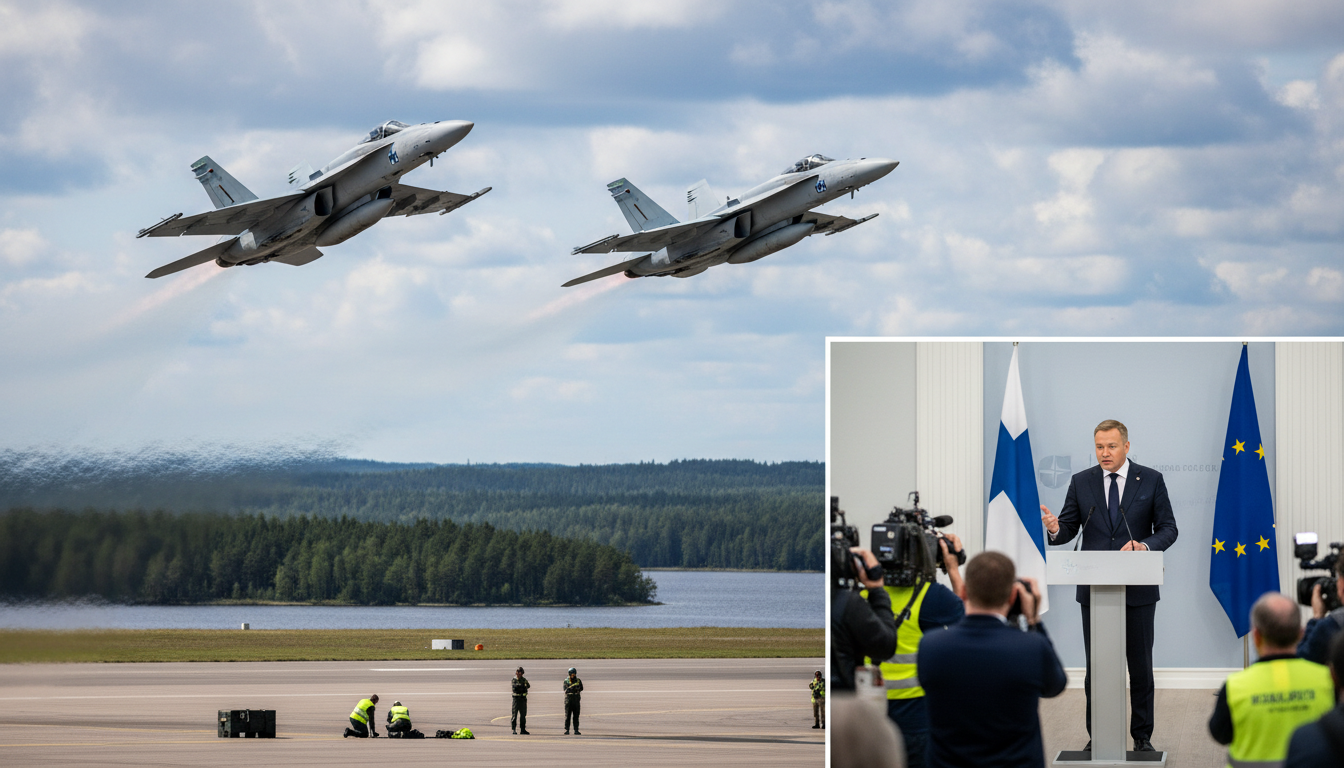
Drone activity in Finland prompts fighter jets and temporary closure of Helsinki airport
Suspected drone activity in Finland over Helsinki triggered jets and an airport shutdown before authorities stood the alarm down; officials warned repeats were possible as the war in Ukraine continues.
Finland’s defence and rescue services launched an emergency response on Friday after reports of suspected drone activity above the Helsinki region, scrambling fighter jets and temporarily closing Helsinki Airport while residents were told to remain indoors. The alert, which began in the early hours of the morning, was later lifted after authorities said the situation no longer posed a direct threat. Officials described the operation as a precautionary measure and cautioned that similar incidents could occur while the conflict in Ukraine persists.
Early morning scramble across the capital
The Helsinki City Rescue Department advised nearly two million residents in the Uusimaa region to stay inside beginning at about 4:00 a.m. local time while military and emergency services investigated the reports. Fighter jets were dispatched and airport operations were suspended for roughly three hours as controllers and defence forces assessed the situation. Local authorities emphasized that the fast response reflected readiness rather than a confirmed hostile incursion.
President Alexander Stubb posted on X that the swift mobilisation “demonstrated their readiness and capacity to react,” and said the country faced no immediate military threat after the alarm was cleared. Kimmo Kohvakka, director general for rescue services at the Interior Ministry, described the measures as precautionary and said authorities were returning to normal operations while maintaining vigilance. The Ministry of Defence did not immediately publicly identify any physical debris or confirmed drone recoveries inside Finnish airspace.
Military assessment and possible sources of information
Kari Nisula, the defence forces operations chief, indicated that Finnish authorities had received information from Ukraine suggesting a risk of drones straying into neighbouring countries, although he said there was no concrete evidence that unmanned systems had entered Finland on this occasion. He warned that such episodes could repeat as long as Russia’s campaign against Ukraine continues, underlining that the regional security environment remains volatile. Finnish military spokespeople framed the incident as part of a broader trend of cross-border navigational errors and misdirected systems amid a high-tempo conflict.
Officials stopped short of attributing the alert to any specific actor and said investigations would continue into flight traces and radar data. The defence forces maintained that the rapid mobilisation — including jets and civil defence alerts — was intended both to deter and to gather timely information, with public safety as the immediate priority.
Regional spillover concerns and Baltic incidents
The Helsinki alarm unfolded against a backdrop of renewed concern in the Baltic region about spillover from the Ukraine war, where Estonia, Latvia and Lithuania have each reported suspected drones crossing into their airspace at different times. Those incidents have prompted debates in capitals over air-defence readiness and political accountability, most notably in Latvia where a domestic political crisis followed a drone crash near a fuel storage site. Latvia’s prime minister resigned after a coalition partner withdrew support amid criticism of the government’s handling of the security breaches.
Finland itself experienced incursions in March when two drones crossed into Finnish territory and crashed after flying low over the sea and into the country’s southeast. Those episodes have sharpened public awareness in Helsinki and other northern capitals about the risk that unmanned systems operating around Ukraine might deviate or be misidentified, particularly during intense strikes and counterstrikes.
Impact on transport and public life in Helsinki
The airport closure and shelter-in-place order disrupted travel and morning commutes, with flights halted while controllers coordinated with defence and rescue services. Authorities urged residents to follow official guidance and avoid sharing unverified reports on social media, noting that rapid information flows can complicate response efforts. City officials later said that everyday activities could resume, but that the alert had demonstrated the need for clear communication channels between civil and military agencies.
Emergency services described the steps taken as proportionate to initial indicators and intended to reduce risk to civilians and infrastructure. Airport operators and airline representatives reported delays and rebookings, while municipal authorities activated contingency plans for passenger handling and ground operations.
Wider conflict backdrop: strikes, casualties and prisoner exchanges
Friday’s alarm coincided with intense fighting and strikes linked to the Russia-Ukraine conflict, including Ukrainian drone attacks on Russian energy infrastructure and Russian barrages inside Ukraine. Russian officials claimed air-defence units shot down hundreds of incoming drones overnight, and regional authorities reported damage at an oil refinery in Ryazan after a strike that killed three people and wounded a dozen. In Kyiv, officials said a Russian strike on an apartment building had raised the death toll to at least 24 people, including children, with dozens more wounded.
Amid the violence, Russia and Ukraine proceeded with a prisoner exchange on Friday that returned 205 prisoners to each side, the first tranche of a larger planned swap that both governments say could eventually involve about 1,000 detainees per side. The two governments also carried out the exchange of dozens of bodies; Kyiv and Moscow both thanked mediators for facilitating those transfers. Ukrainian officials said most of the returned prisoners had been held since 2022 and vowed to continue efforts on behalf of those still detained.
Authorities in Finland and across the region said the broader conflict increases the likelihood of accidental or incidental crossings by drones and other unmanned systems, and that governments must be prepared to react quickly to protect civilians and critical infrastructure.
Finland’s leaders stressed that the country’s rapid mobilisation underscored its preparedness, while defence officials reiterated that continued conflict in Ukraine keeps the possibility of similar alerts alive and that civilian authorities and the military will keep coordination lines open.
