
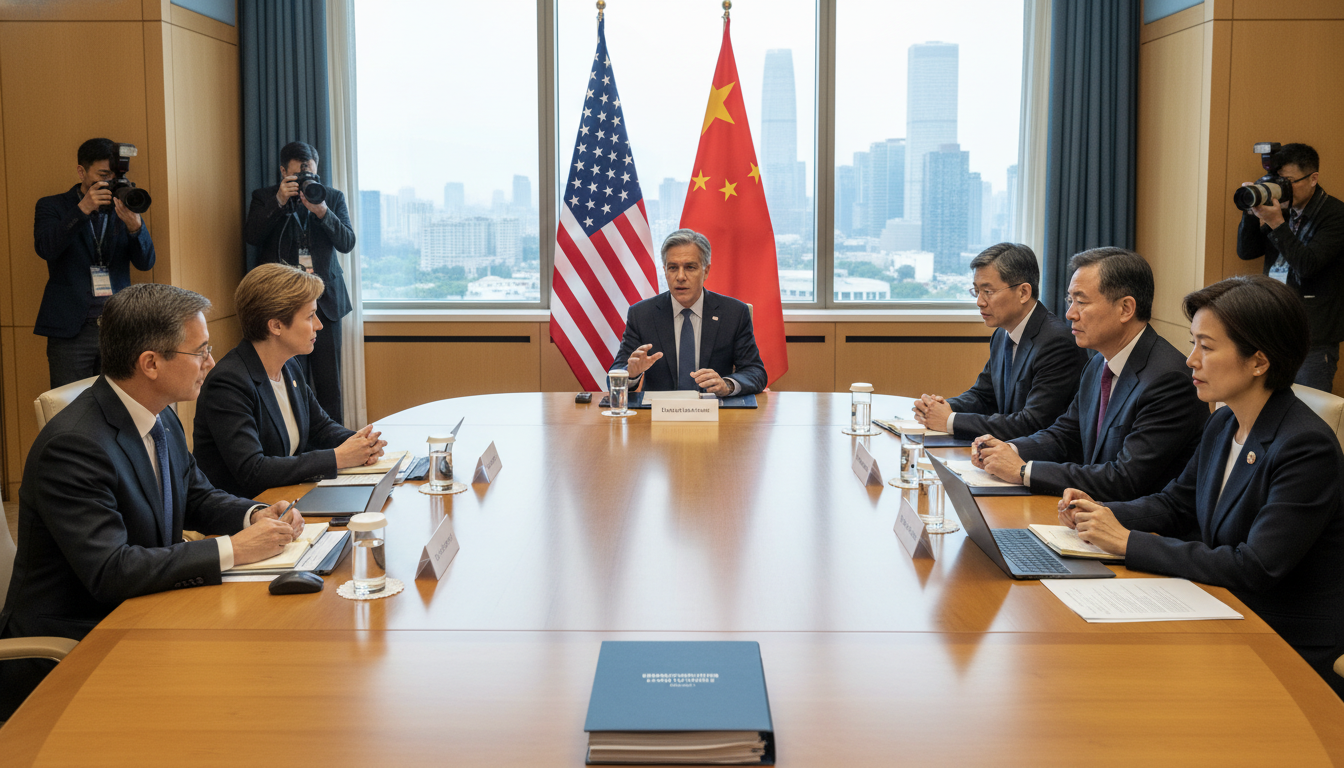
Trump Xi summit in Beijing brings hawks, industry and tech chiefs to the fore
U.S. political hawks, corporate CEOs and semiconductor executives attended the Trump Xi summit in Beijing, spotlighting trade, export controls and market access in high-stakes talks.
The Trump Xi summit in Beijing opened with a visibly strategic U.S. receiving line that signalled the priorities on the table: trade friction, technology restrictions and security concerns. Senior American officials and advisers known for tough stances on China stood beside President Trump as he greeted President Xi Jinping, underscoring the mixture of confrontation and commerce shaping the encounter. The delegation’s composition suggested agenda items would range from tariffs and agricultural buys to semiconductor export controls. Photographs of handshakes and formal protocol framed an otherwise tense diplomatic set piece.
Senior U.S. hawks lead the receiving line
At the front of the U.S. delegation were senior figures who have frequently criticised Beijing’s policies, a clear message about priorities at the summit. Secretary of State Marco Rubio, Treasury Secretary Scott Bessent and Defense Secretary Pete Hegseth led the receiving line, each with public records of sharp comments on China. Their presence signalled that human rights, economic reliability and regional security would be prominent items in bilateral discussions. Observers noted the optics of established critics meeting face-to-face with Chinese leaders under formal protocol.
White House aides with hardline rhetoric accompanied the president
Several White House aides with outspoken views on China were positioned close to President Trump, indicating domestic political considerations also influenced the delegation’s makeup. Deputy Chief of Staff Stephen Miller, known for forceful rhetoric on trade imbalances, and James Blair, charged with steering the administration’s legislative priorities, were among those greeting Mr. Xi. Their proximity to the president suggested the summit’s outcomes could have direct implications for U.S. policy and political messaging ahead of upcoming elections. The lineup reinforced that negotiations would be closely tied to internal U.S. political dynamics.
Agribusiness and aerospace push for market access
A sizable corporate contingent accompanied the U.S. team, reflecting strong commercial interest in restoring or expanding sales in China’s market. Brian Sikes of Cargill and Kelly Ortberg of Boeing were present to press for renewed purchases ranging from agricultural commodities to major aircraft orders. U.S. agricultural suppliers see China as a critical buyer for beef, soybeans and sorghum, while aerospace manufacturers pursue long-term contracts and fleet commitments. Business leaders’ presence underscored that economic diplomacy and private-sector stakes were central to the summit’s commercial thread.
Semiconductor bosses highlight technology export tensions
The attendance of major chip-industry executives made clear that technology controls would be a central talking point at the Trump Xi summit in Beijing. Jensen Huang of Nvidia, Sanjay Mehrotra of Micron and Cristiano Amon of Qualcomm joined the delegation as the U.S. continues export restrictions aimed at limiting China’s access to advanced semiconductors. Their participation reflected the intersection of national security policy and commercial interests, as firms navigate compliance with U.S. curbs while courting one of the world’s largest tech markets. Conversations on supply chains, licensing and future cooperation were expected to be technical and contentious.
Xi surrounded by trusted lieutenants and economic policymakers
China’s side of the meeting featured senior officials long associated with President Xi, signalling a consolidated front in handling sensitive talks. Cai Qi, who manages Communist Party leadership affairs, and Vice Premier He Lifeng, responsible for economic policy, accompanied Mr. Xi and were positioned to influence both political and economic dimensions of the summit. Wang Yi, returning to foreign policy duties after earlier service as foreign minister, was among senior diplomatic figures present. The delegation blended political loyalty with administrative experience, indicating Beijing sought tight central control over negotiations.
Protocol scenes belie substantive policy divides
Despite formal handshakes and ceremonial optics, the composition of both delegations suggested substantive disagreements would be central to the talks. Officials on both sides who have publicly criticised the other’s policies nonetheless followed diplomatic protocol, creating moments of civility amid deeper strategic competition. The mix of hardline policymakers, political aides and commercial leaders reflected the multi-layered nature of U.S.-China relations, where trade, technology and security each demand different approaches. Analysts warned that diplomatic theatre should not be mistaken for immediate policy convergence.
Agenda points point to complex, interlinked negotiations
Officials and executives in attendance made it likely the summit agenda would span trade terms, agricultural purchases, semiconductor export rules and regional security concerns in the South China Sea. U.S. representatives who have previously sanctioned or sharply criticised China stood alongside corporate figures seeking access, creating an unusual combination of pressure and persuasion. Chinese leaders arrived with experienced economic and political hands to manage those conversations and maintain strategic priorities. The outcome of the Trump Xi summit in Beijing was expected to hinge on negotiators’ ability to separate technical deals from broader geopolitical disputes.
The summit’s opening scenes captured a careful balance of ceremony and strategy: formal diplomacy underscored the continuing importance of face-to-face engagement even as deep policy differences persist. As negotiations proceed, attention will remain on whether the meeting yields concrete agreements on trade and technology or simply reaffirms existing lines of contention between Washington and Beijing.
