
Iranian oil shipments find new routes to China despite U.S. naval blockade
U.S. blockade aims to halt Iranian oil shipments, but satellite and shipping data show tankers and covert transfers reaching East Asia despite enforcement.
President Trump’s naval blockade of Iranian oil exports has curtailed some flows but has not halted Iranian oil shipments to East Asia, according to a fresh analysis of satellite imagery and maritime tracking data. The enforcement effort, launched in mid‑April, has led vessels to adopt spoofing, transponder shutdowns and ship‑to‑ship transfers as they seek alternate routes to China and nearby ports.
U.S. naval blockade and enforcement
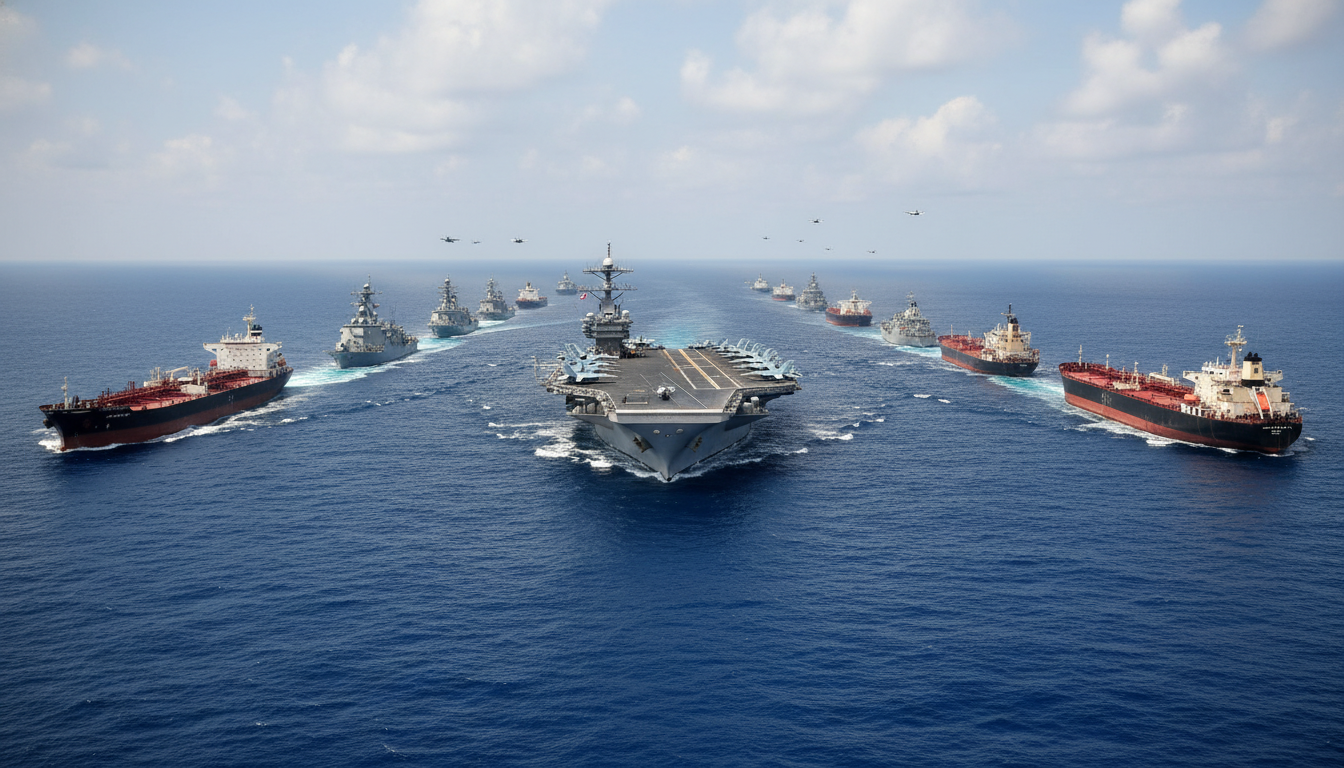
The United States deployed a broad maritime interdiction effort beginning in April to choke off revenue from Iranian oil exports, with warships operating in and beyond the Gulf of Oman and the Arabian Sea. U.S. Central Command officials say the operation has intercepted more than 70 vessels and boarded tankers that they allege were carrying sanctioned Iranian crude.
U.S. officials describe the blockade as focused on vessels entering or leaving Iranian ports rather than every transfer at sea, and they say enforcement relies on a mix of radars, radio‑frequency monitoring and satellite imagery rather than solely on ship transponders. A U.S. naval spokesman emphasized the operation includes targeted seizures and selective waivers for humanitarian or other permitted movements.
The Huge’s transits and stealth tactics
One large Iran‑flagged tanker, identified in maritime records as the Huge, loaded at Kharg Island in early April and transited the Strait of Hormuz before the blockade became fully active on April 13. The vessel reportedly carried roughly two million barrels of crude and kept its automatic identification system (AIS) transponder switched off for much of its voyage.
Satellite imagery shows the Huge resurfacing near the Lombok Strait in early May, then moving north past Vietnam toward the South China Sea, suggesting a possible rendezvous zone near Hong Kong where ship‑to‑ship transfers have occurred. Analysts say the tanker’s decision to use the less common Lombok route instead of the Strait of Malacca reflects an effort to reduce visibility amid heightened scrutiny.
Atomis: spoofing and arrival in Chinese waters
A midsize tanker sailing under a Comoros flag, tracked as the Atomis, provides a second example of evasion techniques. The vessel’s AIS feed remained active for much of its trip across the Indian Ocean, but investigators found evidence it used electronic spoofing at the origin and destination of its voyage.
Satellite images dated April 2 show the Atomis loading at Kharg Island even as tracking data placed it near Kuwait, indicating deliberate manipulation of location signals. By mid‑April the Atomis — which had briefly changed its name — reached a holding area near Hong Kong, where maritime analysts say it is likely to transfer cargo to another ship for onward movement to Chinese ports.
Salute Legend and ship‑to‑ship transfers
Smaller coastal and regional vessels appear to be receiving cargoes in mid‑sea transfers that complicate enforcement. The Salute Legend, a Hong Kong‑flagged ship, used spoofed signals to obscure its movements and is believed to have received oil from a larger supplier in the Gulf of Oman before moving east and docking in Quanzhou, China.
U.S. authorities have acknowledged that ship‑to‑ship transfers in international waters are not the primary target of the blockade, which concentrates on shipments to or from Iranian ports. Still, maritime analysts say these transfers, and a string of smaller vessels that moved from the Gulf of Oman to Asia in recent weeks, illustrate how Iranian oil shipments can be masked and redistributed through intermediary ships.
Shipping data points to falling offshore inventories
Independent maritime data firms report a notable decline in the volume of Iranian crude held on tankers in Southeast Asian waters. Estimates show floating inventories near Malaysia dropped from roughly 85 million barrels in early February to about 51 million barrels in recent weeks, indicating reduced replenishment and faster drawdown of offshore stocks.
Maritime intelligence providers tracking vessel behavior recorded a spike in deceptive practices between April 19 and May 3, with a roughly 600 percent increase in ships using spoofing, transponder shutdowns or false flags. Analysts caution that while some cargoes still reach East Asia, overall throughput appears diminished compared with months earlier.
U.S. and private analysts also point to selective waivers issued for humanitarian shipments or other exceptions, and they stress that enforcement combines multiple sensors — including radar‑based satellite imaging and radio‑frequency collection — to compensate for spoofed or darkened AIS feeds.
Ami Daniel, chief executive of a maritime analytics firm, said the level of focus on the Hormuz area is unprecedented and that large tankers are difficult to move without detection. Other analysts note that persistent opacity in the shipping chain — from falsified registries to complex transfer chains — will make comprehensive interdiction challenging.
The new pattern of routes and concealment techniques shows how Iranian oil shipments are adapting to pressure at sea, even as the blockade has reduced volumes and incentivized riskier navigation.
