
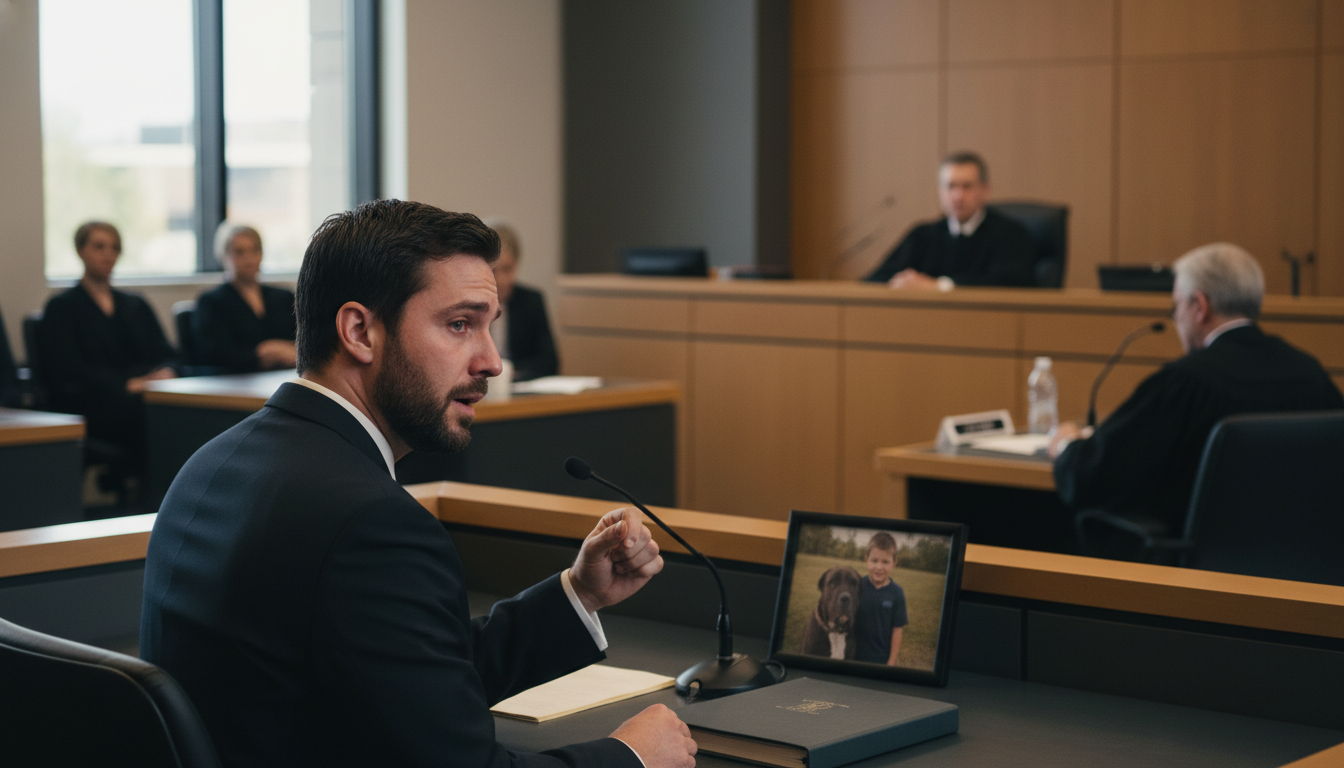
Edmonton father testifies in criminal negligence trial after Cane Corso attack killed 11-year-old son
Father testifies in Edmonton trial after Cane Corso attack that killed 11-year-old Kache Grist on April 1, 2024; court hears about dogs’ prior attacks.
Wesley Grist told an Edmonton courtroom he rounded a kitchen corner and found two Cane Corsos standing over his son, describing a scene he could not immediately process after the deadly Cane Corso attack. The testimony on Thursday in the criminal negligence trial of owner Crystal MacDonald detailed the final moments of 11-year-old Kache Grist and the anxiety that preceded the April 1, 2024 mauling. The crown prosecution and defence are contesting how much MacDonald warned others about the dogs’ behaviour and whether she took sufficient steps to prevent the tragedy.
Father recounts discovery and emergency response
Grist testified he screamed when he realized his son had been attacked and tried to force the dogs out into the backyard, punching and kicking them to free Kache. He said he held his son and followed instructions from a 911 operator to begin chest compressions while waiting for paramedics. Paramedics later informed him that his son had died; Grist described the moment as shattering and said he lashed out in the house in grief.
Courtroom testimony painted a chaotic scene as friends and neighbours arrived, with one witness later telling police she was stunned to see Grist emerge from the home covered in blood. The emotional testimony was delivered in a low, gravelly voice as Grist repeatedly returned to small details of the evening that remain vivid to him.
Evening timeline and household context
The attack occurred at the southwest Edmonton residence where Grist and MacDonald lived together at 8213 11 Ave. SW, during a spring-break visit when Kache had stayed an extra day after a scheduled ride home fell through. Court documents and testimony said Kache returned from a store errand around 6:48 p.m., bringing snacks and a soft drink, and was later found by his father less than an hour afterward.
Grist described planning a movie night with his son before the visit turned fatal, and told the court the dogs each seized one of Kache’s legs during the attack. The trial record includes an agreed statement of facts on times and responses as the Crown seeks to establish what warnings, if any, preceded the Cane Corso attack.
History of bites and killed pets at the home
Under questioning, Grist acknowledged incidents involving the dogs well before the fatal mauling, saying the animals had killed a cat and a Pomeranian at the residence and had previously bitten household members. He described one dog, Khairo, as comparatively gentler and the other, Khaos, as bigger and more destructive in the way he moved through the home.
A woman who was attacked in a separate incident, identified in court as Tina Kelepouris, testified that she was sent to the emergency room and that MacDonald did not disclose earlier bites to her. A peace officer who investigated Kelepouris’s attack told the court he did not seize the dogs at that time because MacDonald was not present and warning signs were posted on the property.
Defence highlights owner’s expressed concerns
The defence, led by Evan McIntyre, probed Grist about warnings MacDonald had allegedly voiced regarding leaving Kache alone with the dogs. McIntyre pressed that MacDonald had told Grist she “didn’t know if it was a good idea” for the child to stay, though Grist said she never gave a direct, unequivocal refusal.
During cross-examination the defence also pointed to steps MacDonald said she had been pursuing, including training, kennelling the animals regularly and plans to have them neutered. The defence framed those efforts as evidence the owner had concerns and was taking remedial actions prior to the April 2024 incident.
Autopsy findings and animal disposition
An autopsy determined Kache’s cause of death was bite wounds to the neck, evidence prosecutors say shows the lethality of the attack by the two Cane Corsos. The larger dog, Khaos, weighed about 124 pounds, according to court testimony, underscoring the animals’ size and the severity of the injuries sustained.
Both dogs were euthanized within days of the incident. That decision and the autopsy findings feature in the Crown’s argument that the animals posed a known risk that required decisive action by their owner to prevent harm.
Next steps in the criminal negligence trial
The trial against Crystal MacDonald on a charge of criminal negligence causing death resumed after Grist’s testimony and is scheduled to continue Friday, with both sides expected to call additional witnesses. The proceedings will examine the owner’s awareness of the dogs’ prior behaviour, the adequacy of posted warnings and whether reasonable steps were taken to protect visitors and household members.
Legal observers say the case will hinge on whether the Crown can prove MacDonald’s conduct met the test for criminal negligence under Canadian law, a determination that will rely heavily on testimony about prior attacks, warnings and the owner’s response.
The courtroom testimony on Thursday offered a sharply personal account of loss and confusion as family members relive the night an 11-year-old boy was killed, and it set the stage for further evidence about how those dogs came to be in a position to attack a child.
