
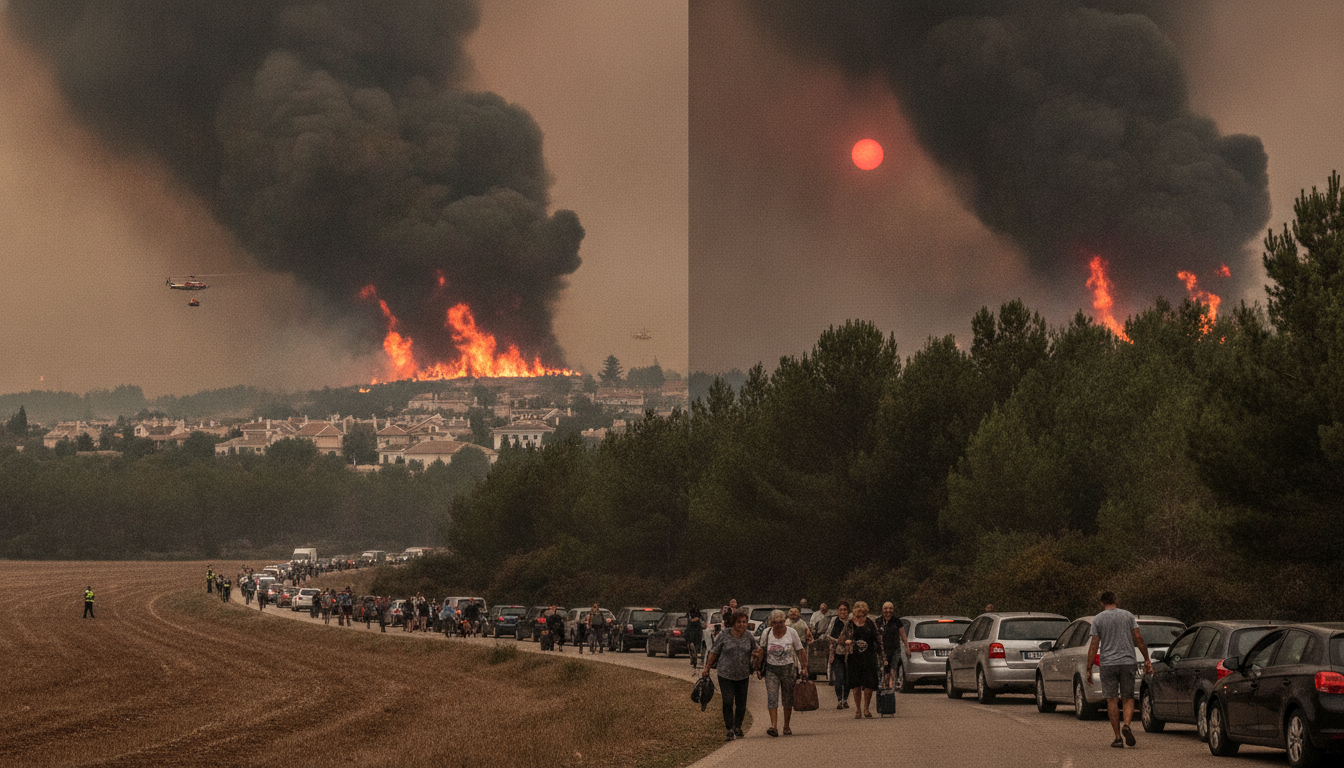
European wildfires spread across France and Spain as evacuations surge
European wildfires scorch France and Spain, forcing mass evacuations and burning tens of thousands of hectares as governments and the EU deploy military aid.
The fast-moving European wildfires engulfing parts of France and Spain have triggered large-scale evacuations and prompted emergency mobilization at national and EU levels. Dry soils and parched vegetation after record heat in June and July have allowed fires to ignite quickly and spread with exceptional intensity. Authorities report tens of thousands of hectares burned and tens of thousands of people displaced or confined as crews and military units move to protect towns and critical infrastructure.
Scope and scale of evacuations
French officials said roughly 110,000 people have been evacuated from fire-affected areas since midweek amid rapidly shifting flames in the southwest. In the Gironde department, the largest blaze has consumed about 14,000 hectares and forced widespread evacuations, according to the interior ministry. Authorities have warned that the evacuation numbers and burned area are significantly higher than this time last year, underscoring the exceptional scale of the current season.
In Spain, regional authorities said more than 63,000 people across the Madrid region have been either evacuated or ordered to shelter in place because of a huge wildfire moving across populated areas. About 20,000 of those were evacuated from at-risk towns and villages as thick smoke and flames approached communities on multiple fronts. Local officials emphasized that protecting life remains the top priority as resources are redistributed to the worst-hit zones.
French government response and Bordeaux threat
Paris moved quickly to coordinate a national response, with the prime minister convening an interministerial crisis cell to bring together interior, defence, health, transport and environment ministries. The interior minister described some blazes as “totally unprecedented” and warned that convective fires — those that create their own extreme wind patterns and embers — are complicating containment efforts. President Emmanuel Macron ordered military assistance to augment civil protection resources and bolster ground operations around threatened towns.
Officials said the city of Bordeaux was not under immediate threat but that all available ground and aerial assets would be used to protect the metropolitan area if the fire’s direction changed. Firefighters and soldiers have been deployed to reinforce containment lines and support large-scale evacuations from low-lying and coastal communities in the Gironde and neighbouring areas.
Spain’s worst fire in Madrid region and criminal probes
Regional leaders in Madrid called the blaze one of the worst in local memory and described a chaotic firefighting environment as flames moved unpredictably. Commanders at the incident post warned that certain fires were “impossible” to fully extinguish while weather and fuel conditions remained extreme. The regional president emphasized that saving lives and preventing further urban encroachment were the immediate concerns.
Investigations are underway into suspected human causes for several major blazes. In Ávila, authorities arrested a man accused of starting a fire after using an agricultural machine in a prohibited area, and a second person remains under investigation. In Gironde, two individuals were detained and face charges related to endangering life after they were reportedly seen smoking in a forested area amid the crisis.
Large-scale blazes and historical comparisons
Some of the country’s largest recorded fires have been cited by officials as the season’s blazes continue to grow. In Madrid’s vicinity, local leaders called the event “the worst in the region’s history,” reflecting both the size of the affected area and the population densities threatened. In central Spain’s Guadalajara province, a separate blaze burned roughly 32,000 hectares over more than a week before authorities reported a drop in intensity, allowing some military units to stand down while containment operations continued.
French authorities reported that total burned area since the start of the year had surpassed the 50,000-hectare mark, nearly triple the area affected at the same point last year. Those comparisons have been used by ministers to argue for heightened preparedness and expanded resource commitments as the season progresses.
EU and international firefighting support
Brussels activated European support mechanisms to send aerial firefighting resources where they were most needed, dispatching four water-bombing aircraft to Spain in addition to planes already directed to France. The Commission warned member states to prepare for a difficult period of sustained fire activity and stressed that coordinated international assistance would remain essential. EU officials also signalled willingness to redirect logistical and technical support as hotspots shift across the continent.
Nationally, countries moved military units to assist with evacuation logistics, supply transport and ground-based firefighting where civilian capacities were overwhelmed. Commanders said military engineers and helicopters are helping to reinforce firebreaks, move people out of harm’s way, and supply crews operating at the edges of containment perimeters.
Local impacts and community response
Communities along the coasts and in forested interiors reported scenes of sudden displacement, with families boarding buses, taking shelter in community centres, or leaving by boat from threatened beaches and marinas. Firefighters described surreal scenes of orange skies and roofs smouldering under intense ember showers as crews battled to protect homes and infrastructure. Emergency hotlines and temporary reception centres were set up to process evacuees and co-ordinate medical and accommodation needs for those displaced.
Local authorities urged residents in vulnerable areas to follow evacuation orders, avoid nonessential travel, and heed air quality advisories as smoke spreads to surrounding provinces. Hospitals and health services prepared to treat smoke-related respiratory issues, while water and power utilities monitored networks for wildfire-related disruptions.
The evolving emergency highlights the challenges faced by fire services coping with multiple large blazes at once and underscores growing concerns about drought and heat-driven fire dynamics across southern and western Europe.
