
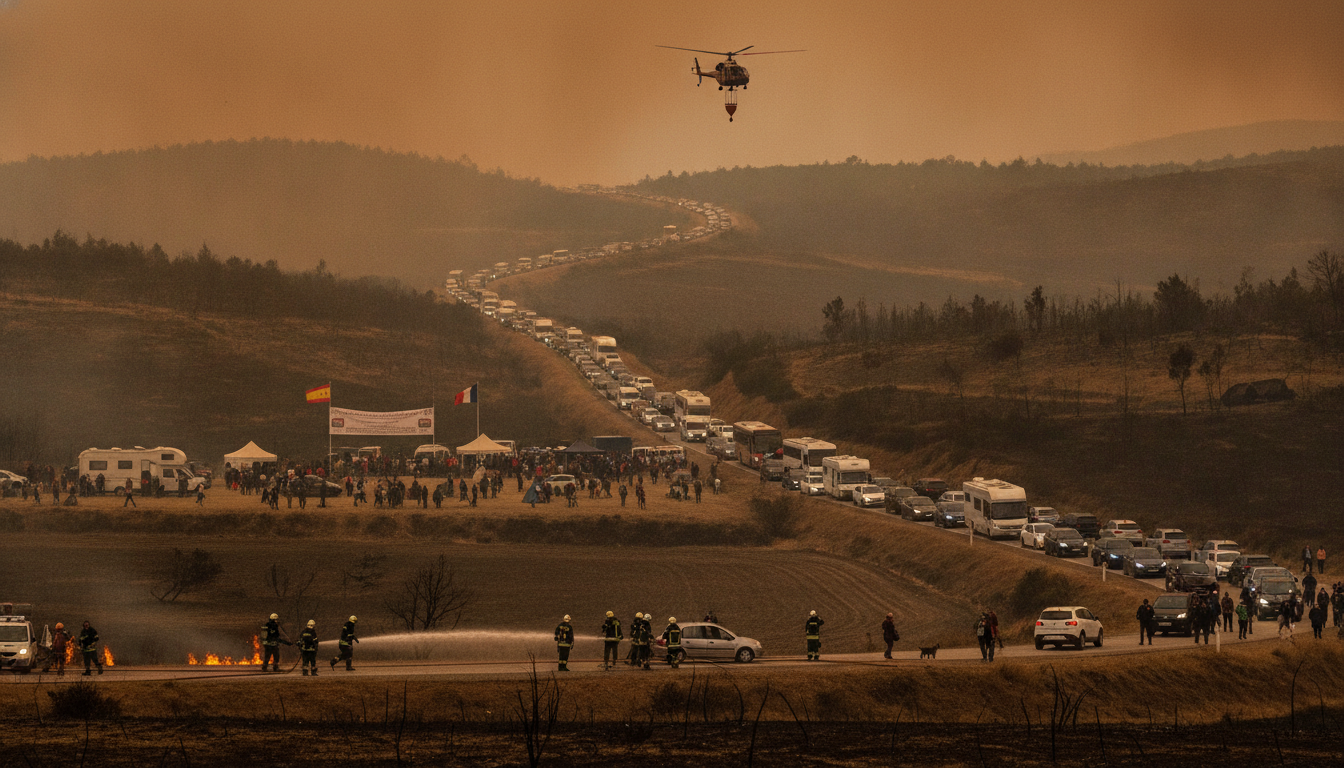
Spain and France wildfires force more than 100,000 people to flee
Wildfires in Spain and France have forced over 100,000 residents to evacuate as blazes rage across multiple regions, prompting arrests, a national emergency in Spain and renewed calls for European firefighting support.
The scale of evacuations and the speed of the flames have overwhelmed local resources and pushed authorities to impose restrictions on farm machinery and other high-risk activities.
Emergency officials in Madrid and southwestern France described the situation as unprecedented in recent memory, with several large fires merging and spreading under extreme heat.
Spanish police arrested a tractor driver suspected of igniting one of the major blazes, while investigators probe a second incident linked to machinery use.
The crisis has prompted cross-border cooperation and urgent appeals for aircraft, crews and ground crews from across Europe.
Mass evacuations across Spain and France
The combined impact of the fires has displaced more than 100,000 people, with officials ordering tens of thousands to leave their homes or shelter in place as smoke and flames advanced.
Around 40,000 residents west of Madrid were told to evacuate or remain indoors as one merged fire consumed roughly 30 square kilometres of land, authorities said.
In southwestern France, authorities estimated that about 44,000 people were moved away from the Cap Ferret Peninsula and another 23,000 were displaced in the Landes area, with some evacuees ferried out by boat.
Madrid-area blaze described as historic in scale
Two separate blazes west of Spain’s capital merged into a single front that officials called the worst in the region’s recorded history, forcing highways closures and mass relocations.
The merged blaze burned through agricultural land, pine forests and scrub, challenging containment efforts as it advanced toward populated towns and infrastructure corridors.
A separate wildfire in the Avila province in Castilla y Leon scorched roughly 90 square kilometres and led to additional evacuations, illustrating the widespread nature of the outbreak.
Arrests and probes over farm machinery use
Spanish police arrested a man accused of starting one of the wildfires after using farm machinery in tinder-dry conditions, an action that authorities say can spark flames during heatwaves.
Officials also disclosed that a second person is under investigation for a related incident, and regional governments have placed temporary bans on the use of machinery and other ignition-prone activities to reduce new outbreaks.
Spanish emergency managers warned that human-caused ignitions are a significant driver of recent fire activity, and investigators are working to determine whether negligence or deliberate acts played a role.
France requests European reinforcements
French Interior Minister Laurent Nunez confirmed that fires are active on multiple fronts in the southwest and appealed to the European Union for reinforcements to supplement national firefighting assets.
France reported dozens of active wildfires and said the area burned since January has surged compared with last year, prompting a multi-pronged request for aerial and ground support.
Officials emphasized that water-bombing aircraft and additional crews are critical to protecting densely populated coastal and forested zones threatened by the fast-moving flames.
International firefighting assistance deployed
The European Union and several member states mobilized assistance, sending water-bombing aircraft, specialized crews and logistical support to both Spain and France.
Four aerial firefighting planes were dispatched to Spain while three were sent to France, and countries including Italy, Greece, Croatia, Portugal, the Czech Republic and Slovakia pledged additional resources and personnel.
Coordinated relief aimed to prioritize evacuation support, bolster containment lines and provide relief to exhausted local firefighters battling prolonged, intense heat and wind-driven flames.
Rising wildfire trends and health warnings
International health and environmental agencies have noted an upward trend in burned land across Europe, raising concerns about climate-driven shifts in fire season length and intensity.
The World Health Organization’s regional office highlighted a substantial rise in land affected by wildfires in recent years and warned that smoke exposure poses immediate health risks, particularly to children, the elderly and people with respiratory conditions.
Public health officials urged residents to follow evacuation orders, limit outdoor exposure to heavy smoke, and use approved masks or air filtration when sheltering indoors to reduce inhalation of harmful particles.
The coming days will test containment strategies as forecasts indicate continued hot, dry weather that can sustain fire behavior and complicate firefighting operations.
