
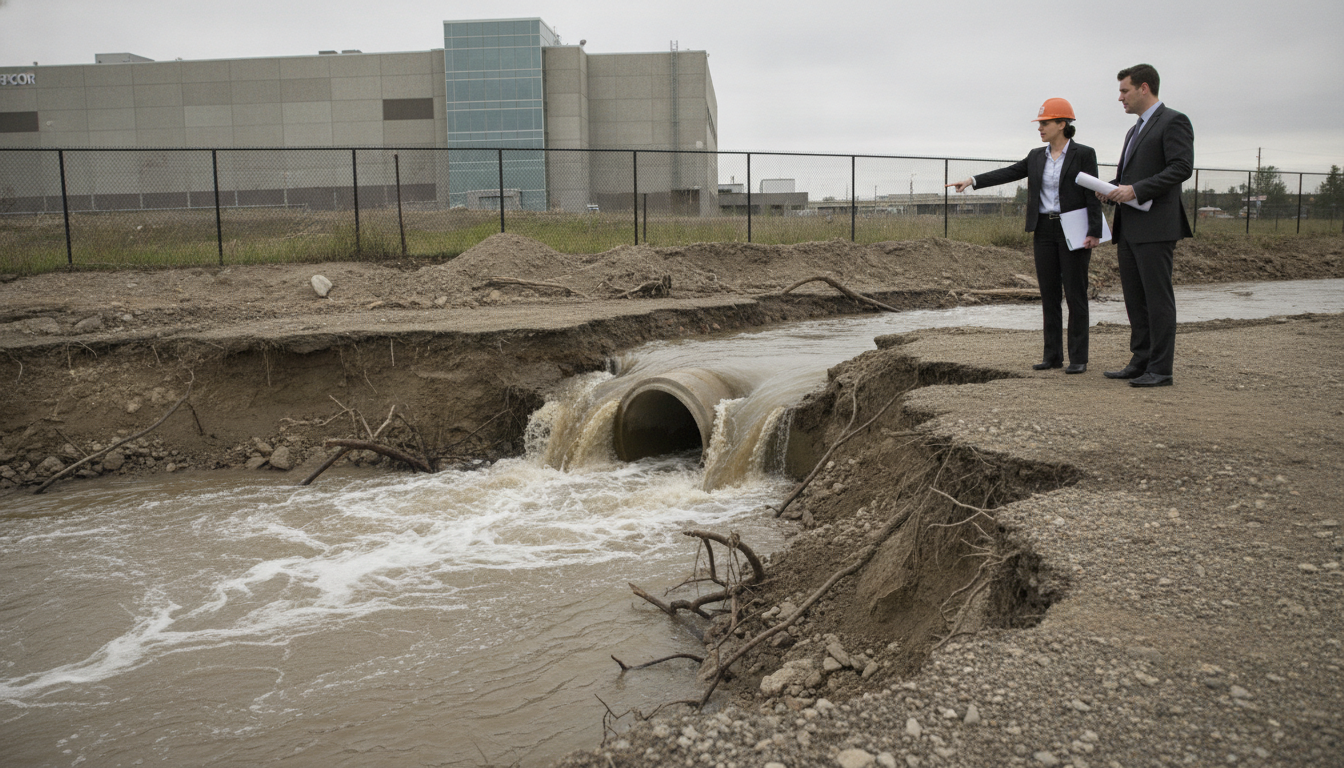
Resident says undersized culvert ignored by Epcor led to visible slope erosion
Resident alleges Epcor ignored warnings about an undersized culvert, saying erosion on a nearby slope worsened after years without repairs or reinforcement.
A local resident has accused Epcor of failing to act after repeated warnings about an undersized culvert beneath a roadway, saying the problem has led to visible erosion on a slope adjacent to the road. The resident said they informed Epcor in mid-2023 that the culvert was too small, and by mid-2024 they began to see measurable erosion on what they described as the 137 slope. According to the resident, Epcor acknowledged the undersized culvert and the erosion but did not undertake rip-rap protection, inlet enlargement, or upsizing of the structure.
Resident timeline and direct account
The resident said they first contacted Epcor in July 2023 to report concerns that the culvert under the road could not handle storm flows. They added that by July 2024 they had observed soil loss and scouring down the slope, evidence they say shows deterioration over time.
They told reporters that Epcor staff acknowledged the problem during subsequent conversations but declined to install rip-rap or increase the inlet size. The resident’s account centers on the sequence of notification, acknowledgement and inaction, which they say increased the risk to the road and neighbouring property.
What an undersized culvert means for the road
An undersized culvert can restrict water flow during heavy rains, forcing water to find alternative paths that erode soil and undermine nearby slopes. The resident raised concerns that the restricted flow and lack of protective armouring have exposed the slope to accelerated scouring.
Without measures such as rip-rap—rock or concrete placed to protect soil— or a larger discharge outlet, concentrated flows can strip away support beneath pavement and shoulders. Local engineers typically watch for these signs because progressive erosion can lead to road failures and costly emergency repairs.
Epcor’s acknowledgement, according to the resident
The resident said Epcor staff acknowledged both the undersized culvert and the visible erosion when notified. They insisted, however, that no rip-rap was placed and no inlet enlargement or culvert upsizing was carried out in the months that followed.
The account does not include a direct statement from Epcor in response to the allegations, and the resident framed the company’s inaction as the primary concern. The resident emphasized that the lack of remediation left the slope exposed through multiple seasons of runoff.
Community safety and infrastructure risk
Local residents worry that ongoing erosion could undermine the road surface or adjacent properties, especially during high-flow events. Soil loss on slopes near transportation corridors can produce sinkholes, edge failures and increased maintenance costs if left unaddressed.
Municipal and utility infrastructure best practices generally prioritize early intervention where undersized culverts exist, since corrective work is usually less disruptive and less expensive if performed before significant deterioration. The resident urged a prompt engineering inspection to assess the current risk and recommend remediation.
Common remediation options cited by engineers
Remedies for an undersized culvert commonly include upsizing the pipe, enlarging inlet and outlet structures, and installing rip-rap or other slope stabilization measures. Engineers may also recommend regrading the slope, installing erosion-control matting, or adding energy dissipation features to reduce flow velocity at the outlet.
These treatments aim to prevent further soil loss, protect the roadbed and extend the service life of the crossing. The resident said they wanted a clear timeline for such measures and for any inspections to be shared with the neighbourhood.
Calls for inspection and municipal oversight
Neighbourhood members and the resident called for a formal inspection by an independent professional or municipal engineer to document the condition and propose a remediation plan. They suggested that transparent reporting and a defined schedule for repair would help restore confidence that the issue will be resolved before it becomes an emergency.
The resident also expressed hope that any required work—whether rock armouring, culvert replacement, or inlet modification—would be scheduled outside of heavy rain seasons to minimize disruption and safety risks.
The situation highlights the challenges communities face when small but critical pieces of infrastructure become points of contention between residents and utilities. The resident’s account places emphasis on a recorded timeline of notification and a perceived failure to act, and they want prompt, concrete measures to protect the road and surrounding land.
