
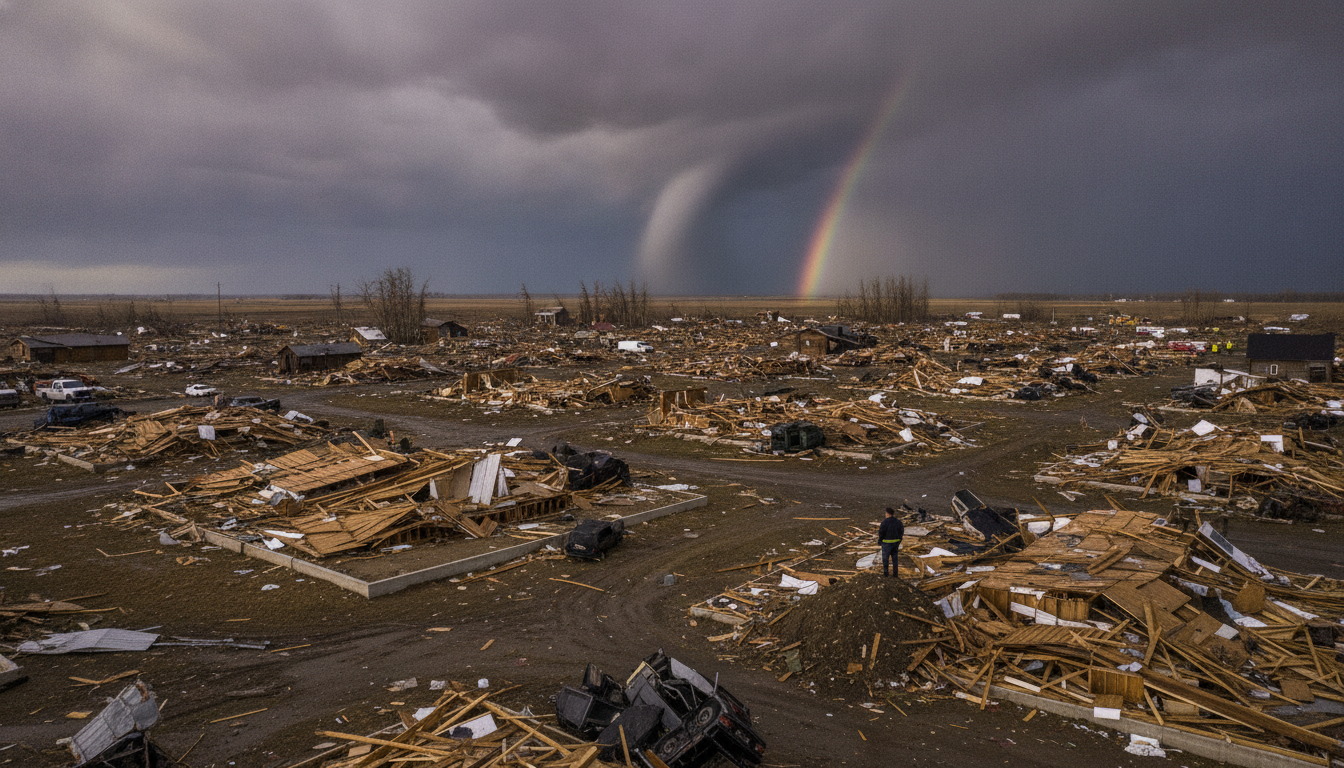
Rocky Mountain House tornadoes leave dozens of buildings damaged after sudden July 18 storms
Two EF2 tornadoes struck south and east of Rocky Mountain House on July 18, 2026, carving an 18-kilometre path and damaging roughly 50 buildings during an unusually active Alberta tornado season.
Residents on a rural property outside Rocky Mountain House described a calm evening that turned violent in minutes when the Rocky Mountain House tornadoes arrived, forcing them into their basement as heavy rain, hail and destructive winds struck. No injuries were reported, but the storm left four of six buildings on one farm destroyed and roofs torn from houses across the affected area. Emergency crews and damage survey teams moved in quickly to assess impacts and begin recovery work along the storm tracks.
Tornadoes strike outskirts of Rocky Mountain House
A pair of tornadoes touched down on the evening of July 18, 2026, striking farmland and forested land south and east of the town. Local witnesses reported sudden, intense conditions after what had been a clear, calm night earlier in the evening. The two twisters followed adjoining tracks that together covered about 18 kilometres before dissipating.
The first tornado tracked along the southern edge of Rocky Mountain House for approximately seven kilometres, narrowly missing large commercial properties along Highway 11. Officials said the twister skirted two hotels and a car dealership, limiting what could have been far greater damage within the town of about 8,000 residents.
Farm family recounts sudden storm and damage
Bryn Hansen, who lives on a multigenerational farm near the touchdown area, said he was feeding cattle shortly before the storm and had returned inside for dinner when conditions deteriorated. He described the wind and hail arriving “out of nowhere,” prompting the family to shelter in their basement until the worst passed. When they emerged, four of six outbuildings on the property had been destroyed and the home’s roof had been badly damaged, though no one was hurt and the animals were safe.
Neighbours and volunteers mobilized to help clear debris and secure damaged structures, and local authorities issued safety guidance for residents returning to affected properties. Officials cautioned that shaken infrastructure and downed trees would prolong cleanup and restoration work.
Extent of destruction and emergency response
Preliminary counts indicate about 50 buildings were damaged or destroyed along the combined tornado paths, with large swaths of trees flattened by the violent winds. Emergency services prioritized welfare checks, debris removal from roadways and stabilizing partially collapsed structures. Power crews worked to restore electricity where lines were downed, and municipal staff began mapping the worst-hit zones for longer-term recovery.
Local leaders have coordinated with provincial emergency management teams to channel resources to the hardest-hit rural areas. Authorities emphasized the absence of fatalities or injuries as a key outcome amid significant structural losses.
Northern Tornadoes Project confirms EF2 intensity
Damage surveys conducted by the Northern Tornadoes Project determined both twisters reached EF2 strength on the Enhanced Fujita scale. EF2 classification corresponds with severe wind speeds capable of uprooting trees, demolishing outbuildings and causing substantial roof and wall damage to well-built homes. One post-storm assessment recorded peak winds near 190 km/h for an event in the same general period.
The scientific team used ground observations and aerial surveys to map the tracks, document structural impacts and assign the ratings. Those findings will feed into regional tornado records and help refine risk assessments for the region.
Alberta’s unusually active tornado season in 2026
Meteorologists say 2026 has been a notably busy year for tornadoes in Alberta, with 27 confirmed events as of mid‑July, up from 15 in 2025. Of those, six have been rated EF2 and one reached EF3 intensity on July 16, 2026, near Tulliby Lake where a home was destroyed. Provincial officials noted that, despite the increased frequency and severity, there have been no reported injuries in this season’s confirmed storms.
Researchers and emergency planners are monitoring patterns behind the uptick, including atmospheric conditions that have favored convective storms across the province this summer. The spike has renewed attention on preparedness, warning systems and rural shelter options.
Recovery operations and public safety measures
In the days after the Rocky Mountain House tornadoes, municipal crews and volunteers concentrated on clearing roads, conducting damage assessments and supporting displaced residents. Temporary shelters and assistance programs were set up for families who lost homes or sustained major structural damage. Local authorities urged residents to avoid storm-damaged areas while crews work and to report hazards such as exposed nails, fractured gas lines or unstable trees.
Public safety officials also reminded residents to review tornado plans, identify the safest location in their homes and keep emergency kits accessible throughout the summer storm season. The province’s emergency management office said it would continue to coordinate recovery assistance and update communities about available supports.
Recovery from the July 18 tornadoes will extend into the coming weeks as repair work, insurance assessments and ecological restoration progress across the affected landscape.
