
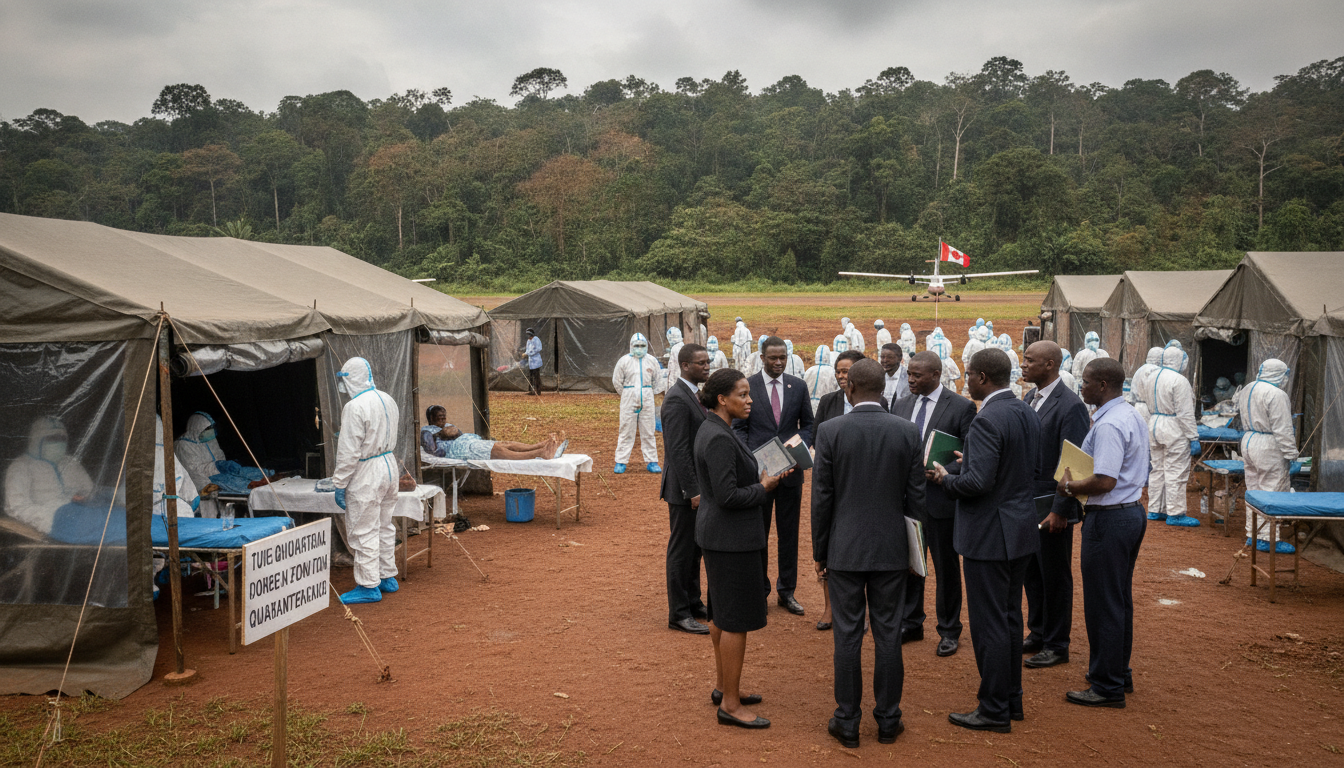
Ebola outbreak in the Democratic Republic of Congo kills at least 930 as Canada tightens border
Ebola outbreak in the Democratic Republic of Congo kills at least 930; 2,344 confirmed cases reported as security problems and strained health services hinder containment.
The Ebola outbreak in the Democratic Republic of Congo has claimed at least 930 lives, the health ministry said, as confirmed infections reached 2,344. Authorities reported 37 deaths over a recent Friday and Saturday stretch, marking one of the deadliest short-term increases in the current epidemic. The outbreak, declared in mid-May, is spreading rapidly across multiple provinces and is testing local and international response capacities.
Death toll rises amid accelerating transmission
The health ministry’s latest figures put the death toll at a minimum of 930, with 2,344 confirmed cases documented as of the most recent update. Officials noted that the recent cluster of 37 fatalities occurred over two days, underscoring the outbreak’s quick escalation. Five provinces have now reported cases, with the eastern province of Ituri identified as the epicentre of the surge.
Local hospital systems are strained by the volume of patients and the pace of new infections, according to the ministry’s statement. The ministry reported 724 patients currently in isolation and under hospital care, while teams work to expand treatment capacity in affected health zones.
Less common Bundibugyo strain complicates response
Laboratory testing has identified the Bundibugyo strain as the cause of the current outbreak, a variant less commonly seen in previous epidemics. Public health authorities warn that there is no approved vaccine or specific antiviral treatment for this strain, complicating clinical management and prevention planning. The virus transmits through direct contact with infected bodily fluids and contaminated objects, making traditional infection-control measures essential.
Health messaging has emphasised the role of safe burial practices, hygiene, and rapid isolation of suspected cases to limit spread. Public health teams are attempting to scale contact tracing and community outreach, but those efforts are being undermined by access and security constraints in several affected areas.
Attacks on clinics and staff limit interventions
Response efforts have been repeatedly disrupted by violence and mistrust in affected regions, with at least 12 attacks reported against health facilities and teams since the outbreak began. Those incidents are largely driven by local scepticism and rumours about the disease and response activities, leading to reduced access for surveillance and treatment. The security environment in Ituri and neighbouring areas has also been shaped by broader rebel activity, complicating movement for health workers and humanitarian agencies.
In addition to direct attacks, health services have been hit by labour actions, with numerous staff staging protests over unpaid salaries. At least 36 health workers who contracted the virus have died, a toll that has further depleted the workforce and heightened fears among remaining personnel.
WHO raises alarm about hidden transmission chains
The World Health Organization has highlighted that an estimated 80 per cent of new cases are linked to unknown transmission chains, indicating that the outbreak is expanding faster than investigators can trace contacts. That gap in surveillance hampers efforts to identify clusters early and prevent onward spread, the WHO cautioned. Despite growing response investments, the rapid pace of infections and missing links in transmission pose a significant obstacle to containment.
Authorities also reported a modest number of recoveries amid the surge, with 22 new discharges recorded in a 24-hour period, reflecting ongoing efforts to provide clinical care where feasible. Still, the predominance of unlinked cases is a critical concern for epidemiologists working to characterise and interrupt transmission.
Canadian government restricts entry for recent DRC travellers
Citing the risk of importing the disease, Canada announced a temporary restriction this weekend barring foreign nationals who have been in the Democratic Republic of Congo within the previous 21 days from entering the country. The Public Health Agency of Canada said the measure will take effect on Monday at 23:59 local time and is framed as a temporary public health precaution. The policy targets non-Canadian nationals; information on exemptions and operational details is being handled by federal border and health authorities.
Canadian officials described the step as part of a broader set of protective measures while monitoring the evolving situation in the DRC. The move mirrors precautions some other countries adopt during outbreaks, balancing entry controls with screening and public health surveillance at ports of entry.
Response efforts constrained but continuing
Health authorities in the DRC say they are intensifying containment operations in affected health zones, expanding isolation capacity and working to scale contact tracing despite the operational challenges. International partners and humanitarian organisations continue to support laboratory testing, surveillance and community engagement where access is possible. Authorities stressed that bolstering local care capacities and restoring trust with communities remain priorities to bring transmission under control.
Public communications aim to counter misinformation, encourage cooperation with health teams, and reinforce practices that reduce risk of transmission. However, the combination of a less familiar Ebola strain, security concerns and workforce losses has left the response fragile and dependent on sustained assistance and stability on the ground.
The outbreak’s trajectory will depend on whether teams can close gaps in surveillance, secure safe access for health workers, and reverse the recent rise in fatalities. Continued monitoring by national and international health agencies will be crucial as authorities work to curb transmission and protect vulnerable communities.
