
China launches Shenzhou-23 and docks at Tiangong, marking first Hong Kong astronaut and year-long stay trial
China launched Shenzhou-23 and docked at Tiangong on May 24, 2026; the crew includes Hong Kong’s first astronaut and will test a yearlong stay to aid lunar plans.
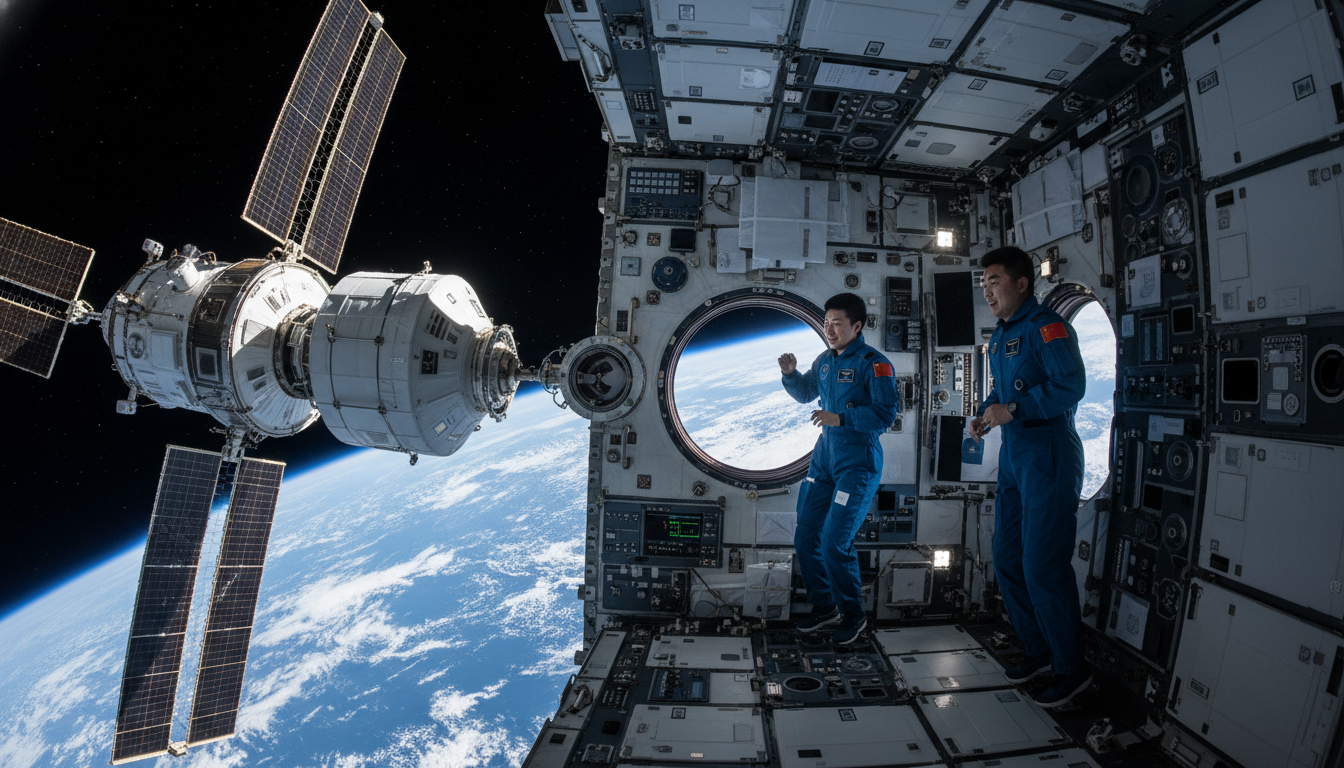
China launched the crewed spacecraft Shenzhou-23 and successfully docked it to the Tiangong space station early on May 24, 2026, advancing Beijing’s long-term objective of sending humans to the Moon. The Shenzhou-23 mission includes three crew members and will test a continuous one-year orbital stay by a taikonaut, a critical step for sustained deep-space operations. The mission’s launch from Jiuquan and the subsequent docking were described as successful by Chinese state agencies. Officials say the flight will conduct a wide range of scientific experiments and systems tests to inform future lunar sorties.
Launch and docking timeline
The Long March 2F rocket lifted off from the Jiuquan Satellite Launch Center late on May 23 local time, carrying Shenzhou-23 into low Earth orbit. After roughly three and a half hours of flight and automated maneuvers the spacecraft achieved a hard dock with the Tiangong complex early on May 24, 2026. State media released imagery of the crew and launch ceremonies, and China’s human spaceflight agency reported the team and systems were operating nominally. The rapid rendezvous profile mirrors previous Chinese crewed missions and underscores routine orbital access to the station.
Crew composition and historic first
Shenzhou-23’s three-person crew comprises commander Zhu Yangzhu, flight engineer Zhang Zhiyuan, and Lai Ka-ying, also known as Li Jiaying, who becomes the first person from Hong Kong to fly in space. Zhu, 39, is an experienced engineer within China’s astronaut corps, while Zhang, 39, is a former air force pilot making his first spaceflight. Lai, 43, formerly served in the Hong Kong police and represents a milestone in Beijing’s integration of personnel from the Hong Kong Special Administrative Region. Officials have highlighted the diverse skill set aboard as valuable for long-duration mission planning.
Year-long residency objective
The defining element of Shenzhou-23 is the plan to keep one crew member on Tiangong for a continuous year to study prolonged microgravity exposure. Until now, Chinese station crews have typically stayed for about six months before rotation, so a yearlong residency will test life-support reliability and human endurance at extended durations. Mission managers will select which taikonaut remains for the full year based on in-orbit conditions and health monitoring, according to agency statements. Data from this trial will feed directly into preparations for future lunar missions and potential crewed operations beyond low Earth orbit.
Scientific experiments and human health focus
Onboard Tiangong the crew will carry out experiments across life sciences, materials research, fluid physics and medicine to exploit the station’s microgravity environment. A central aim is to quantify physiological changes such as bone density loss, muscle atrophy, radiation exposure and sleep disruption during prolonged flight. Engineers will also assess the long-term performance of water and air recycling systems and emergency medical protocols far from Earth. The mission’s science agenda is explicitly linked to designing countermeasures and operational procedures for astronauts on longer interplanetary journeys.
Lunar hardware and timetable
Shenzhou-23 is part of a phased program that China says will culminate in crewed lunar landings by the end of this decade. Chinese planners are testing a new generation of spacecraft, informally named Mengzhou, which is intended to replace older Shenzhou-type vehicles and eventually carry crews toward the Moon. Beijing has publicly discussed goals to establish an initial habitable research presence on the lunar surface by the mid-2030s, and missions like Shenzhou-23 are presented as building blocks toward that objective. Engineers will use results from long-duration station missions to refine life-support, habitability and medical response capabilities for those lunar ambitions.
International outreach and partnerships
China has expanded its space cooperation with selected international partners while remaining excluded from direct NASA collaboration on the International Space Station. Officials say Shenzhou-23 will be followed by greater international activity aboard Tiangong, including plans to host the first foreign astronaut from Pakistan later in 2026. Beijing’s investments over recent decades have rapidly matured its launch, robotic exploration and crewed flight capabilities, including lunar surface missions and Mars landings in previous years. The country frames Tiangong as a platform for scientific collaboration and as a proving ground for technologies needed for sustained human presence beyond Earth.
The Shenzhou-23 mission represents a concerted push by China to move from routine low-orbit operations toward longer-duration human spaceflight and eventual lunar surface activity. Results from the planned yearlong residency, along with the performance of station systems and in-orbit research, will shape Beijing’s timelines for crewed lunar missions and influence the architecture of future Chinese deep-space programs.
