
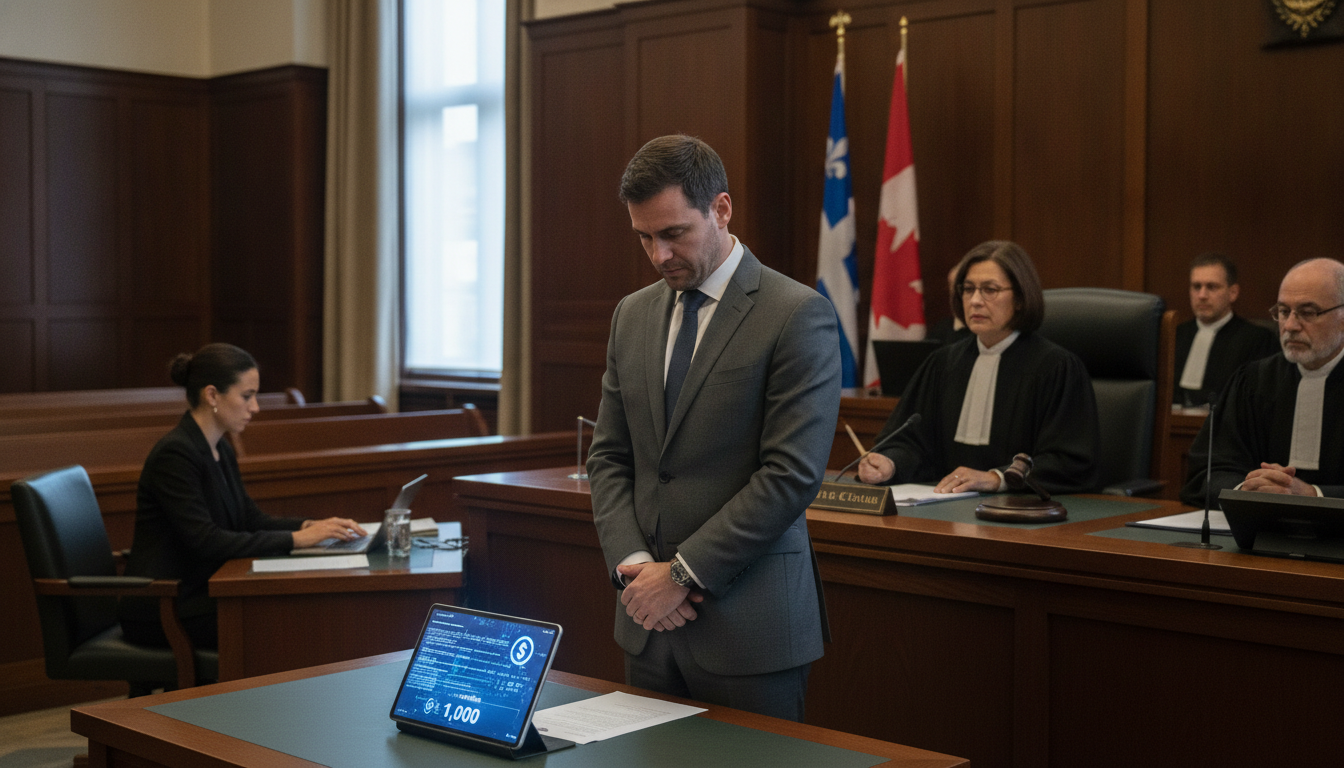
ChatGPT hallucinations lead to $1,000 sanction in Quebec appeal
Quebec Court of Appeal sanctions ChatGPT hallucinations in divorce case; self-represented man ordered to pay $1,000 and costs after AI-made false legal citations.
Asen Petrov, who represented himself in an appeal over asset division, was ordered by the Quebec Court of Appeal to pay $1,000 to his former spouse and cover legal costs after using ChatGPT to draft parts of his filing. The court found that the generative AI produced fabricated legal decisions — so-called ChatGPT hallucinations — that misled the record and forced the opposing side to verify invented authorities. The ruling, dated August 11, 2026, underscores increasing judicial scrutiny of AI-generated materials in Canadian courts.
Court orders $1,000 payment and costs
The Court of Appeal concluded that Petrov’s use of the AI-generated material caused unnecessary delay and expense for the other party. The $1,000 award was described by the court as compensation for the “loss of time” incurred verifying the accuracy of the citations and references presented in his written submissions.
Judges also directed that Petrov bear the outstanding legal costs tied to the appeal, signalling that presenting unreliable sources in formal filings can lead to financial penalties. The decision notes that the court expects litigants, even those acting without counsel, to take reasonable steps to ensure the truthfulness of materials they file.
AI tool produced fabricated legal authorities
According to the judgment, the generative model supplied legal citations and decisions that do not exist or were inaccurately presented. The court used language indicating these were “hallucinations,” a term commonly applied to AI outputs that invent facts or references without basis in source material.
Records show Petrov had been alerted by a lawyer to the presence of erroneous entries in his draft before filing, but initially chose not to correct them. He later acknowledged the mistakes when they were pointed out in court, which the judges said exacerbated the waste of judicial and party time.
Decision references prior Quebec ruling and national cases
The appeal court explicitly referenced an earlier Quebec decision from autumn 2025 in which a litigant was ordered to pay $5,000 after submitting AI-generated false information. That earlier ruling, by Justice Luc Morin of the Superior Court, emphasized that access to justice must not become a licence to present fabricated material.
Judges noted similar problematic uses of generative AI have arisen across Canada over the past year, with reported incidents in Ontario and Manitoba. The court also observed that comparable sanctions have been imposed in other jurisdictions internationally as courts adapt to the risks posed by publicly available AI tools.
Barreau du Québec issues guidance and training
The Barreau du Québec has acknowledged that self-represented litigants may be tempted to use generative AI to prepare court documents, but warns the technology carries significant risks. The professional body has published guidance for people acting on their own behalf and for lawyers, stressing the need to verify any AI-generated legal information against authoritative sources.
Catherine Ouimet, speaking for the order, said all members of the Barreau are required to undergo training on the use of artificial intelligence. The training and resources aim to reduce the chance that flawed or invented AI outputs are relied upon in legal proceedings.
Court highlights burden on opposing parties and the justice system
In its written reasons the Court of Appeal pointed to the practical consequences when unreliable sources are filed: the opposing party must expend time and money checking each reference, and the court’s resources are consumed resolving avoidable disputes. The judges concluded that compensation is sometimes necessary when one party’s conduct creates an unreasonable verification burden.
The ruling framed the issue as one of responsibility: while courts retain flexibility for self-represented litigants, that latitude does not extend to tolerating falsehoods presented as legal authority. The decision thus sets a clear expectation that AI-generated material must be treated with the same scrutiny as any other evidence or citation.
What this means for litigants and lawyers in Quebec
For individuals representing themselves, the judgment is a cautionary note that convenience tools do not substitute for careful legal research and verification. Legal professionals are reminded that they must understand the limits of generative AI and confirm any authorities they plan to rely on in court filings.
Bar associations and courts are increasingly developing practice notes, checklists and training to help bridge this knowledge gap for both lawyers and the public. Legal clinics and duty counsel may be a resource for litigants unsure how to evaluate authorities generated by automated tools.
Courts across Canada are watching the intersection of new technology and courtroom procedure closely, and this ruling reinforces a growing trend: reliance on AI without adequate verification can carry tangible penalties. The decision serves as a practical reminder that accuracy, not novelty, is the currency of legal submissions.
