
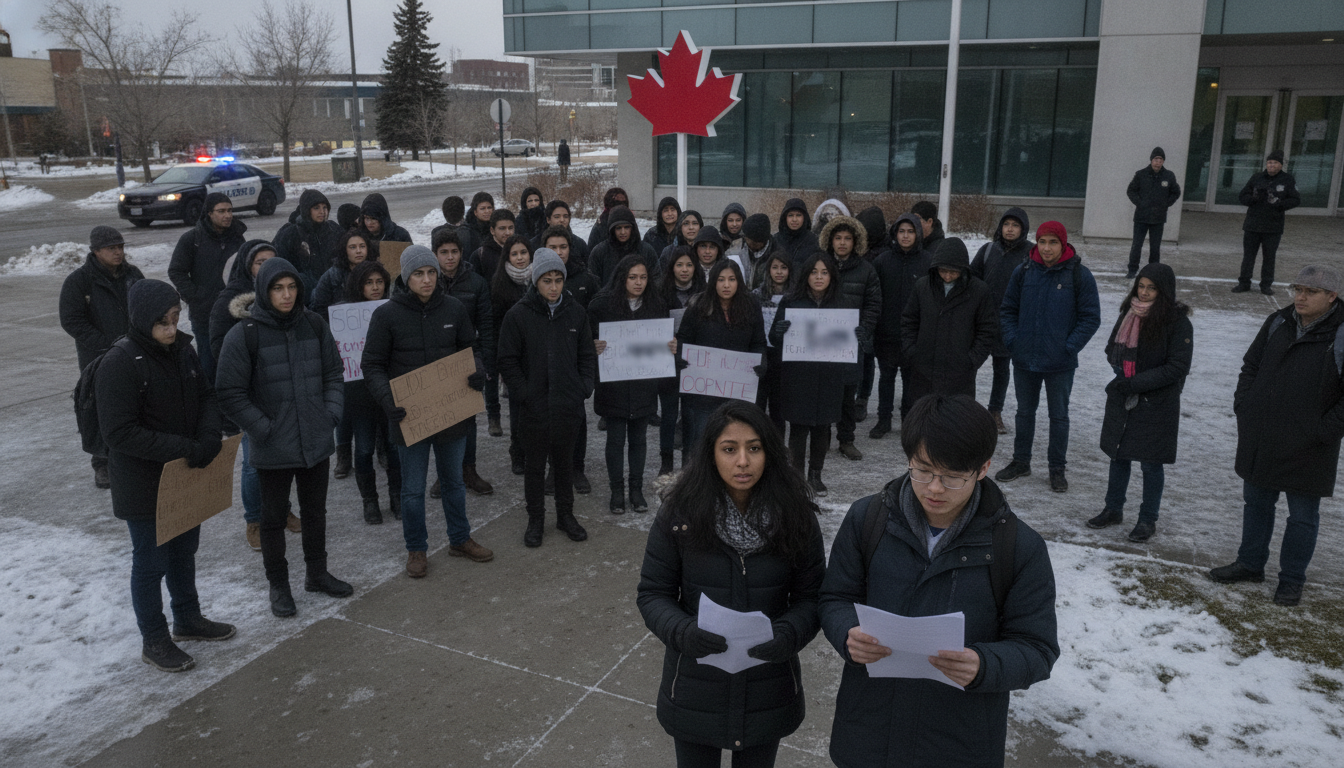
International student protest Calgary draws federal immigration checks as a dozen flagged for possible inadmissibility
Tensions flare at Saddletowne encampment as CBSA verifies status of international student protesters amid work-permit dispute; 12 people identified as potentially inadmissible.
The weeks-long international student protest Calgary at Saddletowne Circle prompted Canada Border Services Agency officers to attend the encampment this week after Calgary police requested immigration status verification.
CBSA says officers checked the records of 20 people at the site and identified 12 individuals as possibly inadmissible under federal immigration law.
Organizers and legal counsel for some protesters say the action follows a larger dispute over post-graduation work-permit denials that has drawn attention across Alberta.
CBSA conducts status checks after police request
The Canada Border Services Agency confirmed it responded to a call to the protest location and verified several attendees’ immigration records.
CBSA officials said they initially attended to follow up on the identification of a small number of people and then expanded checks when discrepancies were found.
A spokesperson for the agency said 20 people had their statuses verified and that 12 were identified as possibly inadmissible under the Immigration and Refugee Protection Act.
The agency also noted that anyone subject to immigration enforcement actions is entitled to legal process and that privacy rules prevent the disclosure of individual details.
How the status verifications unfolded at the encampment
Calgary police told reporters they attended the Saddletowne Circle demonstration after receiving multiple complaints relating to noise, obstruction and public disturbances.
Officers reported encountering tents and other temporary structures set up without a city permit and requested identification from several people at the site.
Police said that, based on the identification provided, they contacted CBSA to verify immigration statuses and that agency personnel followed up later the same day.
CBSA confirmed it asked some individuals to attend a CBSA office for follow-up interviews but declined to disclose whether those interviews took place or what the outcomes were.
Students say work-permit denials sparked the protest
Protesters and supporters have been demonstrating for weeks to demand clarity and reversals of work-permit denials affecting graduates of certain programs.
Many of the students involved claim they enrolled expecting to be eligible for post-graduation work permits, and that applications were later refused once processed.
Representatives for the college tied to many of the affected graduates say they are seeking clarification from federal immigration authorities about how recent policy changes apply to students who began programs before a key May 15, 2024 date.
College officials argue their interpretation of the rules matched public guidance available at the time and that the denials have left graduates in precarious positions as they seek employment and stability.
Legal counsel warns protesters of immigration risk
A Calgary immigration lawyer representing a group of students has advised clients not to participate in public demonstrations pending the resolution of their cases.
The lawyer noted that a public encampment can make the immigration status of participants more visible and increase the likelihood of enforcement action.
He said it is common for individuals found without status in Canada to receive exclusion orders following CBSA interviews, a measure that requires departure and can bar re-entry for a period.
While legal avenues exist to challenge exclusion or removal orders, counsel warned those options are difficult and do not guarantee that an individual will remain in Canada.
Portage College and federal authorities exchange questions
Portage College has publicly stated it is seeking clarification from Immigration, Refugees and Citizenship Canada about how recent regulatory changes should be interpreted.
The college maintains that students enrolled in certain non-credit programs before a May 2024 policy change believed they would be eligible to apply for post-graduation work permits.
Federal officials have been asked to explain the application of the changes, and the situation has prompted scrutiny of how guidance was communicated to international students and institutions.
Students and advocates say the inconsistent application of rules has led to confusion and, in some cases, unexpected refusals.
Broader protests and hunger strikes amplify issue across Alberta
Similar demonstrations have appeared in other Alberta communities, including Edmonton, where some students and supporters have staged hunger strikes to press federal officials for action.
Organizers say their tactics are intended to draw public attention to what they describe as administrative errors and abrupt shifts in policy interpretation.
The protests have sparked debate about the treatment of international students, the responsibilities of educational institutions, and the transparency of federal decision-making in immigration cases.
Advocacy groups and some elected officials have called for urgent clarification and more consistent guidance to prevent further harm to students who came to Canada expecting to build careers.
Possible outcomes for those identified as inadmissible
Individuals flagged as potentially inadmissible under the Immigration and Refugee Protection Act face a sequence of administrative steps that can culminate in removal orders.
CBSA typically provides an opportunity for follow-up interviews and assessment before issuing exclusion or removal orders, but legal counsel stresses timelines can be short.
An exclusion order normally requires immediate departure from Canada and includes a prohibition on returning for a defined period, while a removal order can carry longer-term consequences.
Affected individuals may seek judicial review or other legal remedies, but those processes are complex and can be costly and time-consuming.
Civil society groups and lawyers for the protesters are urging swift case-by-case reviews and are preparing legal challenges where they believe denials were unjustified.
The final paragraph must be unlabeled and contain text only.
Protesters, college officials and legal representatives say they will continue to press for clarity and relief while the federal agencies involved maintain that enforcement and due process will proceed according to law.
Advocates on both sides have called for improved communication between educational institutions and federal authorities to prevent similar disputes, and for expedited reviews in cases where public guidance may have contributed to applicants’ expectations.
As these cases move through administrative interviews and potential court challenges, the outcomes will shape how international students, institutions and regulators navigate post-graduation work-permit eligibility going forward.
