
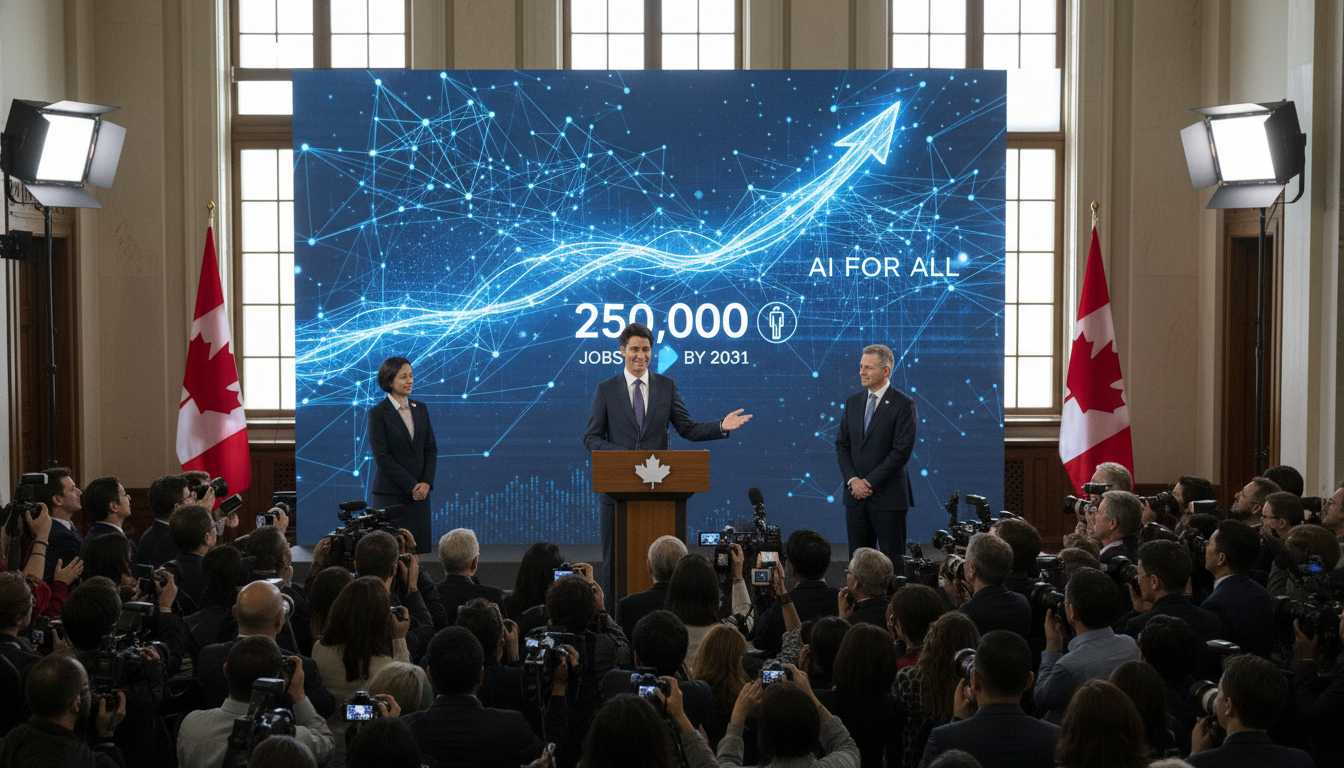
Canada’s AI strategy aims to create 250,000 jobs and expand adoption with training and health investments
Mark Carney unveils Canada’s AI strategy "AI for All", targeting 250,000 jobs in five years, wider AI adoption, free training and major health investment.
Carney unveils national ‘AI for All’ strategy
Prime Minister Mark Carney on Wednesday unveiled Canada’s AI strategy, billed as "AI for All", with a target to create 250,000 jobs over the next five years. The government framed the plan as a national push to accelerate adoption, protect citizens and build sovereign capacity in artificial intelligence. Officials presented a 50‑page strategy that sets broad goals but leaves several implementation details unspecified.
Economic and employment targets set in strategy
The federal plan lays out specific numerical goals for workforce growth and technology uptake. Ottawa projects that the sector could add roughly 250,000 jobs within five years and aims to create 90,000 youth‑focused jobs and internships by 2031. The document also notes current adoption rates and sets an ambition to quintuple AI use among Canadian businesses between 2026 and 2034.
Adoption gap and re‑skilling emphasis
The government acknowledges Canada currently trails peers in business adoption and public understanding of AI. The strategy cites an estimated 12 percent business adoption rate in 2026 and proposes measures to close that gap by supporting companies and workers. Re‑skilling and mid‑career retraining are central pillars, with Ottawa stressing that AI should augment human expertise rather than simply replace jobs.
Education and community training roll‑out
A cornerstone of the plan is expanded public education on AI across age groups and communities. The government will offer free training programs in libraries and community centres and introduce curriculum elements from kindergarten through graduate levels. Officials also said students would gain access to reliable AI tools, though the strategy stops short of setting a minimum age for their use.
Privacy, safety and protection against misuse
Ottawa identified data privacy, disinformation and manipulated media as central risks to address in its AI agenda. The strategy prioritizes protections for children and tightened safeguards against deepfakes and unauthorized data releases. Government statements stressed a focus on responsible deployment and the need for regulatory guardrails while preserving innovation.
Health, infrastructure and the scale of investment
Health care is positioned as a top priority area for AI investment and deployment, alongside transportation, energy, agriculture and manufacturing. In his announcement at a Toronto hospital, the prime minister pledged major new funding aimed at improving health outcomes and reducing system costs through faster, more tailored care. The strategy includes a proposal for significant financial support to modernize health systems, which officials say will be paired with AI tools to improve diagnostics and service delivery.
Concerns from experts and regional risk estimates
Not all observers welcomed the plan without reservations. Independent analyses cited in public discussion warn that automation and AI pose substantial disruption to certain occupations. A 2025 study from the Institut du Québec estimated roughly 810,000 jobs in Quebec alone could be vulnerable to AI‑related change, a figure critics say underlines the need for concrete transition supports. Analysts and labour groups have called on Ottawa for clearer timelines, funding allocations and accountability mechanisms.
Strategy praised for ambition but criticized for vagueness
Supporters lauded the strategy’s ambition to boost education, reinforce sovereignty and channel investment toward priority sectors. At the same time, multiple stakeholders pointed to the document’s high‑level approach and asked for firmer commitments on how targets will be met. Observers from industry, academia and civil society signalled they expect follow‑up announcements detailing program design, governance structures and oversight.
The government said further specifics will be released in subsequent months as departments translate the strategy into actionable programs. Stakeholders and provincial partners have been invited to consultations as Ottawa moves to turn broad objectives into funding envelopes, regulations and training initiatives.
