
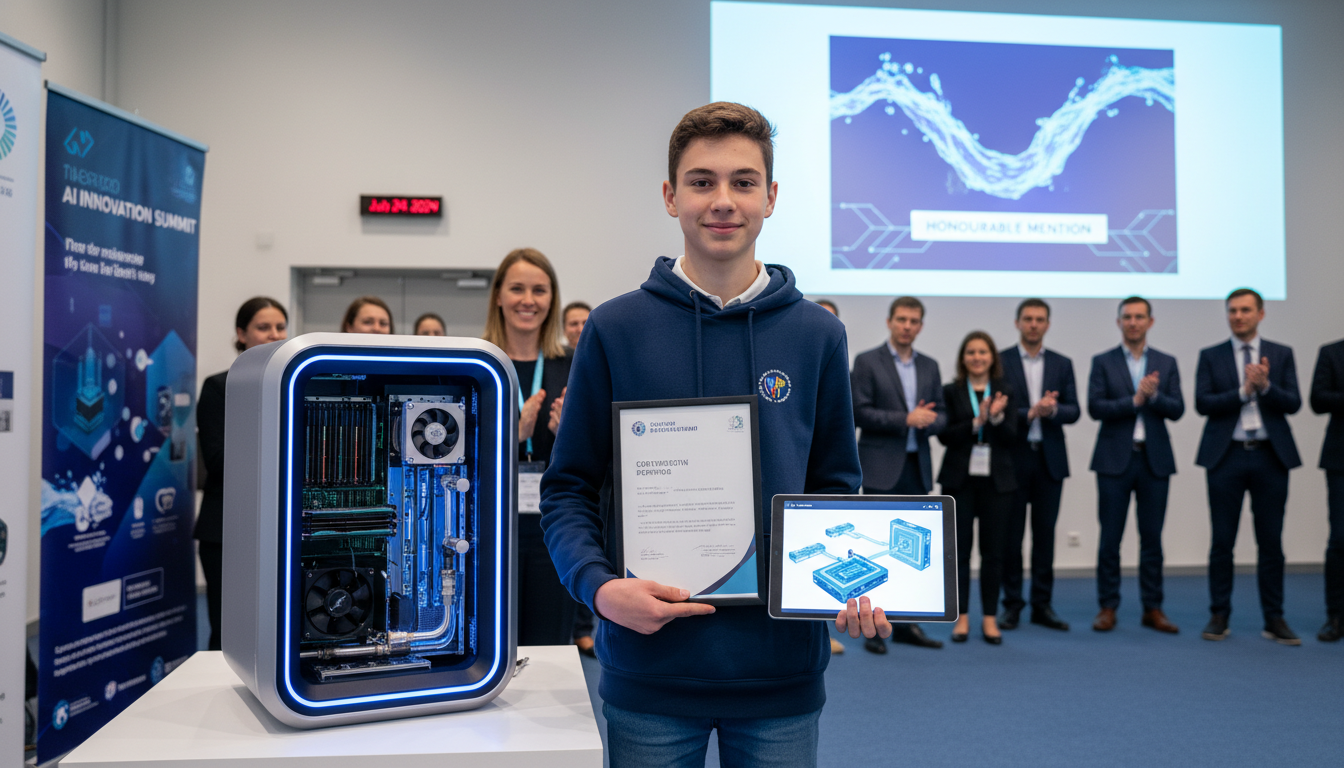
Calgary student earns international honourable mention for data-centre cooling video
Calgary student Ania Udofia earned an international honourable mention for a one-minute video proposing liquid immersion cooling to reduce water use in AI data centres. Her entry stood out among thousands for combining original research, clear visuals and an environmental focus. The recognition included a monetary prize and attention from local academic experts.
Calgary student earns international recognition for data-centre cooling video
Ania Udofia, 15, produced, filmed and edited a one-minute project that placed at the World of 8 Billion International Student Video Contest. The contest drew roughly 5,000 student entries from around the world, and Ania’s submission received an honourable mention and a $300 prize. Organizers judged entries on creativity, research grounding and the clarity of proposed solutions.
Her project examined commonly used evaporative cooling systems at data centres and proposed an alternative: liquid immersion cooling using non‑conductive fluids. Ania said the pivot to immersion cooling could eliminate significant water loss associated with evaporative methods while maintaining server performance. She emphasized both the environmental and energy-sector implications in her short video.
The recognition places a Calgary student in a global conversation about sustainable computing and infrastructure. Youth contributions like Ania’s highlight how local classrooms can feed into international debates on technology and climate. Her work also drew comment from university faculty, underscoring the bridge between secondary-school initiative and higher‑education expertise.
How the international video contest selected standout youth projects
The World of 8 Billion competition invites students to create short videos that address sustainability challenges linked to population and resource use. Judges look for entries that combine compelling storytelling with evidence‑based solutions and feasibility considerations. With thousands of submissions, receiving an honourable mention signals that a project rose above the large field on multiple fronts.
Entries are typically evaluated on originality, scientific literacy, visual communication and the ability to present actionable ideas within a constrained runtime. For many young entrants, the contest serves as both a learning exercise and a platform to reach policymakers and industry observers. The format rewards concise explanation, which makes Ania’s self‑produced one‑minute video a notable example of effective short‑form science communication.
Organizers also aim to showcase projects that can inspire local action, not just theoretical proposals. That emphasis benefits students who connect research findings to practical change, whether through school projects, community campaigns or proposals for pilot programs. Ania’s focus on reducing water waste in data‑centre operations aligned with those goals.
Why evaporative cooling is widely used — and why it matters
Evaporative cooling is commonly deployed in data centres because it offers a relatively low‑energy way to remove heat from server rooms. The method relies on the evaporation of water to lower temperatures, which can reduce the electrical load on mechanical chillers. In many climates this approach is cost‑effective and technically simple to implement at scale.
However, evaporative systems consume water and can pose challenges in regions with limited freshwater resources or during drought conditions. Operators who adopt evaporative techniques often employ water recycling to reduce overall consumption, but the systems still require large volumes to achieve necessary thermal control. That trade‑off between energy savings and water use is central to debates about sustainable data‑centre design.
Data‑centre operators choose cooling approaches based on a mix of factors: local climate, water availability, energy costs, capital investment capacity and the physical footprint of the facility. As computing demand grows, balancing these constraints becomes more urgent for planners and regulators alike.
Liquid immersion cooling: mechanics, benefits and trade-offs
Liquid immersion cooling submerges electronic components or entire server assemblies in a dielectric fluid that does not conduct electricity. The fluid absorbs heat directly from components and can transfer it away more efficiently than air‑based systems, reducing or eliminating the need for conventional air conditioning. Proponents cite lower energy requirements and reduced reliance on external water supplies.
The technology can deliver higher thermal density, enabling data centres to pack more computing power into smaller spaces without proportionally increasing waste heat. It also reduces the need for large air‑handling infrastructure, which can cut both energy use and operational complexity. These benefits are particularly relevant for high‑performance computing and intensive AI workloads.
Trade‑offs include higher upfront costs, the need for specialized maintenance procedures and concerns about long‑term material compatibility. Operators must weigh capital expenditures against projected operational savings and consider supply‑chain availability of suitable dielectric fluids. Pilot projects and phased retrofits are common steps for organizations testing immersion systems.
University of Calgary expert perspective on cooling choices
Faculty members in Calgary’s computer science and engineering communities noted that cooling strategies vary with facility size and use case. A local researcher described common approaches including water recycling and running‑water heat exchange systems, explaining that choice of method often depends on the scale and layout of a data centre. Smaller facilities may favour different mixes of technologies than hyperscale operations.
Experts also pointed out that no single cooling method is universally optimal; what works in one climate or for one workload may not perform well elsewhere. Academic commentary emphasized the importance of life‑cycle analysis and site‑specific assessments when comparing evaporative, immersion and hybrid systems. That kind of rigorous comparison underpinned the technical reasoning in Ania’s project.
University researchers welcomed student engagement that ties technical understanding to environmental considerations. When young people probe real‑world engineering trade‑offs, faculty said it can spur productive collaboration on testing and validation. Local universities and research groups often field inquiries from industry about trialing alternative cooling technologies.
How this recognition ties into Calgary’s STEM ecosystem
Ania’s achievement reflects broader growth in Calgary’s youth STEM programming, which includes school clubs, mentorship networks and regional science competitions. Projects that move from classroom inquiry to recognized external platforms help build a pipeline of students interested in engineering and environmental science. For many educators, the international stage underscores the value of project‑based learning.
Teachers and program leaders say hands‑on work—researching, filming and iterating a single deliverable—teaches both technical skills and communication. The process of producing a short, research‑driven video requires students to synthesize data, craft concise explanations and use multimedia tools. Those competencies are increasingly prized by postsecondary programs and employers in technology sectors.
Local education authorities and community partners often highlight student successes as evidence that practical STEM experiences improve engagement and retention. When a Calgary student attains international recognition, schools may use that visibility to attract resources, sponsorship or mentorship opportunities for more classroom projects.
Potential implications for data‑centre policy and corporate pilots
Proposals that reduce water consumption while maintaining computational performance could influence corporate sustainability planning and municipal policy. If immersion cooling proves scalable and cost‑effective in pilot settings, operators may consider retrofitting existing sites or specifying different technologies in new builds. Regulators and utilities could incorporate water‑use metrics into grants, permitting or incentive programs.
Industry adoption typically follows demonstration projects and clear financial modeling that show acceptable payback periods. Municipalities and regional planners also factor in infrastructure resilience, especially in areas where water scarcity or energy constraints are rising policy priorities. A student proposal like Ania’s contributes to the conversation by framing a technical issue in accessible terms for a broader audience.
Stakeholders suggested that collaboration across schools, universities, industry and local government could accelerate practical trials. Data‑centre operators often seek academic partnerships to validate performance and reliability under real‑world conditions. Early engagement with municipal leaders can help align pilot projects with community sustainability goals.
Next steps for the student and local supporters
Ania plans to continue researching cooling technologies and to pursue opportunities to expand her project beyond the one‑minute format. Mentors and teachers in Calgary indicated they will help connect her with university faculty and local labs for further testing. Small prize awards and recognition often open doors to mentorship, internships and scholarship conversations for students pursuing STEM pathways.
Community groups and schools can amplify the practical impact by using the student’s project as a case study in local classrooms. Hosting workshops, demonstrations or panel discussions with industry and academia can extend the initial idea into collaborative pilots. Such community engagement helps translate youthful curiosity into measurable initiatives.
For the student herself, the next phase typically involves deeper study, networking and participation in more technically focused venues. That trajectory can lead to partnerships that validate concepts at scale and inform both corporate practice and public policy.
Calgary student Ania Udofia’s work shows how focused, research‑based student projects can enter global dialogues about technology and sustainability, and it underlines the value of supporting youth innovation in the city.
