
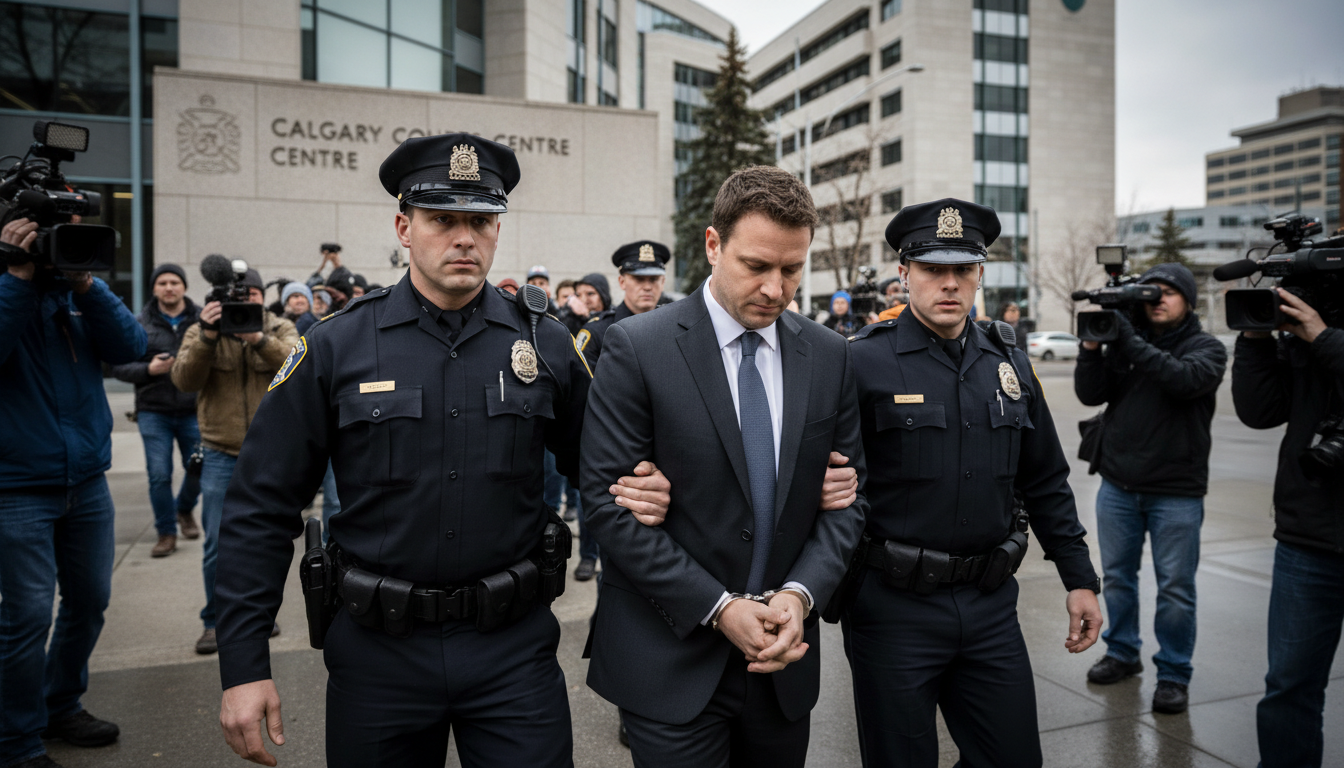
Calgary road‑rage shooting: Man given 20‑month jail term after being beaten by motorists
Ethan El‑Khatib was sentenced to 20 months for a Calgary road‑rage shooting on May 6, 2026, despite suffering a brutal beating by other motorists.
The Calgary Court of Justice has sentenced Ethan El‑Khatib to 20 months in custody after he pleaded guilty to possessing a loaded restricted handgun and firing shots during a road‑rage incident on Sept. 27, 2023. Justice Greg Stirling issued a written decision on May 6, 2026, rejecting a proposed conditional sentence that defence counsel Jim Lutz had urged in light of the severe assault El‑Khatib endured after the shooting. The judge reduced what would otherwise have been a longer sentence by four months to reflect the beating but said the use and accessibility of a firearm in public demanded a custodial term.
Judge rejects conditional sentence
Justice Greg Stirling concluded that, while the physical assault on El‑Khatib was serious and visible on video, it did not negate the need for deterrent sentencing for gun offences. The judge referenced public safety and the necessity of general deterrence when a weapon is used on a busy roadway. Stirling wrote that the surrounding circumstances and the presence of bystanders at the Calgary International Airport area were aggravating features that weighed against a community‑based sentence.
The defence had argued the vigilante reaction by the other motorists should permit El‑Khatib to serve his sentence in the community. Lutz described the attack on his client as prolonged and savage and urged the court to consider a conditional sentence order in submissions made in November 2025. The judge said those submissions were carefully considered but ultimately insufficient to displace the sentence required by the offence.
Shooting and pursuit near the airport
Court facts laid out by Crown prosecutor Margot Engley say the incident began after an exchange of profanities between vehicles near the Calgary International Airport. El‑Khatib brandished a loaded, restricted handgun and fled the scene after the confrontation on Sept. 27, 2023, according to court records. He became stuck in construction traffic shortly thereafter, which allowed the other vehicle to catch up.
When the second driver, identified as Rayad Hammidi in court filings, approached El‑Khatib’s vehicle, shots were fired at Hammidi’s car. One bullet struck or grazed Hammidi’s forehead. Although the Crown initially pursued a more serious attempted murder charge, that charge was later withdrawn as the possibility of self‑defence was acknowledged.
Beating captured on video
After being struck, El‑Khatib was pulled from his vehicle by Hammidi and his passengers and suffered a violent assault, footage shown to the judge demonstrated. Stirling described the images as difficult to watch and said the videos showed El‑Khatib’s head being repeatedly forced into the pavement. Defence submissions emphasized the brutality of that response and asked the court to weigh it heavily in mitigation.
The judge accepted that the beating was significant and reduced the sentence by four months for that reason, but he said the assault did not erase the danger created when a loaded firearm is brandished and fired in public. The violent response by bystanders was treated as an aggravating contextual element for the court’s overall assessment rather than a justification for a wholly non‑custodial penalty.
Crown drops attempted murder charge
Prosecutors dropped an attempted murder charge during the case after reviewing the evidence and acknowledging the recorded circumstances could support a claim of self‑defence. Margot Engley told the court the Crown could not prove beyond a reasonable doubt that El‑Khatib had the intent required for attempted murder. As a result, El‑Khatib was convicted on a lesser charge of possession of a loaded restricted firearm.
The Crown’s decision to discontinue the more serious charge narrowed the legal issue for sentencing to the possession and use of a weapon in a public setting. That focus shaped Stirling’s analysis of aggravating and mitigating factors as he weighed an appropriate punishment under federal and provincial sentencing principles.
Aggravating factors related to the firearm
In his reasons, Justice Stirling identified several aggravating aspects tied to the firearm itself. Court documents note the handgun was readily accessible inside El‑Khatib’s vehicle and that he possessed an overcapacity magazine holding 20 rounds. The serial number on the firearm had been defaced, the judge wrote, and those facts increased the seriousness of the offence in his view.
Stirling also emphasized the timing and location of the incident, pointing to the midday setting on a public roadway near a major airport where members of the public were present. The brandishing of the weapon at multiple occupants of another vehicle and subsequent discharging of a round heightened the risk of harm, the judge said, warranting a sentence that sends a message about the unacceptability of bringing illegal firearms into ordinary public spaces.
Sentence, timeline and legal outcomes
El‑Khatib pleaded guilty to the possession charge arising from the Sept. 27, 2023, incident and was sentenced to 20 months’ imprisonment on May 6, 2026. The court trimmed four months from what would otherwise have been a longer custodial term to reflect the serious assault he suffered after the shooting. That reduction acknowledged the role of the vigilante beating in the overall sequence of events without eliminating the need for incarceration.
The decision leaves intact the court’s finding that gun offences on public roadways require firm sentences to achieve both specific and general deterrence. It also highlights the complex factual mix that sometimes surrounds violent encounters on public roads, where claims of self‑defence, vigilante reprisals and public safety concerns intersect.
The sentence marks the latest ruling in a case that began in September 2023 and that saw contested legal decisions, including the Crown’s withdrawal of an attempted murder charge and vigorous mitigation efforts by defence counsel in late 2025. The judgment makes clear that while violent reprisals against an accused may be a mitigating consideration, they do not outweigh aggravating weapon‑related conduct that endangers the public.
