
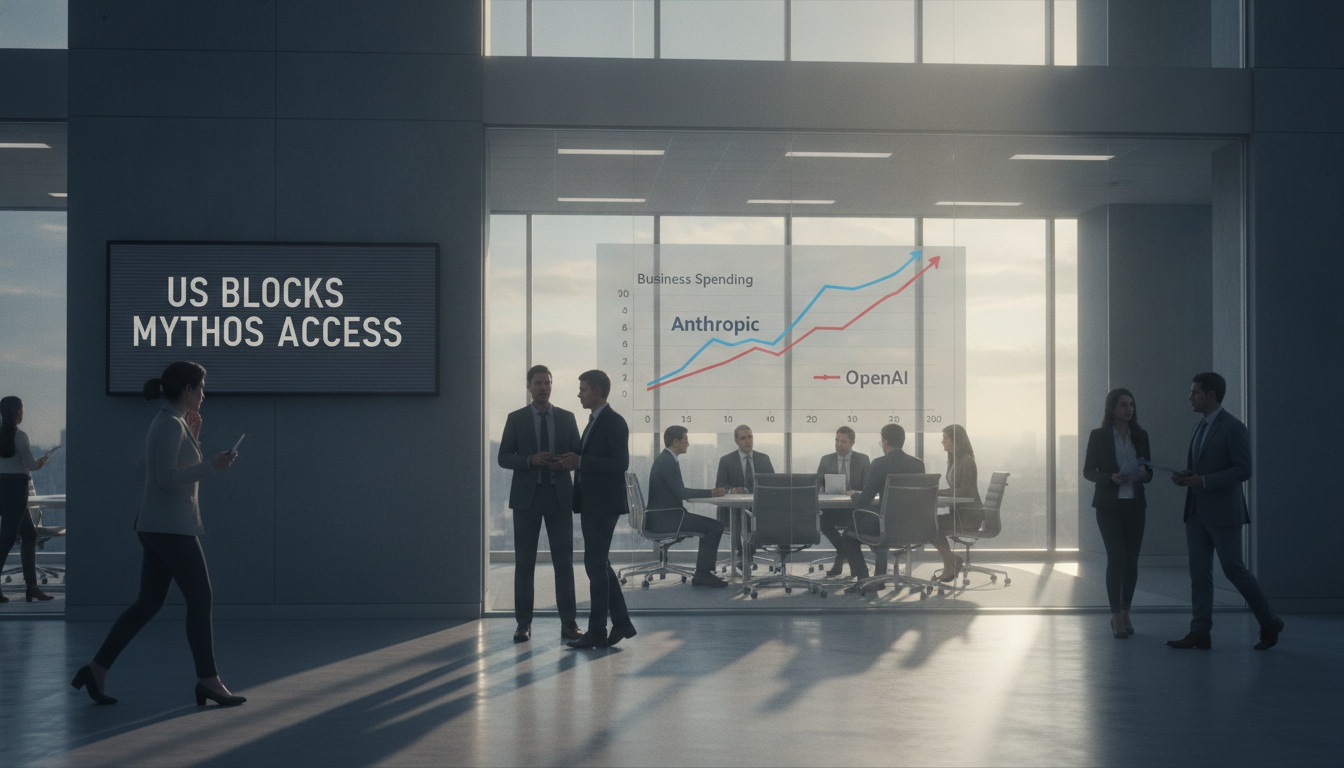
Anthropic models ban forces lab to pull Mythos and Fable 5 amid record business adoption
Anthropic models ban: White House order to block non-U.S. access to Mythos 5 and Fable 5 forced Anthropic to withdraw its latest models even as business spending on its offerings surged.
Anthropic models ban halts public use and follows export-control letter
Anthropic said this week it removed its most advanced models from public access after the White House directed the company to block non-American users from interacting with Mythos 5 and the near-public variant Fable 5.
The administration cited an export-control directive in a letter that required the restrictions, effectively ending the short-lived public availability of Fable 5 and constraining access to Mythos 5 for most external users.
Company officials confirmed the shutdown of those services as they worked through the government’s order, noting the move interrupted a key commercial rollout.
White House action framed as export-control enforcement
The government’s letter invoked a federal export-control mechanism rather than an explicit national-security ban, leaving the precise legal basis and technical triggers opaque to outside observers.
Administration officials characterized the step as necessary to prevent foreign access to powerful capabilities, while also warning of potential misuse that could arise if advanced models were widely available without restrictions.
Observers noted the choice of an export-control pathway signals concern about cross-border transfer of technology rather than a criminal enforcement action.
Security concerns cited over Mythos’ capabilities
Industry sources and reporting point to safety worries tied to Mythos’ ability to surface vulnerabilities in software and its demonstrated success at bypassing some guardrails in Fable 5.
Anthropic itself had previously limited Mythos’ release, describing the model as having potent capabilities that required careful handling, and the company had publicly warned against unrestricted distribution.
The apparent ability for researchers or malicious actors to exploit Fable 5’s protections is the most-consistent explanation offered for the administration’s decision, though no single definitive incident has been publicly confirmed.
Ramp data shows enterprise adoption surging in May
Despite the regulatory clash, commercial demand for Anthropic models accelerated in May, according to payment-processor and platform data compiled by Ramp.
Ramp’s dataset, drawn from more than 70,000 businesses, shows Anthropic’s share of paid AI subscriptions climbed to roughly 41% in May, edging past a reported 39.5% for a major rival in that same month.
The firm-level metrics suggest companies are increasingly buying Anthropic’s Opus and Claude-branded models for tasks such as code generation and workflow automation.
Opus models and Claude Code underpin business spending
Where model-level detail is visible within the payments data, a plurality of spend is tied to Claude Opus variants and Claude Code products that enterprises use for API-driven workflows.
Anthropic released an updated Opus 4.8 late in May, and Ramp reports indicate that the Opus lineage remains widely deployed even as Mythos was being tested by a smaller cohort of users.
Companies appear to favor the more controlled, commercially available Opus models for production tasks while Anthropic’s limited Mythos tests were confined to select partners and internal pilots.
Prior tensions with U.S. defense and potential IPO consequences
Anthropic’s dispute with the U.S. government is not new: earlier this year the company resisted government requests to integrate its models into mass surveillance and fully autonomous weapons systems and was later designated a supply-chain risk by the Department of Defense.
That designation did not halt commercial traction; Ramp’s economist notes that controversy has not prevented — and may have even fueled — enterprise curiosity and adoption.
Still, the newly imposed Anthropic models ban injects fresh uncertainty into the company’s path to public markets after it announced a large private financing at a near-trillion-dollar valuation and filed confidential IPO paperwork in late May.
Market and investor implications remain uncertain
Public-market investors typically discount regulatory risk, and an abrupt government-mandated withdrawal of product access introduces a new variable into valuation and timing decisions.
Analysts say the immediate financial impact is hard to quantify from payment data alone, since much enterprise spend is tied to APIs and subscription services that remain available, while the pulled models represented a narrower, high-capability tier.
For now, operational revenues appear resilient, but longer-term fundraising and IPO timing will likely hinge on how quickly Anthropic and regulators reach a durable framework for safe, export-compliant access.
Anthropic faces a delicate safety-versus-access balancing act
The company must now reconcile commercial demand for powerful AI with government concerns about cross-border risks and the demonstrated shortcuts that exposed Fable 5’s protections.
Anthropic’s prior public stance against government uses it deemed unethical has shaped both its regulatory relations and its market narrative, complicating negotiations even as enterprise customers continue to pay for Opus and Claude services.
How the company adapts its controls and whether regulators accept those mitigations will determine if the Anthropic models ban is a temporary constraint or the start of a longer-term operating limitation.
The coming weeks will test whether restricted access and regulatory scrutiny slow Anthropic’s momentum or reinforce its reputation for building highly capable models that require careful governance.
