
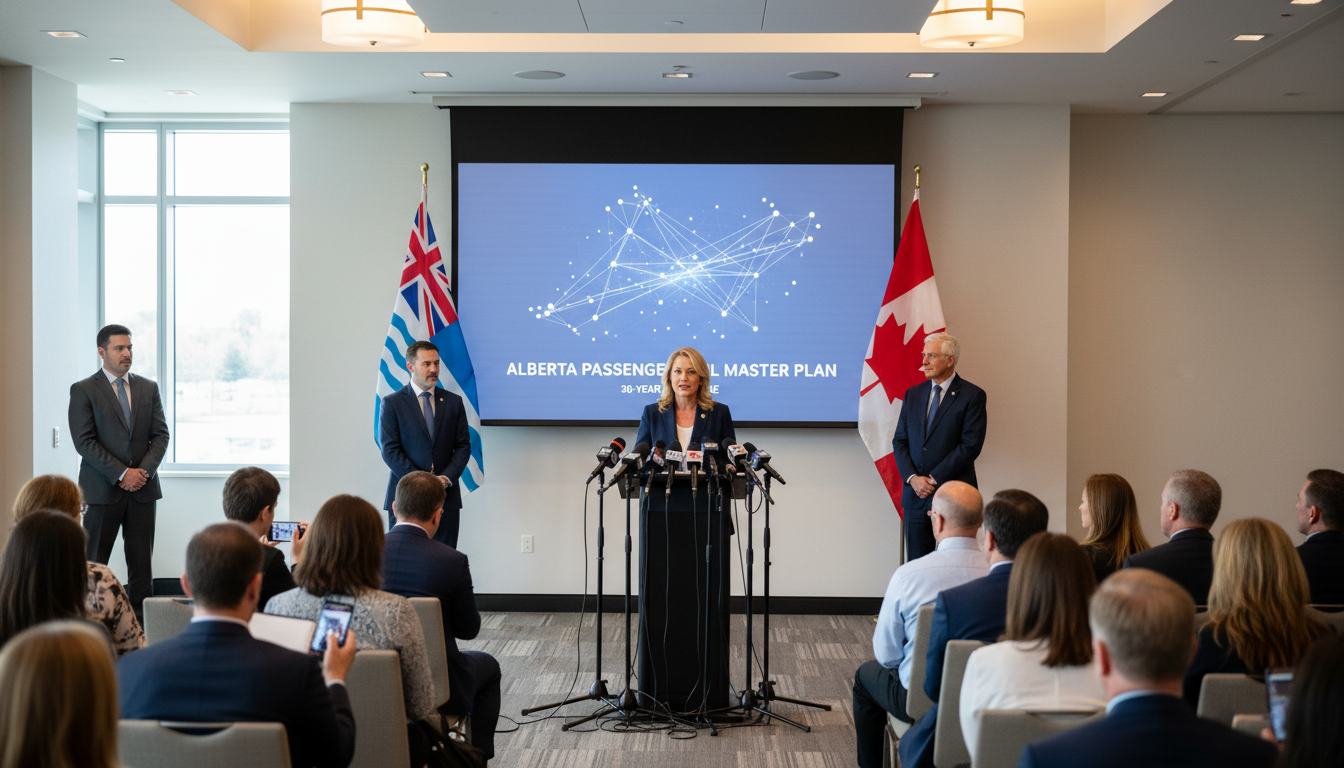
Alberta passenger rail network set as provincial goal with 30-year Master Plan
Alberta passenger rail network is now a formal provincial goal as officials unveil a Master Plan outlining a roughly 30-year rollout, targeted routes and next steps.
Project announced and objective stated
Smith said Friday that a feasible passenger rail network in Alberta has progressed from vision to concrete provincial goal.
The announcement followed completion of a Master Plan that officials described as a roadmap for decades of incremental work.
Leaders cited growing population and mounting pressure on highways as drivers behind the renewed focus on rail investment.
Master Plan outlines long-term approach
The Master Plan sets out an implementation horizon of about three decades, built around steady, staged improvements rather than a single large build.
Planners emphasized phased development to allow adjustments as ridership data and technology evolve.
Officials said that approach is intended to balance ambition with fiscal and operational realism.
Routes and regional connections targeted
The plan singles out corridors that link major urban centres with mid-sized cities and smaller communities, aiming to expand travel options beyond car travel.
Planners highlighted the potential for intercity services that connect economic hubs while also serving commuter markets within regions.
Community leaders across the province have already signalled interest in exploring station locations and service frequency.
Funding structure and partnership model
Officials indicated the next phase will focus on securing funding and formal partnerships with federal, municipal and private sector stakeholders.
No definitive cost estimates were released with the Master Plan, but the framework anticipates mixed financing and phased capital commitments.
Provincial spokespeople said detailed business cases and project-level budgets will be produced as individual corridors move from planning toward procurement.
Transport, congestion and climate rationale
The government framed the Alberta passenger rail initiative as a response to rising road congestion and the need for diversified transportation options.
Advocates argue that intercity rail could reduce vehicle kilometres travelled and provide lower-emission alternatives for longer trips.
Planners expect the network to complement existing transit and freight rail, rather than supplant current services.
Implementation hurdles and public engagement
Officials acknowledged several challenges, including land use coordination, regulatory approvals and negotiations with freight rail owners that control many key tracks.
The Master Plan calls for extensive public engagement and consultation with municipalities, Indigenous partners and stakeholders to refine routes and service standards.
Planners said environmental assessments and technical studies will be conducted before construction begins on any corridor.
Next procedural steps and timing
In coming months the province plans to open a series of consultations and commission corridor-level studies to produce business cases for priority segments.
These studies will aim to clarify ridership projections, capital and operating costs, and procurement pathways for rolling stock and infrastructure.
Officials stressed the work will be incremental and adaptive, with decisions on major investments tied to demonstrated demand and available funding.
The government described the Master Plan as the start of a long process that will require sustained political will, intergovernmental cooperation and community support before passengers see trains running on new intercity routes.
