
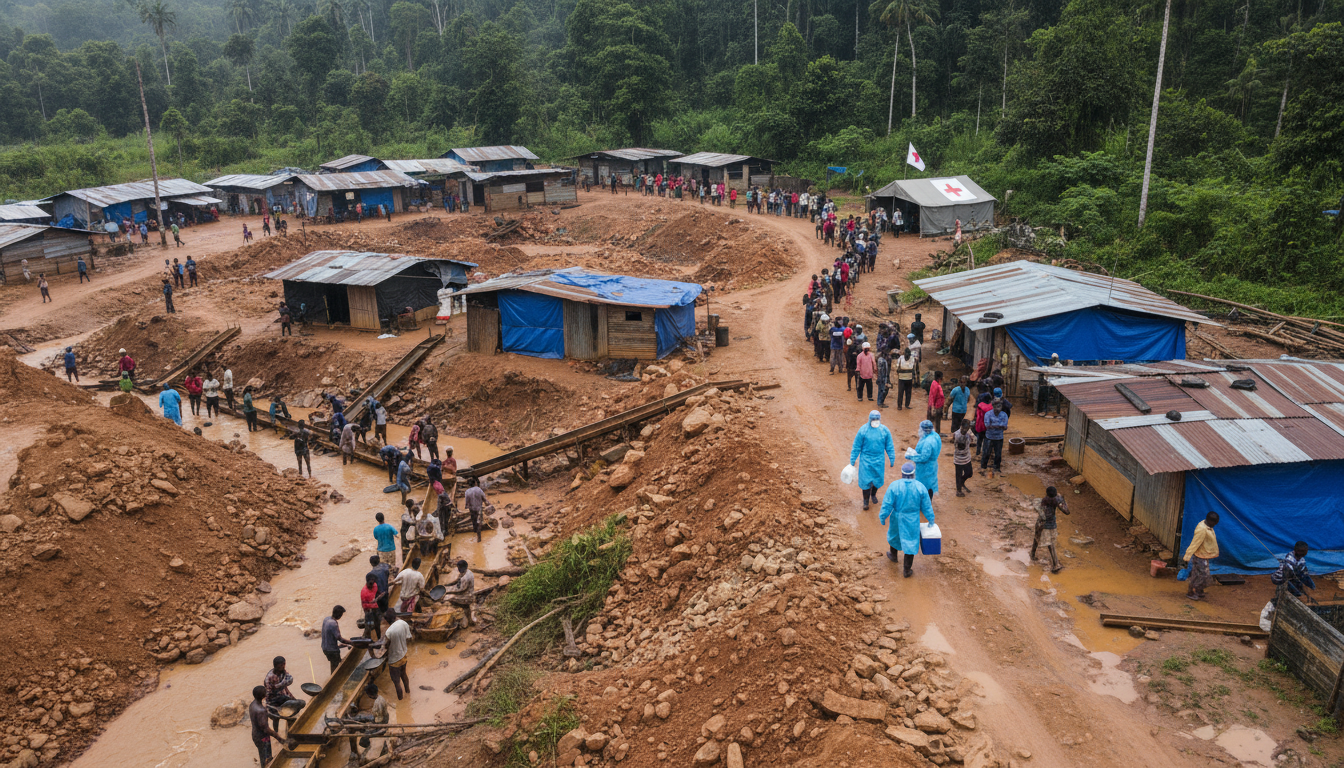
Ebola Outbreak in DRC Accelerated by Gold Mining Networks, Health Officials Warn
Ebola spread through gold mining sites is driving case surges in eastern DRC, complicating contact tracing and international response as health teams race to contain the outbreak.
The latest Ebola outbreak in the Democratic Republic of Congo has spread rapidly through artisanal gold mining zones, where crowded camps and frequent movement of workers have amplified transmission of the Bundibugyo strain, health officials say. The concentration of cases in mining towns and the movement of miners between sites have made contact tracing and infection control more difficult, even as international agencies scale up support. (afro.who.int)
Ebola Cases Concentrated in Ituri Mining Areas
Health authorities report the highest concentrations of suspected and confirmed Ebola cases in Ituri province, where gold mining is a major source of income and population movement. The WHO and local health agencies have documented outbreaks across several health zones that host informal mining operations, noting a high positivity rate in initial samples. (who.int)
The situation prompted the World Health Organization to determine the event a Public Health Emergency of International Concern in mid-May, underscoring the risk of international spread and the urgent need for coordinated response measures. That designation has mobilized additional international resources but also signalled the scale of the challenge facing response teams on the ground. (who.int)
Spread Along Mining Routes and Transit Hubs
Public health experts say the structure of artisanal gold mining—temporary camps, daily migration of laborers, and informal transport networks—creates pathways for the virus to move quickly between settlements and into larger towns. Miners and traders frequently travel between pits and markets, increasing the likelihood that infected individuals will seed new clusters before symptoms prompt isolation. (hhi.harvard.edu)
Sites such as Mongbwalu have been highlighted by humanitarian organizations as focal points where economic necessity, crowded living conditions, and inadequate sanitation combine to heighten transmission risk. These dynamics complicate standard containment steps like ring vaccination, isolation and household-based contact monitoring. (hhi.harvard.edu)
Gaps in Vaccines and Treatments for Bundibugyo Strain
The current outbreak is caused by the Bundibugyo species of the Ebola virus, for which there is no widely approved vaccine or specific antiviral treatment, according to WHO briefings and disease-outbreak updates. Researchers and agencies are testing candidate therapeutics, but the absence of established countermeasures has forced clinicians to rely on supportive care and strict infection-prevention protocols. (who.int)
Health facilities in affected areas are straining under caseloads, and gaps in infection prevention and control have contributed to healthcare-associated transmission, including infections among health workers. That has heightened urgency for supplies, training and safe care spaces to keep both patients and caregivers protected. (who.int)
Mistrust, Violence and Barriers to Aid
Efforts to reach communities have been hampered by deep-seated mistrust of health teams and, in some cases, by violent incidents. Aid workers report that misinformation and suspicion about outsiders have led to attacks on treatment tents and disruption of burial and safe-care procedures, undermining containment efforts. (lemonde.fr)
Authorities and humanitarian organizations stress that rebuilding trust through community engagement, transparent communication and involvement of local leaders is central to reversing transmission trends. Without that social access, surveillance and contact-tracing efforts risk missing chains of transmission in remote mining settlements. (ungeneva.org)
Cross-Border Risks and International Response
Cases linked to the DRC outbreak have been reported across borders, including detections in Uganda, raising concern about regional spread through trade and travel routes tied to mining economies. Health agencies have emphasized screening, surveillance and cooperation between neighbouring countries to limit cross-border transmission. (who.int)
The WHO and UN partners have airlifted supplies and personnel to frontline areas and established treatment centres, while calling for scaled-up laboratory testing, infection-prevention supplies and support for overburdened local health systems. Officials say that international assistance must be sustained and tailored to the operational challenges posed by insecurity and mobile populations. (afro.who.int)
Economic Imperatives and Public Health Trade-Offs
For thousands of people in eastern DRC, artisanal gold mining is an economic lifeline, and economic necessity often competes with public-health advisories to avoid high-risk sites or restrict movement. That tension has made it harder for authorities to impose measures that would slow the virus without risking livelihoods and food security. (hhi.harvard.edu)
Public-health strategists say effective interventions must pair disease control with short-term social supports and livelihood-sensitive policies so communities do not face impossible choices between earning income and complying with containment measures. Targeted cash assistance, safer working protocols and locally led health education are among the measures being discussed. (hhi.harvard.edu)
Global and local health officials say the coming weeks will be decisive: success will hinge on expanding testing and treatment capacity, strengthening infection-control in clinics and mining camps, and rebuilding trust among communities whose daily movements have become the motor of the epidemic. As of June 5, 2026, responders warn that without sustained international support and locally anchored outreach, the combination of gold mining networks and fragile health systems will continue to drive new chains of Ebola transmission. (afro.who.int)
