
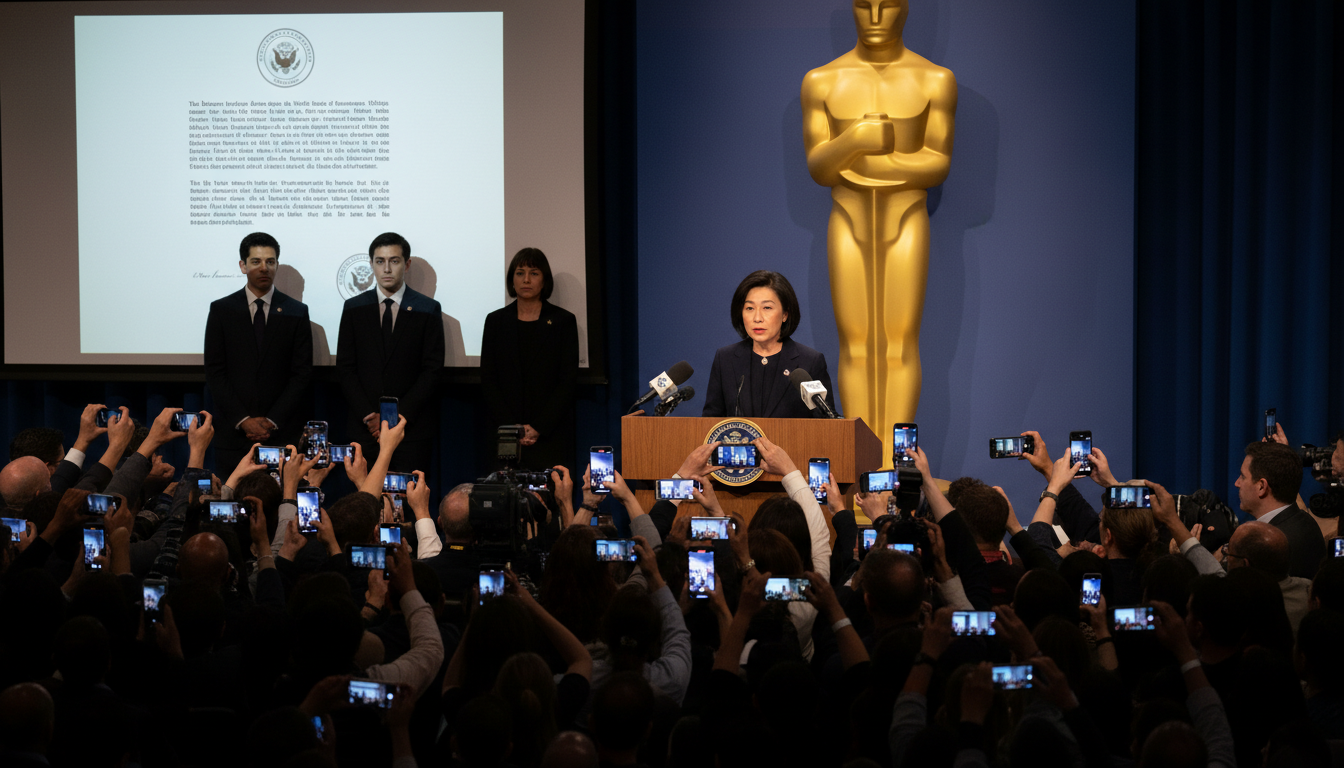
Oscars AI rules: Academy requires human performances and human-authored screenplays
The Academy’s new Oscars AI rules require credited roles to be demonstrably performed by humans and insist that screenplays be human-authored, while allowing audits of AI use and authorship.
The Academy of Motion Picture Arts and Sciences on Friday issued a set of amendments to its awards eligibility that explicitly address the use of generative artificial intelligence in film production. The Oscars AI rules state that only performances credited in a film’s legal billing and demonstrably performed by consenting humans will be eligible for awards. The changes also make human authorship of screenplays a condition of eligibility, signaling a new threshold for what the Academy will consider original human creative work.
Human performance requirement clarified
The revised rules make clear that synthetic or AI-generated renditions of living actors cannot be submitted as eligible performances unless the credited performer actually performed the role and consented to any post-production manipulation. The Academy’s language ties eligibility to legal billing and demonstrable human contribution, effectively closing a pathway some producers had tested for including digital or recreated likenesses in awards consideration. The provision aims to preserve the principle that acting awards recognize human craft and judgment rather than the outputs of algorithms.
Screenplay eligibility restricted to human authors
Under the new rules, screenplays submitted for Academy consideration must be human-authored, reinforcing the idea that dramatic structure, dialogue and narrative intent are products of human creativity. The Academy’s stipulation does not outlaw the use of AI tools in early drafting stages, but it establishes that the final credited writers must be humans who can be shown to have authored the submitted screenplay. This places an explicit barrier between collaborative human-AI workflows and the formal recognition of authorship at awards time.
Academy can request verification of AI usage
The updated guidelines give the Academy the right to ask production teams for documentation about how AI tools were used during development and post-production, and to seek evidence of human authorship where questions arise. That investigatory power is intended to enable the organization to adjudicate borderline cases and enforce the new eligibility criteria. The move responds to a surge in AI-assisted creative processes across filmmaking, and anticipates disputes over the provenance of performances, dialogue and other creative elements.
Recent AI controversies in film and publishing
The policy change comes amid several high-profile incidents that have pushed AI into the center of cultural debate, from independent projects that recreated a well-known actor’s likeness to persistent headlines about entirely synthetic performers. New generative video models and AI-created “actors” have provoked legal and ethical scrutiny, while parts of the industry have cited AI as a central concern during labor tensions in recent years. Outside of film, publishers and writers’ groups have also taken action when AI use has affected claims of originality, underlining the wider implications of machine-assisted creation.
Practical implications for filmmakers and producers
For studios and independent producers, the Oscars AI rules will require clearer documentation of who did what on a film and how tools were employed in the creative process. Casting, contractual language and on-set consent forms may need revision to ensure that credited performers can demonstrate their role and permission for any alterations. Screenwriters and showrunners who use AI in development should consider retaining clear version histories and statements of authorship to avoid eligibility challenges when seeking awards recognition.
Enforcement, disputes and the path ahead
Enforcing the new standards could create contentious hearings and challenges if productions contest the Academy’s assessment of AI contributions. The Academy’s investigatory authority gives it leverage to require disclosure, but it also raises practical questions about how much technical detail will be necessary to prove human authorship. Industry groups, guilds and legal advisors are likely to develop model practices and contractual clauses designed to align commercial production with the Academy’s eligibility framework.
The Oscars AI rules mark a significant formal response by the film academy to rapid technological change, prioritizing human credit and consent in performance and authorship while leaving room for limited, documented tool use. Filmmakers now face both a clearer boundary and a new administrative burden when pursuing awards, and the industry will watch closely how the Academy handles investigations and disputes under the updated regulations.
