
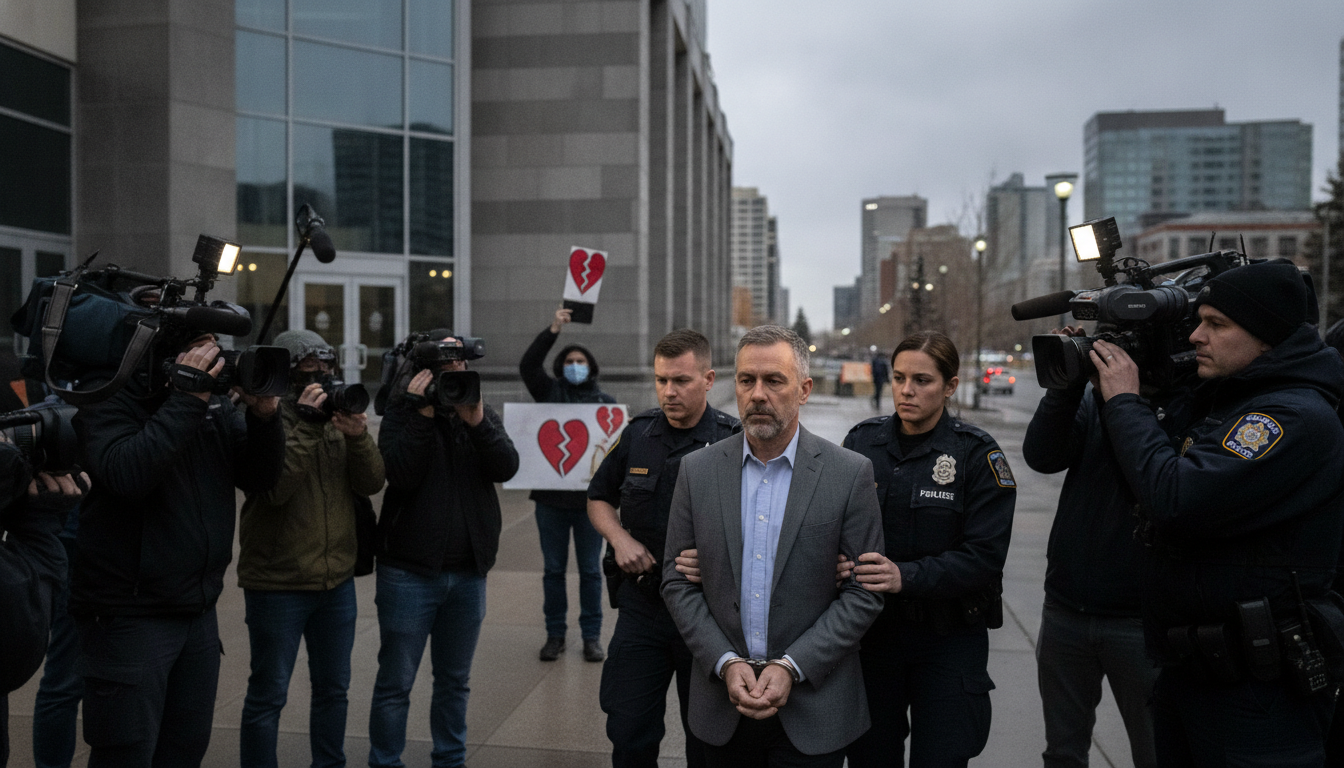
Calgary manslaughter verdict: Court finds Robert Matthews guilty, not murder
A Calgary manslaughter verdict was returned on Tuesday after a judge concluded the Crown had not proven murder in the fatal shooting of Jordan Jacques‑Vetten. The ruling finds 28‑year‑old Robert Matthews criminally responsible for manslaughter in the September 2023 killing but stops short of a murder conviction. Sentencing has been deferred to a later date as the court prepares to determine an appropriate penalty.
Judge rules manslaughter, not murder
Court of King’s Bench Justice Lisa Silver found the Crown did not establish the specific intent necessary for a murder conviction. The judge determined Matthews fired the fatal shot with an intent that amounted to causing bodily harm rather than the higher threshold of intent to kill.
The decision followed a trial in which Matthews admitted to shooting the victim but disputed a charge of second‑degree murder. Defence counsel argued the evidence supported a manslaughter finding and the judge accepted that view after weighing testimony and documentary material.
Justice Silver acknowledged violent aims on the part of Matthews during the night but emphasized the legal distinction between intending to cause harm and intending to cause death. The ruling sets the stage for a sentencing hearing that will consider both the facts of the offence and Matthews’s conduct in custody since his arrest.
Shooting outside Capitol Hill: timeline and context
The shooting occurred in the early hours of September 9, 2023, in Calgary’s Capitol Hill neighbourhood. Matthews and a 17‑year‑old companion were moving through the area after plotting what they described as plans to rob ATMs earlier that night.
Around 4 a.m., the pair encountered 33‑year‑old Jordan Jacques‑Vetten, who had just finished a shift at a downtown restaurant and was carrying his belongings in a backpack. The interaction escalated when Matthews and his companion demanded the bag and Jacques‑Vetten refused to relinquish it.
According to the trial record, Matthews then produced a firearm and shot Jacques‑Vetten, who later died of his injuries. Police located evidence at the scene and subsequent investigative steps led to Matthews’s arrest and prosecution on a second‑degree murder charge that was ultimately downgraded by the judge.
Victim’s background and items taken as evidence
Court testimony painted a picture of Jacques‑Vetten as a man who had recently secured employment and was attempting to stabilize his life. He had been working as a line cook and was walking home with essentials in his backpack when he was confronted.
The backpack contained personal toiletries, identification documents and items the judge described as the victim’s essential belongings. Witnesses noted Jacques‑Vetten carried an ID from a local homeless shelter, underscoring his precarious housing situation at the time of the attack.
Those items formed part of the prosecution’s account of motive, with Crown counsel arguing the accused targeted the victim for his possessions. The judge’s ruling recognized the robbery element of the incident while distinguishing that intent from the mental state required for murder.
Witness evidence and confessions presented at trial
Testimony from several witnesses was central to the Crown’s case, including a young woman who had been in a relationship with Matthews at the time of the shooting. Court documents identified her only by a publication‑protected initial, and she told the court Matthews had admitted to shooting the man because he refused to give up his bag.
The trial record also included a written statement linked to Matthews that investigators recovered in a garbage receptacle at the home of his juvenile companion. The handwritten note described the shooting in admissions that prosecutors relied on to establish Matthews’s role in the killing.
Prosecutors also introduced evidence of remarks Matthews made to the witness in custody, including comments about the seriousness of his situation and references to media coverage. The combination of witness testimony and the recovered written material formed the evidentiary basis for the manslaughter finding.
Youth co‑accused and publication bans in court documents
Matthews’s 17‑year‑old friend, identified only as CD under a court‑ordered publication ban, was convicted of manslaughter in the same matter. The youth received a three‑year sentence under youth sentencing provisions, reflecting the separate legal framework applied to young offenders.
Publication bans protected the identities of multiple young witnesses and the minor co‑accused at trial, constraining public reporting about their personal details. Those restrictions meant the court and parties had to balance transparency about the case with statutory protections for juveniles.
The presence of a juvenile co‑accused added complexity to the proceedings and influenced how certain pieces of evidence were handled. The court carefully navigated those protections while ensuring the jury‑equivalent decision‑making process in the bench trial had access to relevant testimony and exhibits.
Custody conduct and related charges against Matthews
While held in custody awaiting trial, Matthews was found to have committed an assault on a correctional officer using an improvised weapon. He pleaded guilty earlier this year to that incident, which involved a homemade shank, and received an eight‑month sentence to be served in addition to any sentence arising from the manslaughter conviction.
That in‑custody offence was referenced by both Crown and defence as a factor in assessing Matthews’s character and risk profile. Defence counsel argued such incidents reflect the stresses of detention and should be considered in the broader sentencing exercise rather than as determinative aggravating features.
Crown prosecutors flagged the jail assault as an aggravating circumstance they will ask the sentencing judge to weigh when determining an appropriate term. The sentencing hearing will consider the full account of Matthews’s criminal conduct, both the killing and his behaviour while detained.
Next steps: sentencing and community reaction
A sentencing date has not yet been scheduled, and the court will hear submissions from both Crown and defence before imposing a term. Sentencing will address the degree of moral blameworthiness, the harm to the victim and the public interest in denouncing and deterring similar conduct.
Advocates for vulnerable Calgarians and representatives of local shelters have said they will be watching the case closely, citing concerns about violence against homeless people and the need for stronger supports. The case has drawn attention to questions about street safety, services for people experiencing homelessness, and community resources for newly employed individuals seeking stability.
Legal observers note the judge’s decision underscores how Canadian criminal law distinguishes between different mental states required for homicide offences. The upcoming sentencing hearing is expected to probe those distinctions further as the court sets a penalty consonant with the manslaughter finding.
The court found Robert Matthews guilty of manslaughter in the September 2023 killing of Jordan Jacques‑Vetten, deciding the Crown had not proven the requisite intent for murder. A sentencing hearing will determine Matthews’s punishment for the death and consider his subsequent violent conduct while in custody.
