
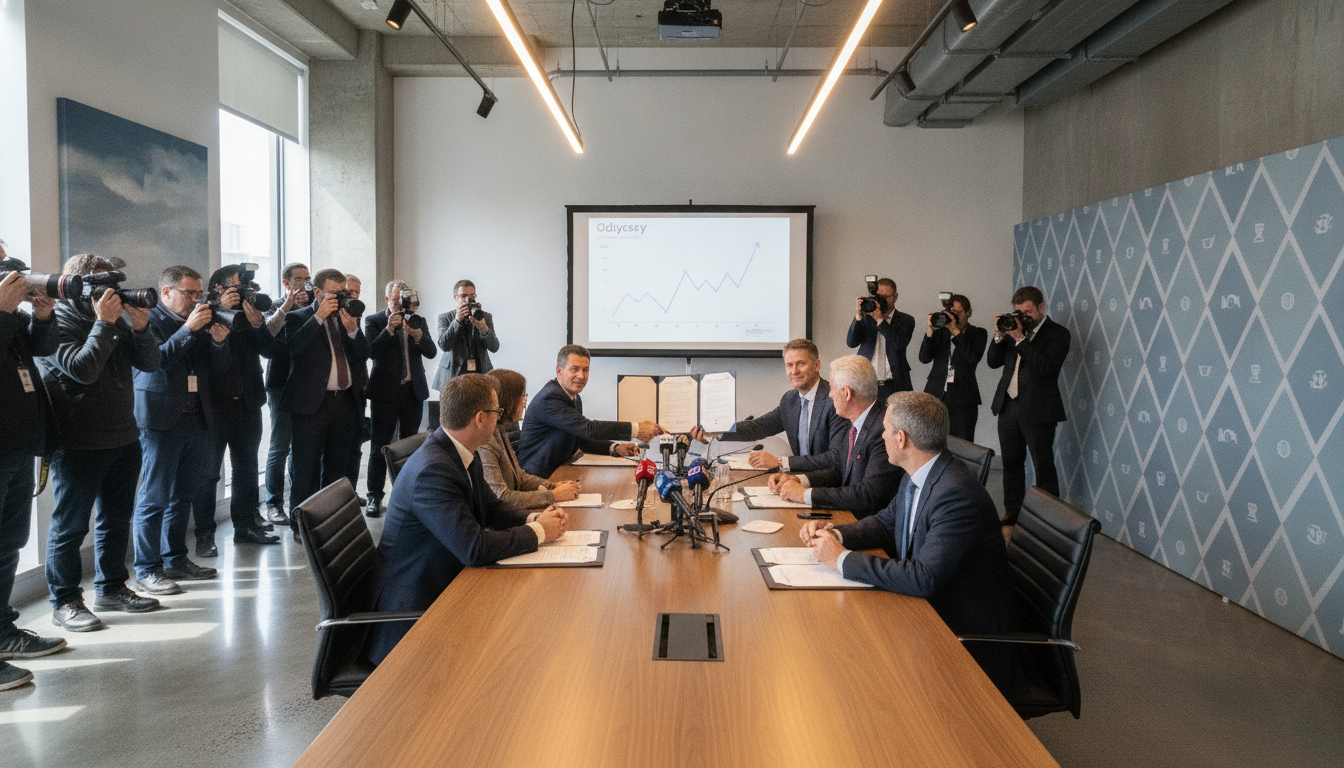
Odyssey world model AI raises $310M Series B at $1.45B valuation
Odyssey world model AI has secured a $310 million Series B round at a $1.45 billion valuation, led by Natural Capital with participation from Amazon, AMD Ventures and GV.
Odyssey world model AI announced a major financing milestone Tuesday, closing a $310 million Series B that values the startup at $1.45 billion. The round was led by Natural Capital and includes strategic participation from Amazon, AMD Ventures and GV, among others. The company said the funding will accelerate development of its physics-driven world models and commercial deployments across gaming and robotics.
Funding and valuation
Odyssey closed the Series B at $310 million, a tranche that pushed the company to unicorn status at a $1.45 billion valuation. Company disclosures indicate the new capital will support model scale-up, productization and expanded data collection efforts.
Including prior rounds, Odyssey has now raised $337 million to date, a total that underscores investor confidence in world-model approaches distinct from text-centric AI. The size and composition of the round also signal strong interest from both traditional venture firms and large cloud and chip players.
Founders’ autonomous-vehicle pedigree
Odyssey was founded in 2023 by CEO Oliver Cameron and CTO Jeff Hawke, both veterans of the self-driving technology sector. Cameron previously co-founded Voyage and later held product leadership at Cruise after that company acquired Voyage, while Hawke worked as an engineer at UK autonomous vehicle firm Wayve.
The founders’ backgrounds shaped Odyssey’s approach to modeling physical environments, borrowing techniques and operational experience from mapping and autonomous navigation. Investors have cited the team’s track record in deploying vehicle-grade perception and control systems as a factor in backing the startup.
Data-collection strategy modeled on mapping
Odyssey’s world models are trained on dense visual and sensor data gathered from real environments, a process the company likens to how large-scale mapping projects assemble imagery. Rather than relying solely on vehicle-mounted systems, Odyssey deployed small teams with wearable cameras to capture diverse viewpoints and human-scale interactions with spaces.
That collection strategy aims to generate richer, more interactive datasets that let models simulate accurate physics and dynamic object behavior. Executives say those data sets are central to producing generative outputs such as interactive video from text prompts, and to powering robotics that must understand and act in the physical world.
World models and product lineup
The startup offers multiple world models tailored to different industries, with use cases spanning video-game creation, virtual production and robotic simulation. Odyssey has become known publicly for producing richly detailed, interactive video driven by textual descriptions, a capability that showcases the company’s emphasis on realism and physical consistency.
Beyond entertainment, Odyssey positions its models as infrastructure for robotics developers who need high-fidelity simulated environments to train manipulation and navigation systems. The company markets its technology as a bridge between generative content tools and real-world automation workflows.
AWS partnership and Trainium optimization
As part of the round, Odyssey named Amazon Web Services its preferred cloud provider and committed to optimizing models for AWS Trainium chips. The shift signals a strategic alignment with Amazon’s compute stack and reflects a competitive stance in the infrastructure layer of AI, where chip choices influence latency, throughput and cost.
Odyssey said the technical work will focus on model kernels and runtime optimizations that exploit Trainium’s architecture, enabling the company to scale inference and training workloads more economically. Executives highlighted that having a preferred cloud partner streamlines deployment for enterprise customers who already run on AWS.
Investor roster and capital runway
The Series B attracted a mix of institutional and strategic investors, including Natural Capital, Amazon, AMD Ventures and GV. The company also counts a roster of high-profile angel backers, among them Jeff Dean, Elad Gil, Garry Tan, Guillermo Rauch and Kyle Vogt, reflecting an investor base familiar with AI and autonomous systems.
With $337 million raised in total, Odyssey plans to allocate funds across product development, data capture, infrastructure and hiring. Management told investors the financing provides a multi‑year runway to commercialize its world models and expand partnerships in media, gaming and robotics.
Odyssey’s latest financing and cloud alignment mark a notable vote of confidence in world models as the next frontier of AI, where simulated physical environments aim to extend generative capabilities beyond text. The company’s combination of mapping-style data collection, autonomous-vehicle experience and strategic partnerships positions it to compete for customers seeking realistic, physics-aware simulations and generative video tooling.
