
Client-choice food bank model expands in Alberta as Fort Saskatchewan and Strathcona adopt grocery-style approach
Alberta food banks in Fort Saskatchewan and Strathcona shift to client-choice grocery models, letting clients pick foods to protect dignity amid rising demand and add community kitchens.
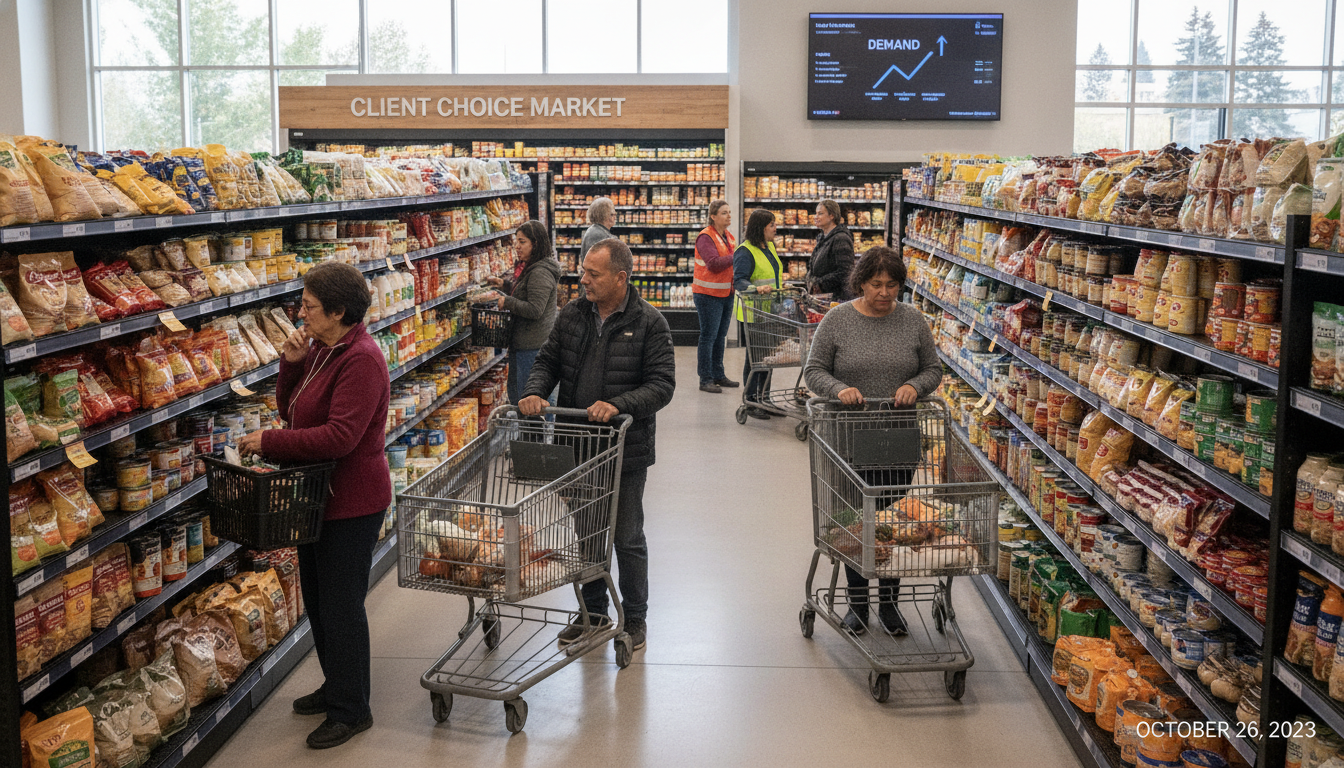
The Fort Saskatchewan Nourishment Centre and the Strathcona Food Bank have moved toward a client-choice food bank model, allowing registered clients to shop for groceries rather than receive pre-packed hampers.
The change comes as local agencies report rising demand and a growing number of first-time visitors who prefer the dignity and flexibility of choosing their own food.
Both organizations maintain registration and portioning by household size, but the new grocery-style setup lets people select most items on shelves, with frozen goods still distributed separately.
Staff and volunteers report immediate, observable shifts in atmosphere: more relaxed interactions, visible smiles, and frequent expressions of gratitude from clients who can now choose foods that suit their preferences and needs.
Fort Saskatchewan adopts grocery-style, client-choice system
The Fort Saskatchewan Nourishment Centre revamped its distribution model after volunteers researched successful client-choice programs elsewhere in Canada.
Under the new approach, clients register in advance and receive an allotment based on household size, then move through a shopping area to select items from stocked shelves.
Frozen and refrigerated products continue to be handed out in pre-sealed portions because the centre has not yet reconfigured freezer access into the shopping space.
Centre leadership says the change was tailored to the facility’s layout and to local demand rather than copying another operation wholesale.
Staff and volunteers at the Nourishment Centre say the new model has changed client experience in measurable ways.
People appear more relaxed and engaged, volunteers report more conversation and connection, and client feedback emphasizes the value of choice in preserving personal dignity.
Strathcona prepares new Nourish Centre with full client-choice services
The Strathcona Food Bank operates a hybrid model now, combining traditional hampers with a shopping-like area where clients can select additional groceries.
That organization is also building a new facility on newly purchased land in Sherwood Park and has rebranded the project as the Nourish Centre to remove stigma associated with the traditional food-bank label.
The campaign driving the construction raised funds through a $5 million capital initiative launched last year, and leaders expect the new space to house a full client-choice grocery area along with a community kitchen and food-literacy programming.
Construction photos show a structural frame rising at the site, and organizers say the planned facility will include space for partners offering wraparound supports.
Executive director Kathryn Howden, who is also a registered dietitian, says the expanded premises are intended to normalize receiving help when it’s needed and to provide services that go beyond emergency food distribution.
Officials expect programming such as cooking classes and nutrition education to complement the grocery model and encourage more effective, long-term food use among clients.
Why client-choice models are growing in Alberta and across Canada
The shift toward client-choice food banks follows a broader reassessment of how emergency food assistance can better meet human needs.
Food Banks Canada reported a record level of use in March 2025, with nearly 2.2 million visits to food banks nationwide, and local operators say demand has increased substantially over recent years.
Service providers and researchers highlight several drivers for the client-choice trend: respect for individual preferences, accommodation of dietary restrictions, improved nutrition outcomes, and a reduction in waste when people receive foods they will actually eat.
Those benefits align with a growing emphasis on rights-based approaches to social services that prioritize dignity and agency.
Researchers at institutions such as the University of Alberta have pointed to client-choice distribution as a way to restore some autonomy for people facing food insecurity.
They note, however, that while distribution models can improve the immediate experience, they do not address the primary driver of food insecurity: inadequate and unstable incomes.
Observed impacts on clients and volunteers
Staff at both Fort Saskatchewan and Strathcona report shifts in atmosphere that go beyond the material value of the food provided.
Volunteers describe more positive exchanges and an environment that feels less clinical, with clients taking time to look at choices, ask questions, and interact with staff.
For many clients, being able to pick a preferred cereal, choose culturally familiar staples, or select items that match dietary needs reduces shame and enhances feelings of control.
These seemingly small choices can have meaningful effects on self-respect during times of financial hardship.
Leaders also emphasize improved efficiency in some respects: when clients take foods they will actually use, the organizations see less spoilage and fewer returns of unwanted items.
That practical benefit can make donated items stretch further and help organizations manage increasingly constrained resources.
Operational challenges, costs and volunteer reliance
Adopting a client-choice food bank model involves logistical changes that can strain small non-profits.
Physical layout adaptations, additional shelving, stock management, and protocols for handling perishables all require planning, time and sometimes new capital investments.
Both the Fort Saskatchewan Nourishment Centre and the Strathcona Food Bank rely heavily on volunteers and community donations, and neither receives ongoing government operating funding to underwrite daily expenses.
That reliance can complicate efforts to maintain regular hours, expand services, or staff community programming tied to the new facilities.
Cold-storage access remains a frequent constraint; for example, Fort Saskatchewan continues to package frozen foods separately because freezers are not yet located inside the shopping area.
Moving refrigeration into client-facing spaces demands investment in equipment and safety protocols, which can be beyond the means of smaller agencies without targeted support.
Fundraising campaigns and capital drives have addressed some infrastructure needs, but operating costs remain recurring and harder to cover.
Food banks often balance immediate purchases of basic staples with solicitations for specific items, and fluctuations in donation patterns can create unpredictable supply challenges.
Policy context and calls for systemic solutions
Experts and local leaders stress that changes in distribution models should not obscure the need for public-policy responses to the root causes of food insecurity.
Academic researchers argue that client-choice food banks improve immediate conditions but are temporary responses to broader problems such as inadequate wages, unaffordable housing and gaps in social supports.
Advocates call on governments to increase income supports, expand affordable housing, and ensure adequate social assistance rates so fewer households require emergency food assistance in the first place.
They say investment in prevention would reduce both the human and economic costs of chronic food-bank reliance.
Local food banks echo the call for structural change while continuing to urge community support for day-to-day operations.
Without sustained public funding, many agencies say they will remain dependent on donations and volunteers to maintain even basic services.
What the new model means for donors and community partners
For donors and community partners, client-choice models change how contributions are collected and used.
Donations of diverse, culturally appropriate items may be more valuable under a shopping model than bulk donations of a single item type.
Food banks also report interest from partners in delivering wraparound services that include nutrition education, employment supports and referrals to social services, leveraging the Nourish Centre’s planned multipurpose spaces.
Community fundraising and volunteer drives remain central to sustaining operations, and leaders encourage local residents to give both time and resources where possible.
Strathcona’s capital campaign and the programming plans for the new centre illustrate how philanthropic support can enable longer-term service improvements beyond immediate food distribution.
Community partners will be able to use shared space in the new facility to reach clients directly and coordinate services, officials say.
That co-location approach aims to reduce barriers to accessing supports by creating a single, welcoming site for multiple forms of help.
The shift toward client-choice food banks in Alberta reflects growing awareness that how food is delivered matters as much as how much is provided.
Organizations making the change report tangible benefits in client well-being, reduced waste and stronger community engagement.
The rise in food-bank visits nationwide underscores the urgency of both improving emergency responses and pursuing policies that reduce the need for charity.
Local leaders and researchers alike caution that while client-choice models are an important improvement, they are not a substitute for measures that address income security and affordability at scale.
Community members are being asked to support these transitions through donations, volunteering and advocacy for broader social-policy change.
Both the Fort Saskatchewan Nourishment Centre and the Strathcona Food Bank say that continued local support will be essential as they expand services and open new facilities that combine grocery-style access with food literacy and community programming.
Longer-term change will require coordinated action from governments, non-profits and community stakeholders to ensure that fewer families must rely on emergency food assistance.
In the meantime, client-choice food bank models offer a tangible, dignity-focused improvement to how communities respond to immediate food needs.
