
Calgary police shooting anniversary marked by Memorial Drive walk as family seeks answers
On the Calgary police shooting anniversary, families led a Memorial Drive walk to honour the dead and press for answers, cultural change and police reform.
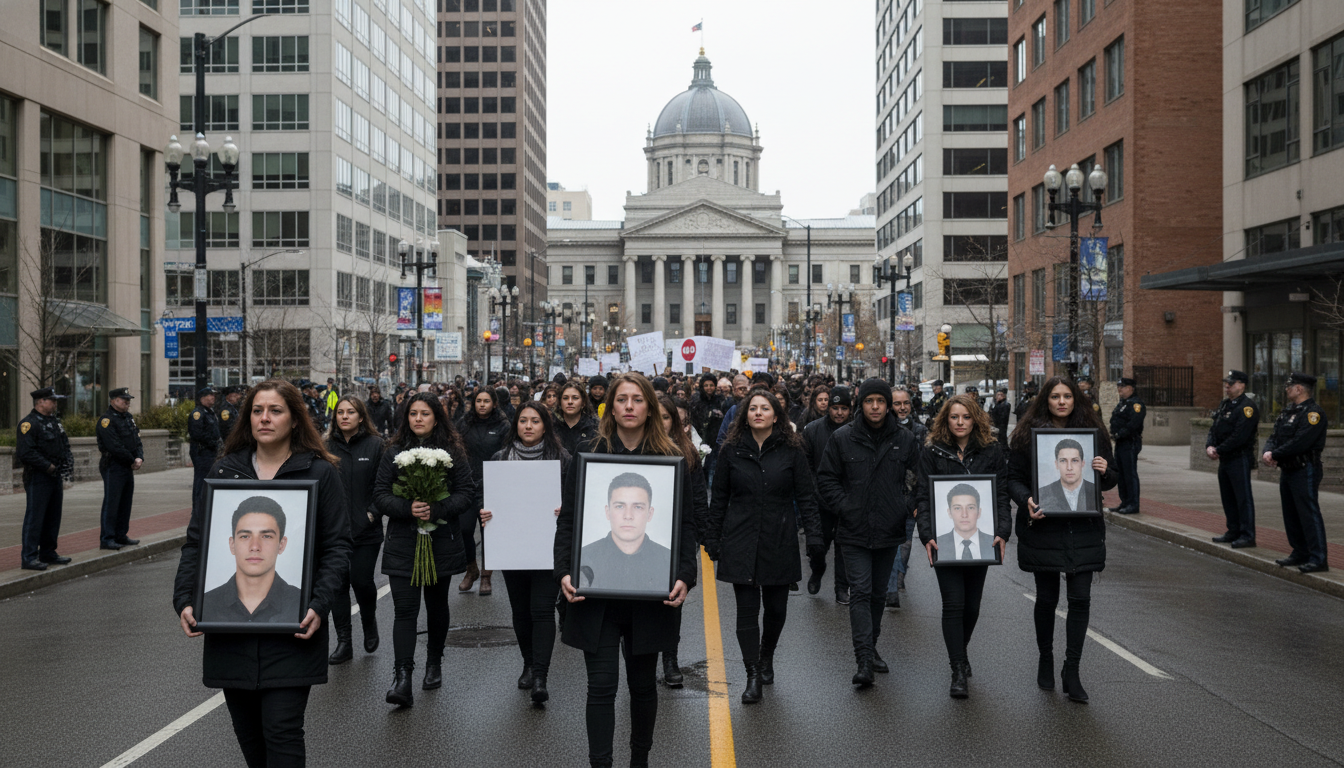
For the third year running, family members and supporters halted traffic on Memorial Drive on Friday to mark the Calgary police shooting anniversary and to walk together to the exact site where the May 29, 2023 incident left two people dead. The gathering brought relatives, friends and community members who described the event as both a memorial and a call for accountability from law enforcement. Organizers said the walk was intended to remember those who died and to demand clearer answers on the circumstances that led to the use of lethal force.
Family-led walk pauses on Memorial Drive three years after shooting
A group of mourners began their walk from a parking lot along Memorial Drive and moved slowly toward the location where the confrontation occurred in 2023. Participants wore shirts and carried photographs and flowers, and they stopped at the roadside to speak quietly and to place tokens of remembrance at the scene. The gathering was solemn and orderly, reflecting a family-led effort to reclaim the public space where their loved ones died.
Relatives described the walk as a ritual of remembrance that has become an annual point of focus since the deaths. They said the march serves to keep public attention on unresolved questions and to offer support to those who survived the shooting. For many attendees, the walk is both personal mourning and civic action.
Organizers said they want the public and the Calgary Police Service to see the human faces behind media reports and legal filings. Family members emphasized that the walk is about more than a single day: it is part of ongoing efforts to pursue legal accountability and to press for institutional change. The memory of those lost, they said, must be carried forward in both grief and reform.
Details of the May 29, 2023 low-speed pursuit and shootings
Police reports and family accounts describe a low-speed pursuit on May 29, 2023 involving a stolen vehicle with three occupants. Officials said the dynamics of the stop “rapidly changed,” and an officer fired at the vehicle, killing the driver, identified as 46-year-old Wesley Davidson, and one passenger, 39-year-old Levon Boyce Fox. The third occupant, Fox’s brother Dennis Wildman, survived but has since reported ongoing mental and emotional trauma.
Family members have publicly remembered Levon Fox as someone who had recently become a grandfather and who was working to address addiction and rebuild his life. Relatives said his role in the family and his efforts toward recovery were central to how they want him remembered, and they wore shirts and carried images that reflected that personal history. The human details underline the toll the incident has taken beyond the immediate physical loss.
Law-enforcement accounts have described the event as an escalated confrontation that required use of force, while family representatives have raised questions about the necessity and proportionality of the officer’s response. Both sets of accounts form the core factual contours that the upcoming legal process and public scrutiny will examine in greater detail. The competing narratives have shaped public debate in Calgary and beyond.
Charges, ASIRT probe and court dates now scheduled in 2026
Following an investigation by the Alberta Serious Incident Response Team (ASIRT), the officer involved, Const. Craig Stothard, was charged with two counts of second-degree murder. The charges reflect ASIRT’s assessment that the circumstances warranted criminal charges and transfer the matter into the provincial court system. The formal charging marked a major development that shifted the focus from administrative review to criminal accountability.
A preliminary hearing has been scheduled for August 2026, according to family members who said they plan to attend each day of the proceedings. That hearing will determine whether sufficient evidence exists to proceed to a trial, and it will give both prosecution and defence the opportunity to present key materials for judicial consideration. Family representatives said they have been preparing for court by reviewing witness statements and surveillance footage.
In the months since the charges were laid, legal counsel and community advocates have signalled that the case will raise significant questions about police tactics, training, and threat assessment. The criminal process will proceed within established courtroom procedures, and any eventual trial will turn on the admissible evidence and legal arguments presented. Observers expect that the proceedings will be closely watched by both local residents and civil-rights organizations.
Family concerns about cultural bias and police threat assessment
Relatives of the deceased have raised concerns that race and cultural bias may have influenced how officers assessed the situation and responded on the day of the shooting. Family members pointed to the Indigenous identity of the passengers as a factor they believe contributed to differential treatment, and they urged the Calgary Police Service to revisit its threat-assessment protocols. Those concerns reflect broader anxieties in many communities about disparate policing outcomes for Indigenous and racialized people.
The family said they have been watching video evidence of the incident and remain troubled by the number of rounds fired and by what they describe as an exaggerated response to a low-speed stop. They cited the volume of shots and the rapid escalation as central grievances they want addressed in court and through policy review. Advocates for the family have called for a transparent review of use-of-force guidelines and for better cultural awareness training within the service.
Calls for change included specific demands: that threat-assessment procedures be updated, that cultural-competency training be mandatory and ongoing, and that community-based approaches be pursued to reduce the risk of fatal encounters. Family members emphasized that their requests are practical and aimed at preventing future deaths, rather than simply punitive. They urged municipal and police leadership to engage with Indigenous communities to rebuild trust.
The family’s concerns have resonated with local Indigenous leaders and with advocacy groups who say the incident underscores systemic issues of bias and disproportionate harm. These groups pointed to statistical disparities and historical patterns to argue for structural reforms in policing. The incident has therefore become part of a larger conversation about public safety, equity and how law enforcement interacts with vulnerable populations.
Community reaction and memorial practices along Memorial Drive
Local neighbourhoods responded to the walk with a mix of quiet solidarity and attention to public safety and traffic management. Residents and passersby paused to watch or to offer words of condolence, while city services coordinated to ensure the walk could proceed without incident. Observers described the scene as respectful, with participants determined to mark the anniversary without inflaming tensions.
Memorial practices at the site have included placing flowers, photographs and handwritten messages along the roadside and at nearby green spaces. Those items have become a focal point for family remembrance and community reflection, and they often gather new tokens of support after each anniversary. Organizers said these visible acts of mourning help keep the conversation alive in the public sphere.
Local faith leaders and cultural supporters attended in small numbers to provide prayers and words of comfort, and several community organizations offered resources for grief counselling to those in attendance. The mosaic of civic actors at the walk illustrated the cross-section of people impacted by the event, from immediate family to neighbours and advocacy groups. For many, the public memorial is a way to transform personal grief into communal memory.
News coverage of the walk reiterated the family’s call for answers while also documenting the ongoing legal process and police statements. Some commentators framed the event as emblematic of broader tensions between law enforcement and Indigenous communities in Alberta, while others emphasized the need for due process in the courts. The public reaction has thus combined elements of mourning, political pressure and procedural scrutiny.
What the preliminary hearing could reveal and next steps
Legal experts say the preliminary hearing scheduled for August 2026 will be a technical but important milestone that can determine whether the case proceeds to trial. That hearing will focus on whether the Crown’s evidence is sufficient to justify a trial and may include witness testimony, expert reports, and other admissible materials. Observers noted that much of the substantive debate about police conduct will ultimately be resolved in a trial setting, should one be ordered.
Family members and their legal representatives expect to raise questions about the sequence of events, the decision-making of officers on scene, and the adequacy of threat assessment procedures. Defence counsel may present evidence intended to justify the use of force under existing legal standards for police action, setting up a contested factual landscape for the judge to evaluate. The outcomes of pre-trial motions and evidentiary rulings will shape what jurors, if a jury is empanelled, will ultimately hear.
Beyond the criminal process, the family continues to press for administrative and policy changes within the Calgary Police Service, including enhanced cultural training and revised approaches to dealing with stolen-vehicle pursuits. Civic leaders and police governance bodies may consider internal reviews or independent recommendations depending on the evidence and public pressure. Community advocates said they will use the forthcoming court schedule to maintain public attention on reform agendas.
Municipal officials and police representatives have not publicly announced specific policy shifts tied directly to this case while criminal proceedings remain active, citing the need to avoid prejudicing the legal process. Still, the public discussion surrounding the shooting and the anniversary walk has intensified questions about how local law enforcement balances officer safety, public safety and proportionality. The family’s annual observance appears likely to remain a rallying point for those seeking change.
The three-year memorial walk on Memorial Drive reflected both personal grief and a continuing quest for accountability and reform. Family members said they will keep attending court and will maintain public vigils until they feel the questions about that day have been fully addressed. As legal timelines unfold, the community will be watching how the justice system and civic leaders respond to those demands.
The anniversary underscored the human impact of a single event and the long shadow it casts over family, community and policing practices. Relatives and supporters continue to press for answers and for concrete changes aimed at preventing similar tragedies in the future.
