
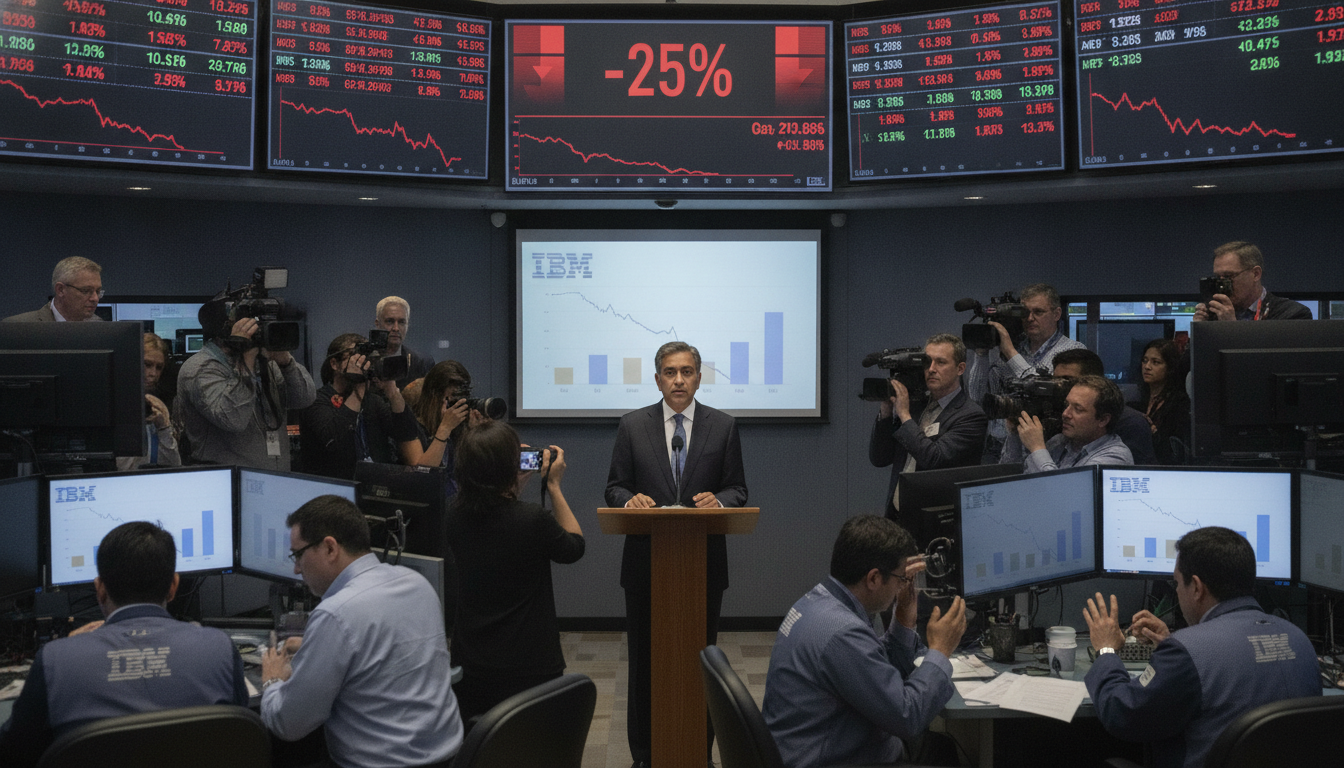
IBM earnings disappoint as mainframe sales plunge 42% and stock tumbles
IBM earnings miss expectations as mainframe sales fall 42%, revenue $17.2B and stock plunges 25%; company cuts full-year guidance and vows recovery. Q2 update.
IBM reported weaker-than-expected second-quarter results that sank its shares and forced management to revise annual guidance, with the decline centered on a sharp drop in mainframe hardware revenue. The company posted $17.2 billion in revenue, $9.9 billion in gross profit and roughly 58 percent gross margins, while net income for the quarter was about $2.2 billion. Despite the solid cash flow metrics, results fell short of Street estimates and triggered a dramatic market reaction that erased a year of gains under CEO Arvind Krishna.
Quarterly figures and market reaction
The headline numbers masked the problem: revenue and profit were undermined by a collapse in the infrastructure segment, driven almost entirely by lower mainframe hardware sales. Investors reacted quickly after management provided preliminary figures in a preannouncement, sending IBM stock down about 25 percent in the largest single-day drop in the company’s history. The scale of the sell-off reflected two concerns at once — the magnitude of the miss and the potential for a multi-quarter earnings impact.
Mainframe hardware slump and revenue mix
Mainframe hardware sales fell roughly 42 percent year over year, creating a steep revenue gap because IBM earns substantial recurring income tied to those systems. On average, the company collects roughly three dollars of software revenue for every dollar of mainframe hardware sold, a dynamic that magnifies hardware weakness into downstream software and services pressure. The drop in mainframe shipments therefore reduced near-term software attach rates and hit overall revenue growth despite healthy margin metrics elsewhere.
Preannouncement from CEO Arvind Krishna
Management took the unusual step of alerting investors to troubling preliminary results in a letter dated July 14, 2026, effectively preparing the market for a worse-than-expected quarter. That preannouncement signaled not only a revenue miss but also margin compression in the infrastructure business, prompting some investors to reassess the sustainability of IBM’s recent performance. The disclosure was intended to manage expectations but instead accelerated selling as traders priced the new risk into the stock.
Customer delays and AI-driven hardware price pressure
Company executives said the primary cause was a set of customers that deferred planned mainframe purchases during the quarter, opting instead to spend on other data center equipment after confronting steep supply-driven cost increases. Hardware suppliers across the industry have warned that memory and component shortages tied to the AI hardware build-out have pushed prices up as much as 15 to 30 percent in some categories. Faced with those spikes, enterprise buyers reallocated limited budgets to immediate needs, leaving costly mainframe refreshes on hold.
Guidance cut and wider financial implications
In response to the shortfall, IBM lowered its full-year growth forecast, signaling that the Q2 weakness will weigh on results for the remainder of the year. Management characterized the revision as a timing issue — that customers would eventually complete mainframe purchases and renew associated software contracts — but the guidance change acknowledged the measurable hit to near-term revenue growth. Analysts will now scrutinize future quarters for signs of recovery in mainframe order flow and for confirmation that software and service attach rates rebound as hardware demand normalizes.
Management outlook and investor reassurance
CEO Arvind Krishna and CFO Jim Kavanaugh emphasized on the earnings call that the company views the slowdown as temporary and tied to a small number of deferred orders rather than a structural shift away from the mainframe platform. They noted that some clients resumed purchases in the weeks following the quarter and that long-term demand drivers for integrated systems and legacy workload consolidation remain intact. Still, management faces the task of translating that confidence into measurable revenue recovery while restoring investor trust after an unusually blunt preannouncement and a dramatic stock decline.
IBM earnings now enter a period of heightened scrutiny as investors and customers watch whether delayed orders return and whether pricing dynamics in the broader data center market ease. The mainframe business remains central to IBM’s ecosystem because of the high-margin software and services it generates, making any sustained weakness there consequential for growth and profitability. Companies in the sector are monitoring component supply and pricing closely, since the ripple effects from AI infrastructure demand have already altered procurement priorities at large enterprises.
The coming quarters will test whether IBM can convert management’s assurances into improved book-to-bill metrics and whether the company’s software-rich model cushions the blow from episodic hardware volatility.
