
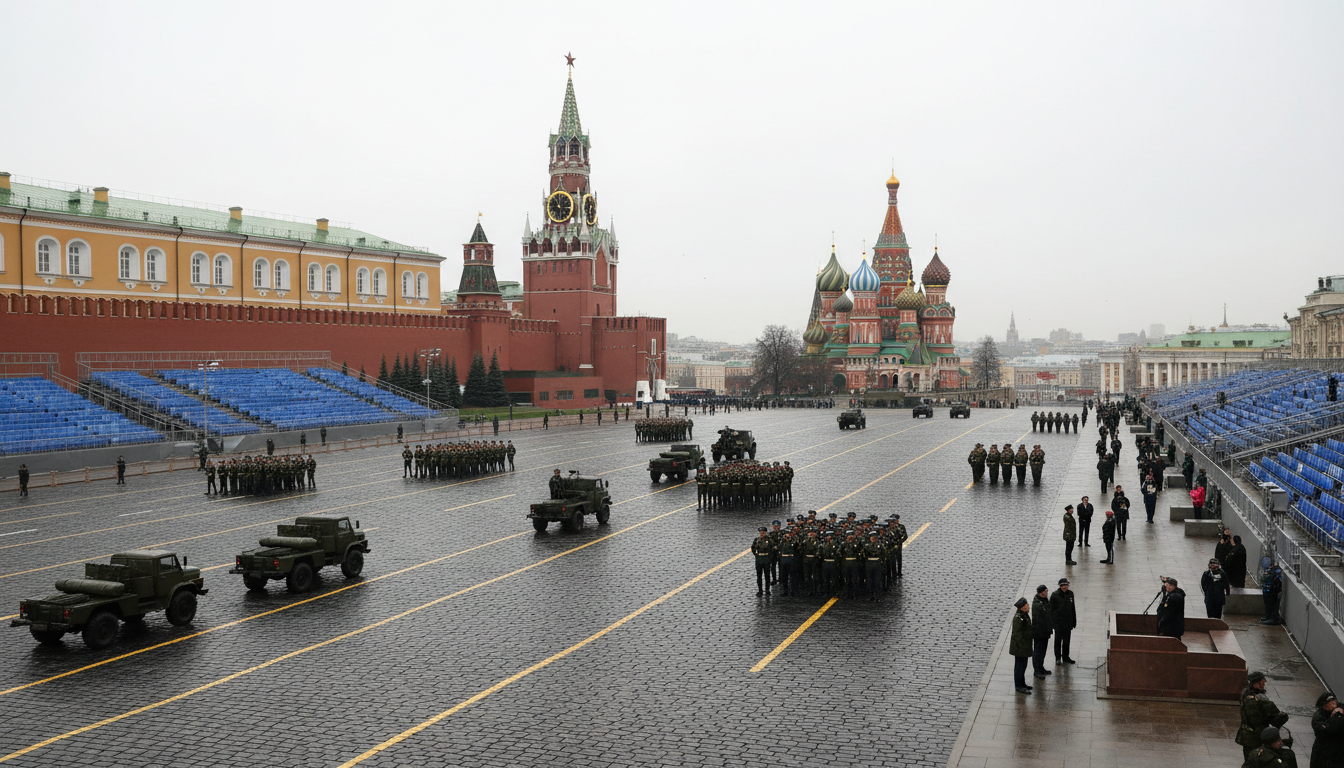
Russia Holds Scaled-Down Victory Day Parade in Moscow Amid Fears of Ukrainian Strike
Russia staged a scaled-down Victory Day parade in Red Square on May 9, 2026, shown on state television amid reported fears of a Ukrainian strike and tightened security measures.
Putin Marks Victory Day with Scaled-Down Parade
President Vladimir Putin attended a shorter Victory Day event in Red Square on Saturday as Russia commemorated the 81st anniversary of the end of World War II in Europe. The ceremony, broadcast by Russian state television, appeared reduced in length and scope compared with previous years, reflecting an altered public profile for the holiday. Officials framed the gathering as a solemn commemoration while simultaneously underscoring national resolve.
Russian State Media Broadcasts Reduced Ceremony
State-run channels led the coverage of the Moscow event, presenting edited footage and commentary that emphasized tradition and continuity. Broadcasters showed marching units and veterans, but the runtime and the number of formations visible were noticeably smaller than in typical parades from prior years. Coverage concentrated on symbolic elements of the commemoration rather than an extended military showcase.
Security Fears Prompt Military Retrenchment
Officials and analysts linked the scaled-down parade to heightened security concerns, including reported fears of a strike targeting central Moscow. Organizers appeared to limit the size of the public spectacle and to curtail some usual elements to reduce potential exposure. Local authorities increased checkpoints and restrictions in the city centre for the day, citing the need to protect both participants and civilians.
Parade Composition and Visible Changes
Observers noted fewer massed formations and a tighter schedule compared with traditional Victory Day displays, with more emphasis on veterans and ceremonial units. There was less time devoted to extended military columns and prolonged aerial segments, according to footage and eyewitness descriptions. The visual focus on uniformed servicemen and historical banners suggested a deliberate calibration of the event’s tone.
Kremlin Messaging and Domestic Framing
The Kremlin portrayed the parade as an essential tribute to wartime sacrifice while avoiding grandiose military pageantry that could heighten security risks. State commentary stressed unity and remembrance, linking the commemoration to national resilience without amplifying the display of contemporary combat capabilities. For domestic audiences, officials appeared intent on preserving the ritual significance of Victory Day while managing public safety.
International Reactions and Regional Tensions
The decision to hold a reduced public ceremony drew attention from foreign capitals monitoring the conflict in Ukraine and regional security dynamics. Western and regional observers interpreted the changes as reflective of Moscow’s concern over potential escalatory responses or tactical operations that might extend beyond frontline areas. Analysts cautioned that symbolic shifts in public ceremonies can signal broader operational and psychological adjustments amid ongoing hostilities.
Analysts Flag Operational and Symbolic Implications
Security analysts said altering the parade may be both practical and symbolic: a safety measure and a message about vulnerability and caution. Some experts suggested the move could indicate an increased threat environment in the capital, while others tied it to a desire to avoid providing attention to military hardware that could prompt targeted strikes. Commentators also noted that public rituals such as Victory Day serve strategic communications roles and that their modulation is often intentional.
The scaled-down parade in Moscow on May 9 reflects a balancing act between honoring long-standing national traditions and adapting to present security realities. As the conflict in Ukraine persists, public ceremonies and state broadcasting choices are likely to remain barometers of both risk assessment and political messaging.
