
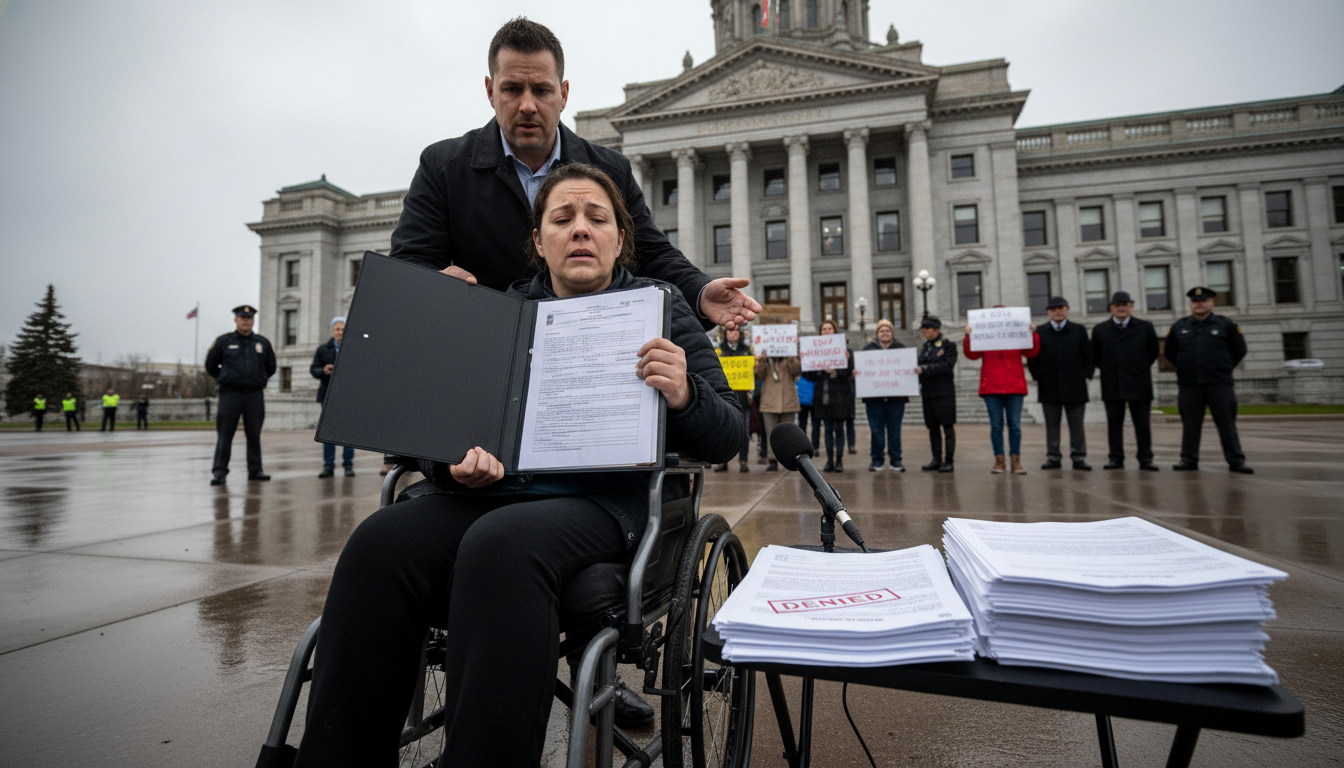
Alberta mother denied out-of-country health funding after vertical imaging gap leaves her bedridden
Tamara Polo, 34, says Alberta’s out-of-country health funding rules blocked the diagnosis she needed, leaving her confined to bed while specialists abroad recommend complex spinal reconstruction.
A Calgary-area mother who suffered catastrophic neck injuries in a 2023 parking-lot collision remains largely confined to bed after her requests for financial support to seek further care abroad were refused by Alberta’s Out of Country Health Services Committee. Polo’s case highlights a technological gap in Canadian diagnostics — namely the lack of upright, or vertical, spinal imaging — that specialists overseas used to confirm a diagnosis and recommend major reconstructive surgery. Her application and subsequent appeal for provincial funding were denied on the basis that an in-province diagnosis was not available, a decision that patients and advocates say exposes structural limits in the out-of-country funding process.
Alberta woman left bedridden after parking-lot accident
Tamara Polo was an active professional and mother of three before a September 2023 collision changed her daily life. She describes near-constant incapacitation when she is upright, with severe nausea and neurological symptoms that force her to lie down for most of the day. Medical consultations abroad concluded she has extensive cervical spine damage that Canadian clinicians were unable to visualize under load.
Polo underwent an initial stabilizing surgery to secure the base of her skull and the top of her neck, but overseas specialists say her injury requires a far more extensive reconstruction. The recommended procedure would extend instrumentation from the skull down into the upper thoracic spine with rods and screws to restore alignment and prevent pathological motion. Without that reconstruction, her doctors and loved ones say she will likely continue to experience profound disability that limits caregiving, work and basic daily activities.
Diagnosis hinges on vertical imaging unavailable in Canada
International neurosurgeons relied on upright spinal imaging to see how Polo’s cervical vertebrae move under the natural force of gravity and the weight of the head. That form of imaging, often performed with a specialized radiographic setup that images patients standing or seated, revealed instability that supine scans missed. Polo and her medical team say that ability to image the spine in a loaded position was essential to establishing the working diagnosis of cervical instability.
Canadian clinicians consulted by Polo reportedly could not produce an equivalent in-country diagnosis because the vertical imaging technology is not broadly available in Alberta. The provincial funding rules require that an eligible out-of-country application be supported by in-country diagnostic evidence when the committee evaluates whether a particular treatment is medically necessary and not available provincially. Patients whose conditions can only be documented using technologies or techniques not offered locally therefore face a procedural catch-22: a diagnosis is needed to get funding to access the diagnostic modality abroad, but the modality is required to make the diagnosis.
Appeal denied by Out of Country Health Services Committee
Polo applied to the Out of Country Health Services Committee for financial support to travel for the reconstructive surgery recommended by foreign specialists. The committee denied her application and rejected her appeal, citing the lack of an in-province diagnosis that meets its eligibility criteria. Those determinations effectively leave patients like Polo to cover the full cost of care outside Alberta or to pursue private fundraising.
Polo organized crowdfunding and sought private financial support to pursue the operation she and her doctors say is medically necessary. Supporters argue the denial reflects a rigid interpretation of rules designed decades ago, before many modern imaging and surgical techniques became part of standard practice in other jurisdictions. The committee’s role, as currently structured, is to determine whether an insured service is not available in the province and whether out-of-country treatment is the most appropriate option — a task that depends heavily on the quality and type of in-province diagnostic material presented.
Families report similar barriers to OOCHSC assistance
Other Alberta families have shared comparable difficulties in obtaining OOCHSC approval, reporting that restrictive eligibility criteria and administrative hurdles can delay or prevent access to specialized care. One cited case involves a toddler with a rare vascular condition whose parents say they were denied funding for out-of-country treatment. Those families say they are left fundraising, advocating publicly, and navigating complex appeals at the same time as they manage urgent medical needs.
Advocates describe a pattern in which the procedural requirement for an in-province diagnosis becomes a barrier when the relevant diagnostic technology or specialized expertise is limited within the province. For rare or complex conditions, patients and families contend that the committee’s criteria do not account for advances in imaging and treatment that exist outside Alberta. As a result, families must often shoulder financial and emotional burdens that health-care insurance is intended to mitigate.
Policy experts call for review of program criteria
Health policy analysts say the committee adheres to its legislated mandate but that the rules governing out-of-country funding were designed in a very different clinical landscape. Myles Leslie of the University of Calgary’s School of Public Policy cautions that committee members will interpret and apply guidelines narrowly without policy direction to broaden their scope. He argues that meaningful change requires the provincial government to update the program’s rules to reflect contemporary medical practice and technology.
Experts point out that universal health coverage necessarily involves trade-offs about what is funded publicly and what remains outside the guaranteed basket of services. Nonetheless, they say regulators should ensure criteria do not create avoidable barriers for patients with legitimately demonstrable needs that cannot be documented using equipment or protocols unavailable locally. Updating eligibility rules to anticipate technological evolution, including diagnostic modalities such as upright imaging, would reduce the risk of patients falling through administrative cracks.
Province launches review but patients wait for decisions
The Ministry of Primary and Preventative Health Services has acknowledged the difficulty families face when treatments and diagnostic tools evolve beyond the regulatory framework established nearly two decades ago. Officials say they have launched a review of the out-of-country health services process to evaluate whether changes are needed to better reflect advances in care and to meet Albertans’ needs. That review, the ministry states, aims to assess program design and whether existing criteria remain fit for purpose.
Despite the announcement, patients affected by current decisions face ongoing, immediate consequences while the review proceeds. Polo and other families say they cannot wait for a policy overhaul and are pressing for interim solutions that would allow timely access to care when clinically indicated. Ministry spokespeople emphasize the review’s intent to balance patient access with stewardship of public funds, pointing to the need for careful, evidence-based changes rather than rapid ad hoc adjustments.
Patients and clinicians urge practical fixes now
Clinicians who treat complex spinal and vascular conditions argue that practical interim measures could reduce harm while the province completes its review. These measures may include temporary exceptions, expedited case reviews for conditions demonstrably dependent on unavailable diagnostics, and clearer guidance on what constitutes adequate in-province evidence. Health-care providers say clearer pathways and faster decisions would lessen the financial and psychological strain on families compelled to seek care outside Alberta.
Patient advocates propose a straightforward alternative: permit diagnostic findings from accredited international centres to inform committee decisions when equivalent domestic tests are not possible. They argue such a policy would prevent the paradox of denying funding because a provincial test—one that cannot be performed locally—was not completed. Implementing these fixes would require policy direction from the ministry but would not necessarily change the overall scope of what is publicly funded.
Financial and emotional toll on families
The out-of-country funding refusals leave some families facing a stark choice between raising substantial private funds for recommended treatments and foregoing care that specialists abroad deem necessary. For parents caring for young children, the stakes include lost income, mounting household stress, and the time required to manage campaigns and appeals. Polo says she spends most of each day in bed and misses the normal rhythms of parenting, describing the experience as an erosion of her ability to be present for her children.
Support systems have sprung up in response, including community fundraisers and social media advocacy that aim to bridge the financial gap for affected families. While these efforts can produce life-changing amounts for individual patients, advocates caution that relying on charity is neither equitable nor sustainable as a public policy solution. Public coverage for care that is clinically indicated and unavailable locally remains, they say, the more just and predictable approach.
The ministry has committed to completing its review and to engaging stakeholders, including clinicians and patient representatives, as it considers updates to the OOCHSC framework. In the meantime, patients like Tamara Polo continue to pursue appeals, private options and community support to secure the treatment their foreign specialists recommend. She and other families are calling on provincial leaders to align funding rules with modern diagnostics and to prevent administrative criteria from determining who receives potentially restorative care.
For Polo, the practical urgency is personal: she wants to be able to participate actively in her children’s lives again and to return to the work she once did with energy and stability. Her case underscores a broader policy question facing provinces across Canada about how to adapt long-standing funding mechanisms to a rapidly changing clinical environment. Families and experts say that resolving that question will require both immediate, compassionate fixes for current cases and longer-term structural reforms that anticipate future medical advances.
