
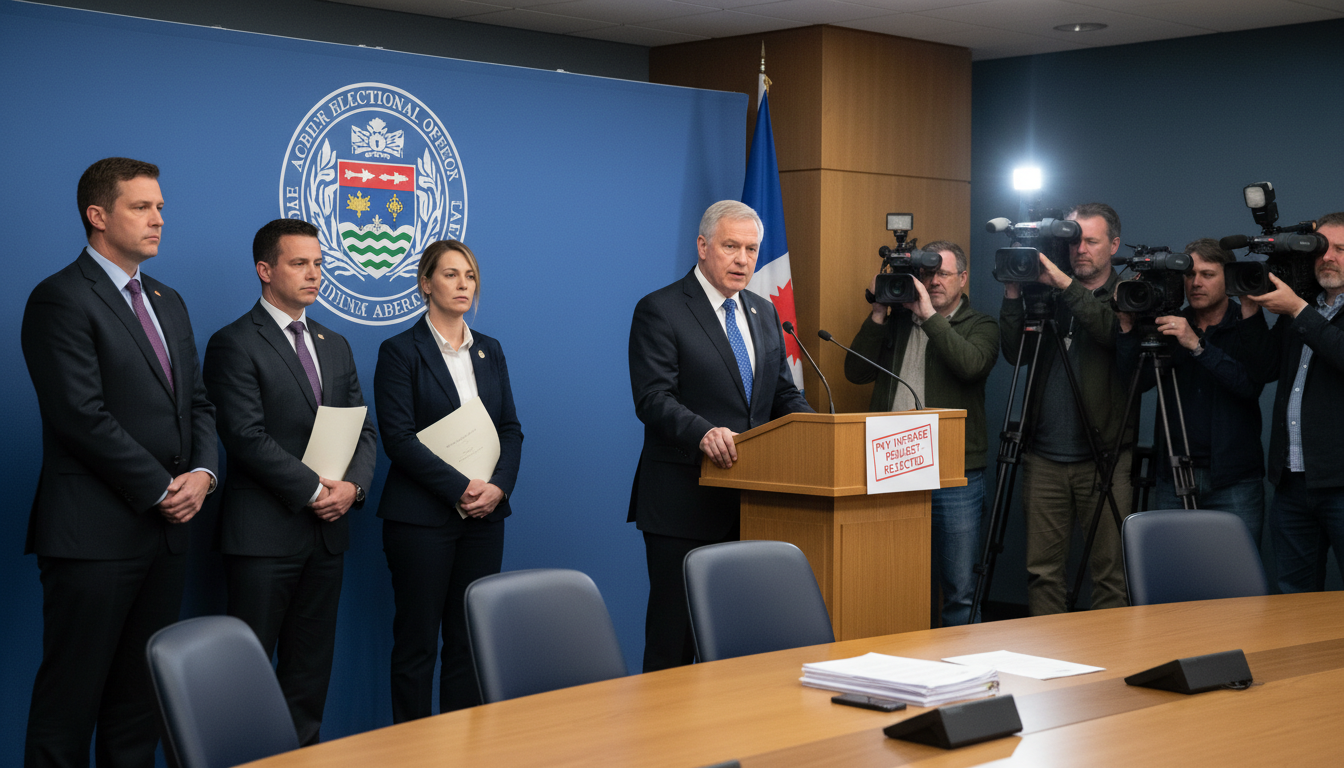
Alberta committee rejects pay raise for Elections Alberta chief; office cites “unprecedented” workload
Alberta chief electoral officer salary request denied after Gordon McClure sought a 3% increase citing an unprecedented workload linked to recall petitions, legislative changes and referendum preparations.
The legislature committee voted down a modest pay bump for Elections Alberta’s head, keeping the spotlight on the office’s workload and resourcing as it prepares for an Oct. 19 referendum and next year’s provincial election while managing multiple investigations.
Chief electoral officer Gordon McClure told the committee he has overseen more than two dozen recall petitions and citizen-initiated referendum drives since taking the job in 2024, and described the cumulative demands as “unprecedented.”
McClure had asked for a three per cent adjustment to his pay on top of the standard small increase he will receive this year, but the request failed along party lines after opposition members supported it and the governing party’s committee majority opposed it.
Public sector disclosures show McClure’s base pay in 2024 was just over $138,000, with nearly $33,000 reported in additional benefits, and witnesses at the committee noted that even with the extra three per cent he would still earn less than his predecessor.
Committee votes down pay request
Committee members debated the three per cent request during a sitting that drew attention to the breadth of Elections Alberta’s recent responsibilities.
Members of the legislative committee voted along party lines, with New Democratic Party members backing McClure’s request and United Conservative Party members forming the majority that rejected it.
The decision leaves the chief electoral officer with only the small, routine salary adjustment already scheduled for the year, rather than the supplemental increase he sought to acknowledge the intensified workload.
Committee chairs and legal advisers framed the matter as a governance and budgetary decision, emphasizing oversight responsibilities while acknowledging the pressures on the office.
McClure outlines scope of workload
In testimony to the committee, McClure detailed the concurrent operational demands his office has faced since his appointment in 2024.
He cited facilitation of more than two dozen recall petitions and citizen-initiated referendum drives, a stream of legislative changes that required adaptation by his team, and the need to prepare for a province-wide referendum slated for Oct. 19.
McClure also pointed to active investigations that have required dedicated staff time and legal resources, and said the concentration of those responsibilities in a short period exceeded normal expectations for the office.
While acknowledging that much of the work falls inside his official job description, he argued the volume and simultaneity of tasks were exceptional.
Volume and types of citizen initiatives
Committee testimony and Elections Alberta background note show a recent spike in citizen-led political initiatives, including recalls and referendum petitions.
Those processes require significant administrative work: validating petition signatures, ensuring compliance with election law, issuing procedural guidance, and sometimes responding to legal challenges.
Elections Alberta must also balance responsiveness to petitioners with safeguards that protect electoral integrity and privacy, which can add complexity when multiple initiatives overlap.
Officials said managing dozens of such efforts while applying new legislative rules is both time-consuming and resource-intensive.
Compensation figures and precedent
Public disclosures filed for 2024 list McClure’s annual salary at just above $138,000, with an additional nearly $33,000 recorded as benefits and allowances.
Committee evidence noted that at the time of his hiring McClure took on the role at 75 per cent of the previous chief electoral officer’s salary, a fact that has influenced comparisons between current and past compensation.
Even with the extra three per cent he requested, officials said McClure’s pay would remain below that of his predecessor, a point highlighted by those supporting the increase as a rationale for modest adjustment.
Opponents of the request emphasized fiscal restraint and the precedent a supplemental increase could set for executive compensation in oversight bodies.
Political split and accountability debate
The pay decision exposed a clear political split in the legislature committee between the governing United Conservative Party and the opposition NDP.
Opposition members argued a small increase was warranted given the added responsibilities and the need to retain experienced leadership during a busy electoral period.
Government-aligned members countered that compensation decisions should be conservative and in keeping with broader public sector policies, and that existing pay structures and incremental increases were appropriate.
Both sides framed their positions as matters of accountability: the opposition pointing to effective resourcing, and the government pointing to fiscal stewardship.
Operational pressures ahead for Elections Alberta
Beyond the dispute over pay, committee discussions highlighted imminent operational pressures for Elections Alberta as it prepares for a high-profile referendum and the next provincial election.
Planning for a province-wide referendum includes logistical coordination, public information campaigns, ballot design and security measures, and arrangements for a possible surge in public enquiries and legal reviews.
Election readiness work also involves updating voter registries, training staff and returning officers, and ensuring procedures align with any legislative changes enacted since 2024.
Officials warned that overlapping timelines for petitions, investigations and referendum preparations increase the risk of staff burnout and operational strain.
The committee heard that McClure’s office has been issuing guidance and notices to manage competing responsibilities while maintaining statutory neutrality and adherence to electoral law.
Elections administrators must follow strict rules to remain impartial, a constraint that adds complexity when the office is simultaneously managing government-initiated changes and citizen-led political activity.
The hearing illustrated how the legal and administrative framework for electoral functions can require rapid adaptation, especially when new rules or high volumes of petitions emerge.
Officials said they were taking steps to prioritize tasks and engage external legal advice where needed, but they stressed that expanded staffing or resources would help ensure robust delivery through the referendum and election cycles.
Public transparency and disclosure context
Public sector compensation disclosures provided the numerical basis for committee comparisons, showing McClure’s base salary and benefits for 2024.
Those disclosures are part of routine transparency for senior public officials and were used by both supporters and critics of the pay request to frame their arguments.
Supporters of the increase pointed to the disparity between McClure’s current pay and that of his predecessor as reason to approve a modest top-up, while opponents focused on the procedural norms that guided compensation adjustments.
The debate underscored how standards for public disclosure shape legislative oversight and public understanding of executive pay.
Elections Alberta’s mandate and statutory independence were framed repeatedly in committee as central to public trust in the electoral process.
Committee members noted the importance of maintaining an office that is operationally independent and adequately resourced to administer elections and referendums without political interference.
McClure reiterated his commitment to neutrality and to fulfilling statutory duties even as he described the operational pressures his office faces.
Observers told the committee that perceptions of under-resourcing could affect public confidence, particularly during complex or contentious political cycles.
The committee’s decision on the pay request did not change the statutory independence of Elections Alberta, but it did leave unresolved questions about whether existing resourcing levels match current demands.
Implications for referendum and election timelines
Officials warned that tight timelines between the accumulation of petition work, legal inquiries, and the Oct. 19 referendum create scheduling and resource challenges.
Effective administration of a referendum requires lead time for public education, ballot design, and secure delivery of voting services, all while managing concurrent administrative obligations.
The committee’s rejection of the supplemental salary request does not directly alter those timelines, but it may influence internal decisions about workload distribution and external calls for additional support.
Members on both sides of the debate said they would continue to monitor Elections Alberta’s readiness as the referendum and election approach.
The hearing concluded with a pledge by some committee members to revisit electoral office resourcing in the future if operational demands continue to intensify.
Several members indicated they would keep the issue under review and could explore options beyond individual salary adjustments to address workload, including staff increases or targeted funding.
Elections Alberta officials said they would continue to report to the committee on capacity and delivery plans, and called for clear lines of communication to ensure any gaps are identified early.
Public interest groups and political stakeholders will likely follow upcoming milestones closely, given the potential impact of administrative readiness on democratic processes.
For now, the chief electoral officer remains in place with the compensation framework established at his hiring, and the immediate priority for his office is operational continuity.
The committee’s decision to deny the three per cent top-up leaves Elections Alberta to proceed with statutory duties while the legislature continues to assess the appropriate balance between fiscal oversight and administrative resourcing.
