
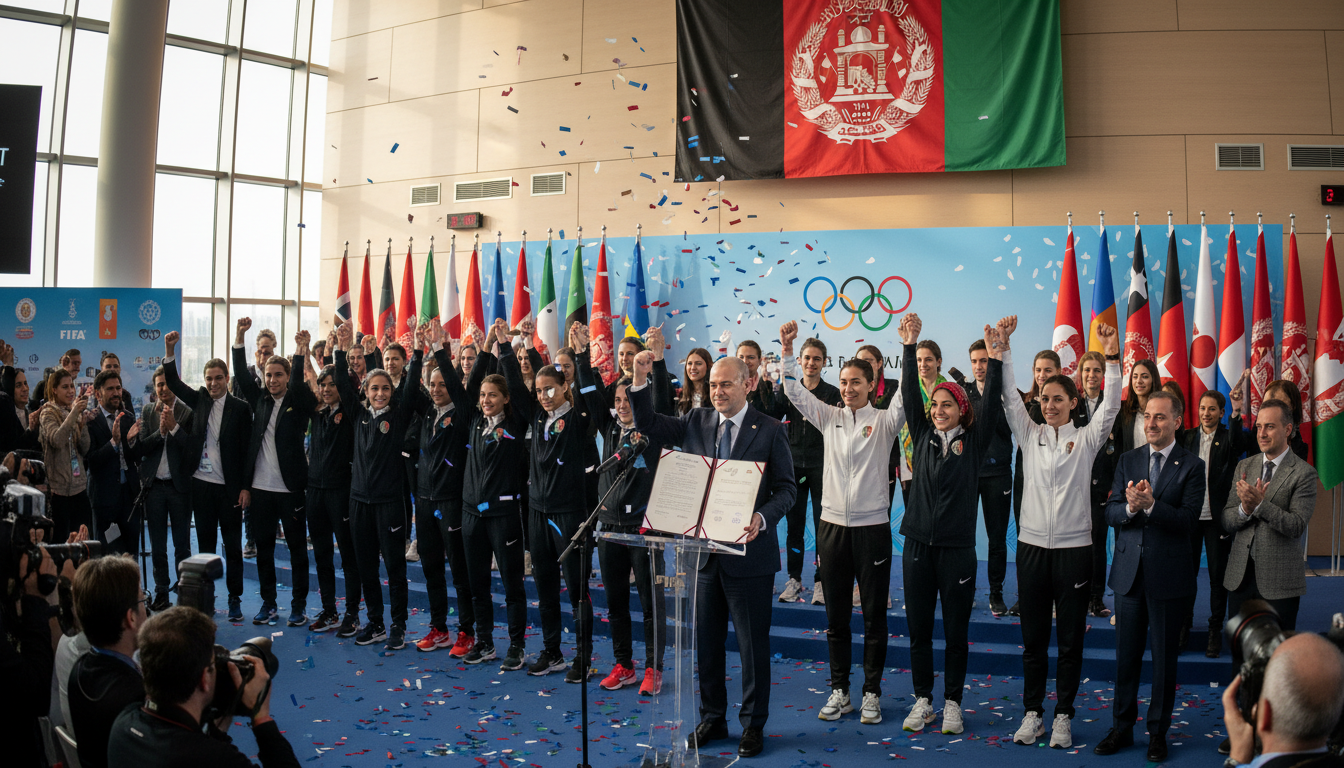
FIFA Recognises Afghan Women United, Clearing Path to International Play and Olympic Qualification
FIFA officially recognises Afghan Women United, allowing the refugee team to represent Afghanistan internationally and pursue qualification for the 2028 Los Angeles Olympics.
The FIFA Council on April 28, 2026, in Vancouver amended regulations to recognise Afghan Women United, a team of Afghan women refugees who fled Taliban rule and have played in exile for nearly five years. The decision grants the squad eligibility to represent Afghanistan at FIFA competitions and opens the possibility of entering qualification for the 2028 Olympic Games in Los Angeles. While the change arrives too late for the 2027 Women’s World Cup in Brazil, it marks a significant policy shift for players who have campaigned for a return to the international stage.
FIFA Council decision in Vancouver
The council’s amendment alters eligibility rules to permit refugee or stateless national teams to compete under their country’s name when their national associations cannot field representative teams. FIFA President Gianni Infantino framed the move as part of an effort to close regulatory gaps and enable players displaced by conflict to compete. The vote took place during a council meeting held in Vancouver on April 28, 2026, and supporters said the change could be used by other associations facing similar barriers.
The new provisions do not automatically place Afghan Women United into upcoming tournaments; they instead create a formal pathway for registration and coordination with the relevant confederation. FIFA officials said administrative steps will still be required before the team can enter official qualifying competitions, including formal approval from the confederation overseeing the slot in question.
How the recognition unfolded
Momentum for formal recognition began in October 2025, when the refugee side took part in a tournament in Morocco featuring teams from Chad, Libya and Tunisia. That appearance followed years of advocacy from players, former captain and activist Khalida Popal, and international human rights organisations pressing FIFA to address the exclusion. The Morocco event was cited by advocates as a turning point that demonstrated the team’s competitive readiness and international support.
Since then, the group organised training camps in England and Australia and worked with coaches and host clubs to keep players match-fit. FIFA’s regulation change codifies what supporters say has already been operating in practice: a dispersed but organised Afghan women’s programme maintained across multiple countries and supported by federations and clubs willing to host the exiled players.
Players, coaching and diaspora
More than 80 Afghan women footballers are now scattered across Australia, the United States and Europe, with many having left Afghanistan after the 2021 return of the Taliban. The players last competed in an official match in 2018 before the country’s shutdown of women’s sports. Coach Pauline Hamill, who has been leading training sessions, is overseeing preparations for exhibition fixtures and potential qualifiers as the team regains a formal international identity.
Australia-based midfielder Nazia Ali described the recognition as profoundly personal for players who have represented their country in spirit while bearing the status of refugees. “To hopefully be able to wear our flag again officially is a feeling I cannot describe,” she said, reflecting the emotional significance for athletes who spent years playing under different names and as guests of clubs abroad.
Eligibility for tournaments and the Olympic pathway
Although the ruling does not retroactively qualify Afghan Women United for the 2027 Women’s World Cup, it makes them eligible to participate in future qualification cycles, subject to confederation rules and timelines. FIFA officials noted that the team could seek entry into the qualification process for the 2028 Olympic football tournament in Los Angeles, provided registration deadlines and competitive criteria are met.
National Olympic committees and continental confederations typically set separate eligibility and qualification mechanics, and the Afghan team will need to coordinate closely with the relevant confederation to secure a place in regional qualifiers. Observers say the June international window, when the team expects to play exhibition matches, will be a critical opportunity to test logistics and competitive readiness ahead of any official applications to confederation competitions.
Accountability and the legacy of the women’s programme
The decision also revisits long-standing issues within Afghanistan’s football governance. Before the Taliban takeover, the Afghanistan Football Federation faced allegations of misconduct in the women’s programme, including charges of abuse that prompted investigations and disciplinary action. Former federation president Keramuddin Keram was banned for life by FIFA amid those findings.
Despite these past sanctions against individuals, the Afghan federation has not been suspended and has not officially reintegrated or endorsed the women’s team. Advocates and rights groups have argued that FIFA’s updated rules are necessary to prevent discriminatory domestic policies from nullifying athletes’ international rights, especially when national associations fail to protect or represent female players.
Reactions from rights groups and the sporting community
Human Rights Watch and other organisations welcomed FIFA’s move as a precedent for international sports governance when national policies exclude athletes on the basis of gender or belief. Rights advocates said the decision could set a template for how global sporting bodies respond to systemic exclusion and protect athletes forced into exile. Football stakeholders also noted the broader sporting and diplomatic implications of recognising teams that operate outside traditional federation structures.
FIFA representatives emphasised the technical and procedural aims of the amendment, framing it as a solution to an administrative gap rather than a political intervention. Still, the symbolism of the recognition has resonated with players and campaigners who saw it as an official reversal of a period in which Afghan women were barred from competing under their national identity.
As Afghan Women United moves toward preparing for possible qualifiers and additional exhibition matches, the team and its supporters face practical challenges including travel, documentation, and securing affiliation with confederation calendars. The coming months are likely to test the new rules in concrete terms as administrators, coaches and players work to transform a policy change into competitive reality.
