
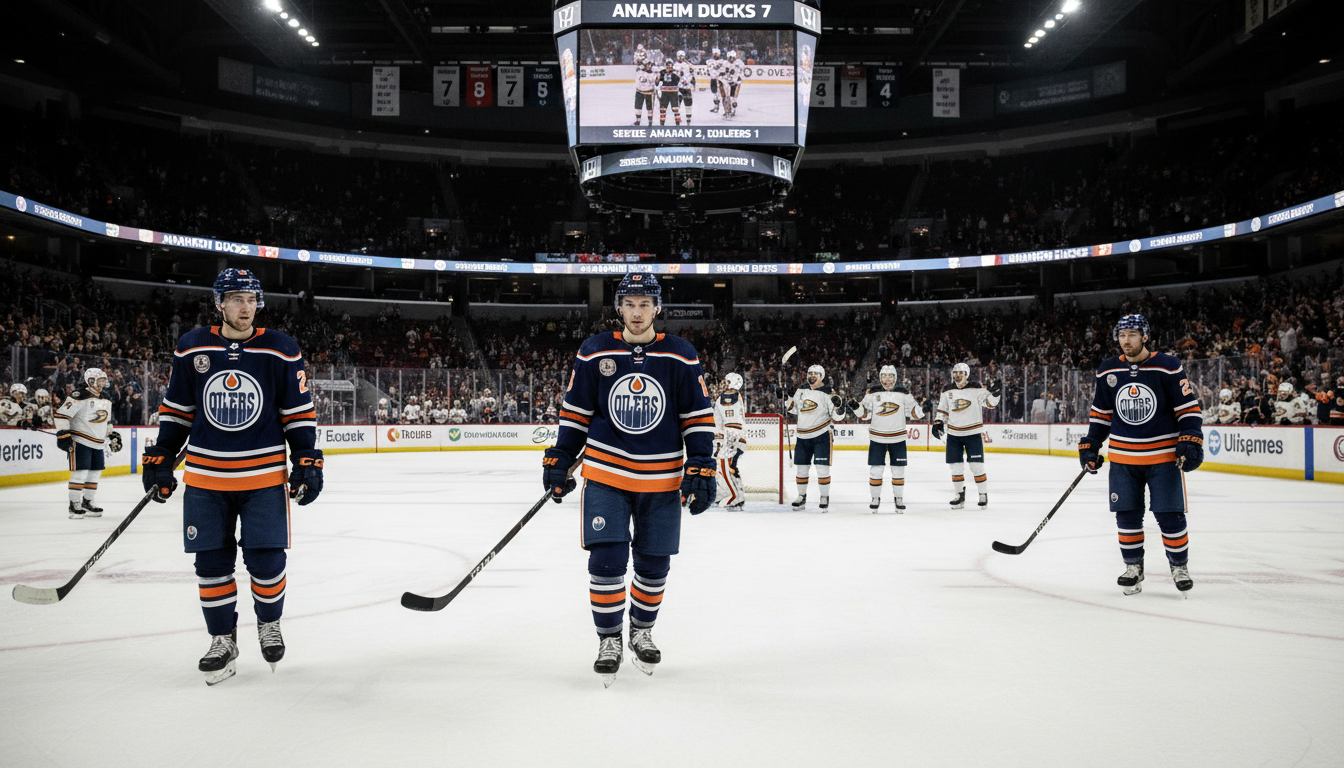
Edmonton Oilers’ defence under fire as McDavid and Draisaitl rest ahead of Game 4 vs Ducks
Edmonton Oilers rested Connor McDavid and Leon Draisaitl on April 25, 2026, after a 7-4 loss to Anaheim as the team searches for answers in a 2-1 first-round series hole.
The Edmonton Oilers arrived at the Honda Center trailing the Anaheim Ducks 2-1 in their best-of-seven opening-round clash and left with more questions than answers. Head coach Kris Knoblauch gave his two biggest offensive weapons a maintenance day following a game in which Anaheim scored a franchise-record seven goals on April 25, 2026. With Game 4 scheduled for Sunday, April 26, 2026, the club shifted its focus to tightening its defensive structure and shoring up goaltending decisions ahead of a crucial stretch of the series.
McDavid and Draisaitl rested ahead of Sunday’s Game 4
Connor McDavid and Leon Draisaitl did not play on April 25, 2026, a decision described by coach Kris Knoblauch as a maintenance move. The pair have carried the Oilers’ offence through recent post-seasons, so the day off underscored concerns about preserving their effectiveness deep into the playoffs. Knoblauch framed the rest as a proactive measure to ensure both forwards are available and effective for the upcoming games, rather than as an indication of acute injury.
Both players remain central to Edmonton’s offensive game plan, with Draisaitl notably returning from a regular-season knee issue that sidelined him for 14 games. Keeping them fresh is a balancing act for the coaching staff, who must weigh short-term fatigue against the long-term need for their top scorers to produce. The club’s decision to rest its stars signals their intent to prioritize structural corrections over forcing players through wear and tear.
Defensive breakdowns and Anaheim’s attack exposed gaps
Edmonton surrendered 16 goals across the first three games of the series, with Game 3’s 7-4 result highlighting recurring defensive lapses. The Oilers struggled to sustain pressure in the defensive zone and repeatedly failed to stay above the puck, allowing the Ducks to capitalize on odd-man rushes and turnovers. Those breakdowns came at inopportune moments, including the latter stages of Game 3 when Edmonton could not protect a 3-2 lead.
Coach Knoblauch pointed to a need for simplicity and increased physicality in defensive execution, calling for players to return to basic defensive responsibilities. The team’s transition defence and puck management in the defensive end have been identified as immediate areas for improvement. Without structural adjustments, Edmonton risks further exposing its goaltenders and overtaxing its top forwards as they try to outscore mistakes.
Goaltending questions and the Ingram-Jarry choice
Connor Ingram started in net during the 7-4 loss and faced significant pressure from Anaheim’s pace and scoring chances. While his raw numbers from that game were poor, many of the goals came off high-quality rushes where coverage and puck management ahead of him were decisive factors. Knoblauch said the team had not made a decision on whether Ingram would start Game 4, leaving the door open to Tristan Jarry, who served as Ingram’s backup late in the regular season.
Goaltending stability is crucial for teams chasing a comeback in a series, and the Oilers must decide whether a change would settle the group or further disrupt defensive continuity. Jarry’s experience and track record could be seen as a stabilizing influence, but any switch will be weighed against momentum, matchups, and the coaching staff’s trust in Ingram’s capacity to rebound. Ultimately, the choice in net will be a tactical one, reflecting how the Oilers plan to address the scoring chances Anaheim has generated.
Depth scoring, lineup changes and injury management
Edmonton’s scoring depth has been uneven through the series, with the Draisaitl-Kapanen-Podkolzin line delivering while production dropped off beyond that top trio. Third-line centre Jason Dickinson, who scored twice in Game 1, missed Games 2 and 3 with a lower-body issue but skated on April 25 and described his status as day-to-day. The health and availability of role players will factor heavily into Edmonton’s ability to both generate offence and support defensive responsibilities.
The Oilers have a history of leaning on their top performers in tight playoff stretches, but sustained success typically requires balanced contributions from bottom-six forwards and defensive pairings. Knoblauch will be reviewing matchups and minutes allocation to find more reliable secondary scoring and better defensive coverage. Managing minor injuries while preserving playoff energy remains a priority as the series flips back to Edmonton for Game 5 on Tuesday, April 28, 2026.
Leadership under pressure and performance metrics
Captain Connor McDavid has faced intense checking from Anaheim and has not matched his usual playoff scoring pace, though he recorded Edmonton’s first power-play goal of the series in Game 3 and added an assist. Despite the production dip, his presence draws significant defensive focus from opponents and creates opportunities for teammates. Still, plus-minus figures through three games — where McDavid and several teammates sit deep in the negative — reflect broader team defensive struggles rather than individual shortcomings alone.
Veteran voices in the dressing room and experience from recent deep playoff runs give Edmonton a psychological playbook for overcoming holes in a series. The club has rallied from 2-1 deficits in past post-season series and forced decisive games after early setbacks, demonstrating resilience that coaching staff and players cited publicly. How the Oilers translate that experience into tighter defensive habits and smarter puck management will determine whether that history becomes a blueprint or merely a reminder.
Scenarios and strategic adjustments heading into Games 4 and 5
With Game 4 at the Honda Center on April 26, 2026, Edmonton faces a critical juncture: tie the series to reclaim momentum or fall into a 3-1 deficit that historically makes series comebacks more difficult. Knoblauch has emphasized basic defensive tenets — simplicity, physicality, and attention to defensive zones — as the immediate actions the team must adopt. Line deployment, defensive pairings, and special teams adjustments will likely be the focus of pre-game preparations and in-game coaching interventions.
On the offensive side, the Oilers must balance protecting their stars with generating secondary scoring and cleaner entries into the offensive zone. Edmonton’s power play, which saw its first goal of the series from McDavid in Game 3, will be an area of continued emphasis given the importance of converting man-advantage opportunities. The mental aspect of resetting after a high-scoring loss will be as important as any schematic tweak going into Game 5 in Edmonton on April 28, 2026.
Edmonton’s playoff pedigree means this club has navigated series adversity before, but the margin for error narrows when defensive structure collapses and goaltenders face repeated high-danger chances. How the team responds over the next two games will reveal whether rest days for star players and potential netminder decisions translate into a tightened defence and renewed competitive edge.
