
RBC economist says new oil pipeline to West Coast needs more than Alberta-Ottawa deal
RBC chief economist Frances Donald warns a new oil pipeline to the West Coast will require sustained policy certainty and cultural change beyond the Alberta‑Ottawa MOU to draw investors.
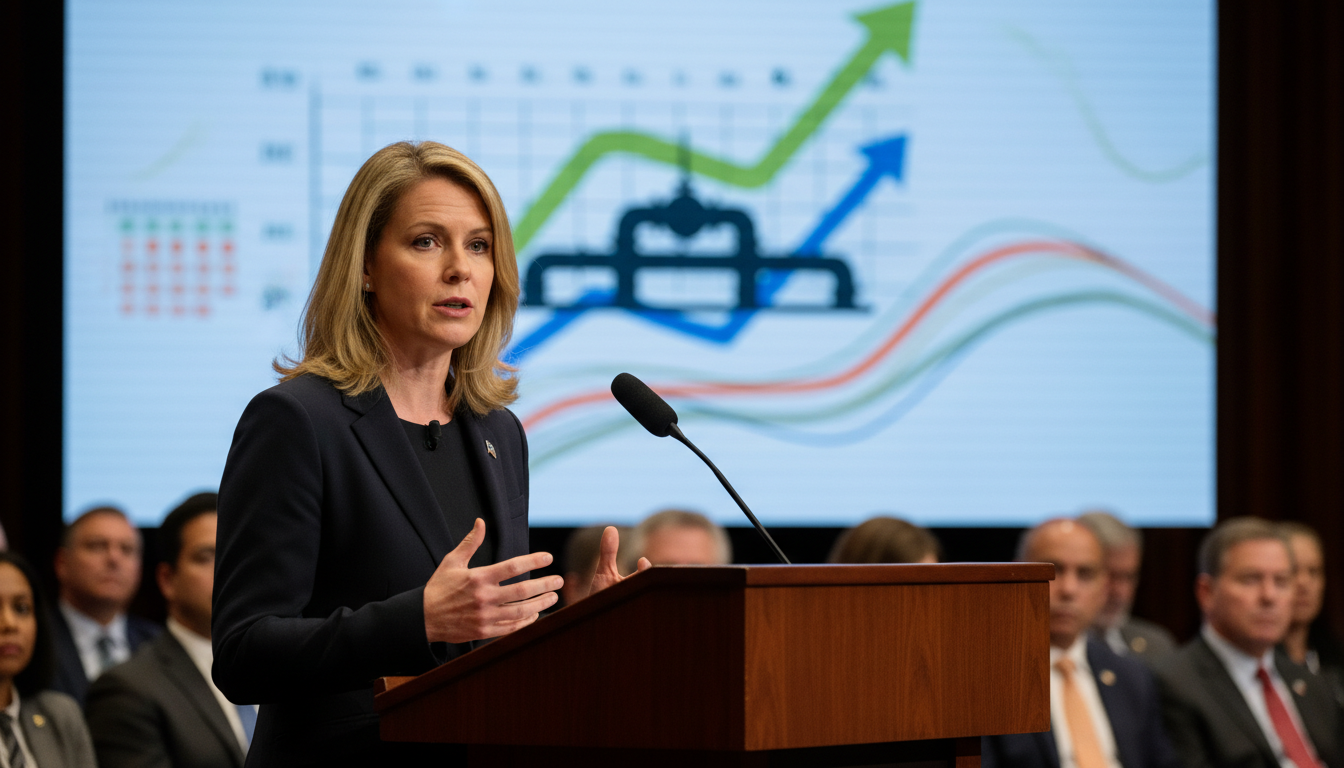
Frances Donald, chief economist at the Royal Bank of Canada, told a Calgary audience that supporters of a new oil pipeline to the West Coast cannot rely on a single agreement to restore industry confidence.
Speaking at a public conversation with the Calgary Chamber of Commerce, Donald said the sector has been "pushed into a position where it could not grow" and needs prolonged clarity before capital will flow.
RBC economist frames the problem as cultural and policy instability
Donald argued the challenge is not a single policy gap but a broader shift in how governments approach energy development over many years.
She said industries such as oil and gas require an extended period of predictable rules and regulatory consistency to justify large, long‑lead investments.
Alberta and Ottawa report partial progress on MOU commitments
Provincial and federal officials achieved draft agreements on methane equivalency and on impact assessments ahead of an April deadline, marking tangible progress on the memorandum of understanding.
However, two key elements — an industrial carbon‑pricing arrangement and terms for the Pathways carbon capture and storage network — remained unresolved and were reported overdue by more than two weeks.
Private backers have not stepped forward and route opposition persists
Despite political support in Alberta and Ottawa, no private proponent has publicly committed to building the proposed pipeline to British Columbia’s coast.
A prospective northern B.C. route has also provoked strong opposition from some First Nations and from the province’s leadership, complicating any pathway to construction.
Industry leaders and economists call for sustained certainty to spur investment
Executives in the oilsands and economists say incremental progress will not be enough unless it is accompanied by clear, long‑term policy frameworks.
Mark Parsons, chief economist at ATB Financial, warned that repeated delays only deepen domestic policy uncertainty and undermine investment appetite.
Economic and geopolitical context raises stakes for decisive action
Analysts note that rising geopolitical uncertainty, including conflict in the Middle East, heightens the commercial imperative to make Canada’s energy sector as investment‑friendly as possible.
Cenovus Energy’s chief executive has said fundamental changes to government policy and regulation will be required for production growth to proceed at scale.
Alberta and Ottawa’s MOU was described by officials as a reset in intergovernmental relations, but analysts and industry insiders are cautious that the agreement may not deliver a clear endpoint.
Momentum has improved compared with recent years, yet sources close to the negotiations say outstanding technical and financial questions — particularly around industrial carbon pricing and the financing model for carbon capture — remain the most difficult to resolve.
For pipeline proponents, the next steps are to secure a credible private sector sponsor, finalize the outstanding aspects of the MOU and address route‑specific concerns raised by Indigenous communities and provincial governments.
Observers say those elements must align before banks and institutional investors will underwrite a project whose economics depend on multi‑decade returns.
Donald and other commentators emphasized that restoring business confidence will require more than a slogan or a single flagship project; it will require sustained, bipartisan policy stability and clear regulatory pathways.
Absent that, the gap between political commitments and private capital commitments is likely to persist, leaving the question of a new oil pipeline to the West Coast unresolved for the near term.
The industry still sees potential if governments deliver a coherent package of measures, but officials and executives acknowledge that significant work remains to translate a political agreement into a financed, shovel‑ready project.
Until those pieces fall into place, investors and communities alike will be watching whether the Alberta‑Ottawa accord can evolve from a memorandum of intent into the sustained certainty Donald says the sector needs.
