
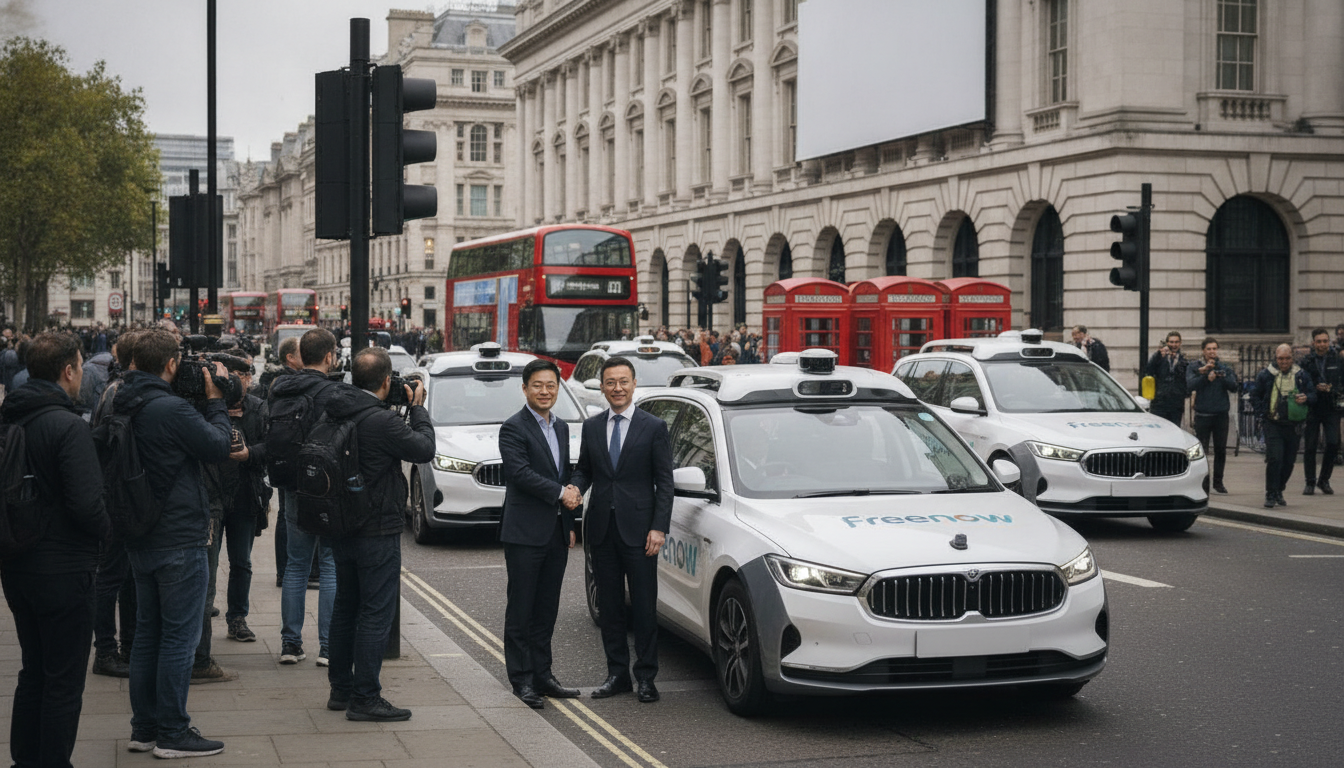
Baidu Robotaxi London Tests Begin Under Lyft and Freenow Partnership
Baidu begins robotaxi testing in London with Lyft and Freenow, operating Apollo Go RT6 vehicles and running trials with safety operators ahead of a planned 2027 public rollout.
Baidu has started on-street trials of its autonomous vehicles in London, marking the company’s first public testing in the UK as it moves to expand robotaxi operations in Europe. The tests, which began on a Tuesday with human safety operators aboard, are part of a broader strategic deployment through Lyft’s platform and Freenow, the European mobility app now owned by Lyft. Company officials said the program is an early phase of work that could lead to public hailing of Baidu’s Apollo Go RT6 robotaxis in 2027, subject to regulatory clearance.
Partnership framework with Lyft and Freenow
Baidu’s London activity follows a strategic arrangement struck nearly a year earlier to distribute its purpose-built Apollo Go RT6 vehicles across key European markets via Lyft’s platform. Lyft’s acquisition of Freenow in 2025 gave the U.S. ride-hailing firm a direct channel into Europe and provided the distribution partner for Baidu’s robotaxi fleet. Under the agreement, Lyft and Freenow will integrate Baidu’s autonomous vehicles into existing ride-hailing services, a model they say will balance new technology with established driver networks.
Scope of trials and operational area
Initial testing is concentrated in the London borough of Brent, where dozens of test vehicles are scheduled to operate with trained safety operators present. Operators will monitor vehicle behavior and intervene if necessary while engineers collect data to refine perception and decision-making systems. Baidu and its partners emphasized that these early lanes are limited and tightly controlled as they evaluate performance in real-world urban conditions, including traffic, pedestrians and complex junctions.
Regulatory engagement and UK pilot program
Lyft and Freenow confirmed ongoing discussions with Transport for London (TfL) and the Centre for Connected and Autonomous Vehicles (CCAV) as part of efforts to secure permissions for expanded testing. The UK government has been developing a framework for autonomous vehicles and opened applications in May to an AV pilot program that allows companies to test self-driving services under official oversight. Companies seeking to move from supervised trials to public service will need to satisfy safety, data and insurance requirements outlined by regulators.
Competition intensifies in London’s robotaxi market
London has become a focal point for rival self-driving programs in Europe, with Waymo and the Uber–Wayve partnership both announcing testing and phased rollouts that begin with safety operators in place. Industry observers say the city’s dense transport network and large population make it an attractive but challenging proving ground. The convergence of multiple well-funded players raises the stakes for regulatory approvals and market positioning as each company seeks first-mover advantages for commercially available robotaxi services.
Hybrid network approach and driver support
Freenow by Lyft plans to operate a hybrid network that will see traditional taxi and private-hire drivers continue to work alongside robotaxis. Company executives have framed the hybrid model as a way to integrate autonomous vehicles without displacing the existing driver workforce abruptly. Freenow’s leadership said they intend to develop the technology in ways that support professional drivers and the broader mobility ecosystem while offering customers additional service options through platform integration.
Authorities and company officials caution that timelines remain contingent on a range of factors, including regulatory sign-offs and successful completion of safety benchmarks. While public hailing through the Freenow app is targeted for 2027, no definitive launch date has been set and the partners stressed that public availability will depend on approvals from UK regulators. The phased approach—beginning with human-monitored trials, progressing to supervised services, and eventually moving toward driverless operations—reflects both technological complexity and the need for public confidence.
Testing in Brent will feed operational data back into Baidu’s Apollo Go program as engineers tune vehicle systems for British road rules, signage and urban behaviors. The program offers an opportunity to validate commercial operating models in a major European capital and to coordinate closely with local authorities on safety protocols, mapping and data sharing. As the trials proceed, regulators and the public will be watching how well the vehicles handle busy streets and unpredictable pedestrian activity.
Public interest and scrutiny are likely to grow as more companies field robotaxis in London and begin taking registrations for early users. For now, Baidu’s entry adds another prominent name to a crowded field aiming to bring commercial robotaxi services to European cities within the next few years. The ultimate pace of deployment will hinge on how quickly regulators are willing to grant permissions and how effectively companies demonstrate safety in increasingly complex urban environments.
Baidu’s London testing phase represents a key step in the company’s European expansion and signals that robotaxi competition in the region is accelerating toward consumer trials and, potentially, paid service in the coming years.
