
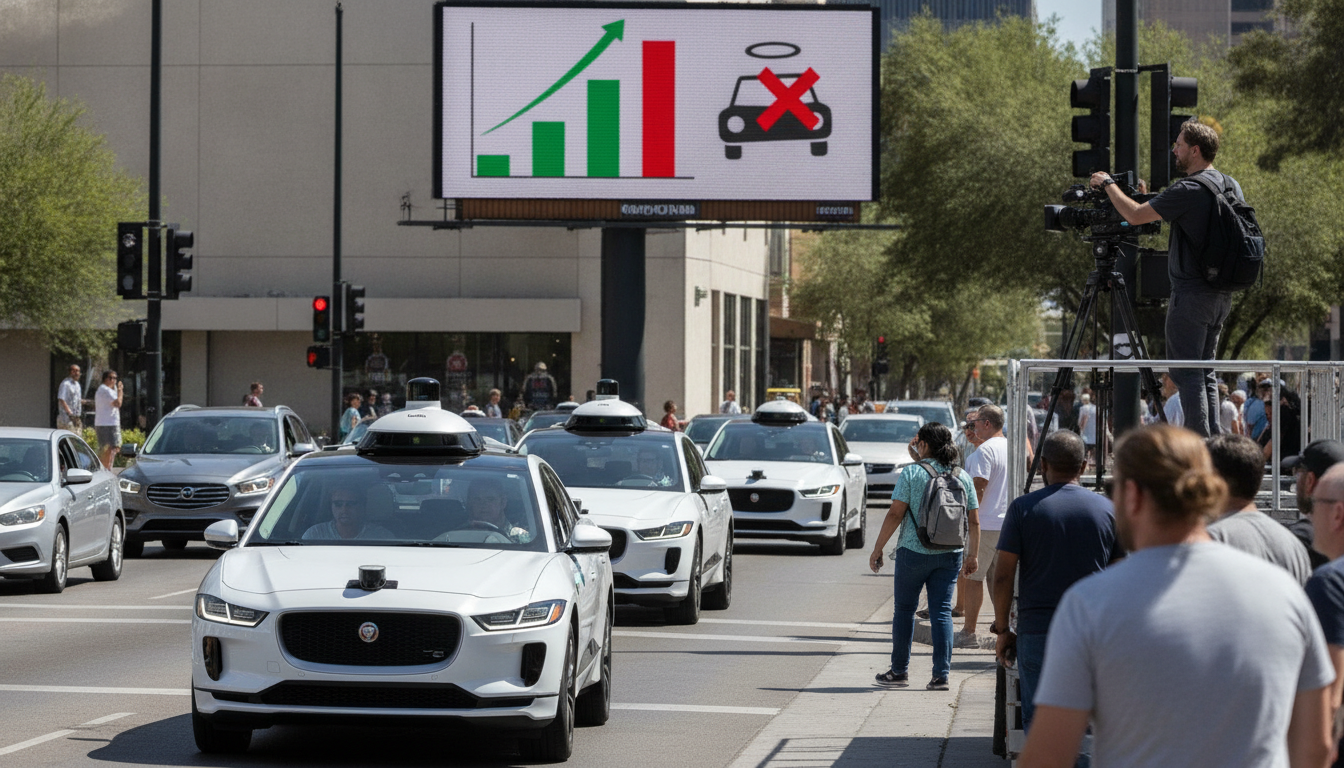
Waymo robotaxis show lower crash rates than human drivers, IIHS analysis finds
Waymo robotaxis recorded fewer police-reported crashes per kilometre than human-driven vehicles in four U.S. cities, an IIHS analysis shows. The study’s findings on Waymo robotaxis highlight safety gains and lingering questions about data collection and regulation.
Key findings from the IIHS analysis
The Insurance Institute for Highway Safety (IIHS) compiled police records, company submissions and federal databases to compare crash rates between Waymo robotaxis and human drivers in San Francisco, Phoenix, Los Angeles and Austin. Between 2021 and 2024 researchers identified 89 police-reported crashes involving Waymo vehicles, equivalent to roughly 1.28 accidents per million kilometres driven.
By contrast, human-driven vehicles in the same cities showed a rate of about 4.06 accidents per million kilometres, a difference the IIHS describes as a roughly 68 percent reduction for Waymo robotaxis. IIHS officials said the reduced frequency and relative mildness of collisions were notable findings in the dataset.
How the researchers handled messy records
Investigators said the comparison required extensive cleaning of public and private records to remove duplicates and reconcile inconsistent entries. Approximately one-quarter of initially collected crash reports were discarded as duplicates or unmatchable entries, illustrating gaps in the current accident-tracking system.
The IIHS cautioned that the existing public reporting mechanisms are not designed for continuous oversight of autonomous vehicle operations, forcing researchers to reconstruct a usable dataset from disparate sources. Analysts also noted that Waymo was the only operator providing usable odometer data, which limited the ability to assess robotaxis run by other companies.
Patterns in collision type and severity
The IIHS analysis found fewer severe impacts in the Waymo crash sample than among comparable human-driven crashes. Researchers said rear-end and frontal collisions appeared less common in the robotaxi incidents, and overall incidents tended to be lower-speed contacts rather than high-severity impacts.
IIHS statistical director Eric Teoh said the pattern suggests Waymo software may reduce certain risky behaviours, such as sudden lane departures or high-speed maneuvers. The institute nonetheless emphasized that the sample covers limited operating domains and that broader geographic testing would be needed to generalize results.
Public footage and expert skepticism
Despite the promising headline figures, experts and public commentators remain skeptical, in part because widely viewed videos show Waymo vehicles pausing in traffic, hesitating at work zones or entering flooded streets. Those clips, some of which have millions of views online, feed public doubts about whether lower crash counts fully capture operational safety.
Academic critics argue that operational limits and selective deployment in predictable environments can lower crash rates without resolving edge-case failures. Author Andrew Miller, who has written about automated driving, said skepticism about data integrity and whether companies may influence reporting remains a legitimate concern.
Regulatory and labour questions in Canada
Waymo has sought to expand into Canada but has faced legal and political headwinds. Provincial rules in British Columbia currently prohibit the class of autonomous vehicles Waymo operates, and Toronto officials have raised labour and displacement concerns, asking the company to demonstrate effects on jobs and livelihoods.
Municipal and provincial regulators in Canada have signalled caution, citing the need for robust proof that driverless fleets will not degrade public safety or harm employment in sectors such as taxi and transit services. Those regulatory hurdles have slowed any concrete approvals for Waymo robotaxis in Canadian cities so far.
Technical limits and expansion plans
Waymo classifies its vehicles at automation Level 4, meaning they can operate without human intervention in defined conditions but are not full Level 5 systems that would work everywhere. The company launched public robotaxi service in Phoenix in 2020 and now operates in multiple U.S. states, while announcing plans to expand to the United Kingdom and Japan.
Observers note that Level 4 systems typically confine service to mapped urban cores and favourable weather, which can help lower incident rates compared with mixed, all-weather driving across wide regions. Critics point out that Canadian winters and complex urban infrastructure would present particular challenges for current-generation robotaxis.
The IIHS report offers the clearest comparative look yet at Waymo’s safety record in four U.S. markets, but it also underscores the limits of current data systems and the need for standardized reporting across jurisdictions and operators.
The debate over Waymo robotaxis is likely to continue as regulators, researchers and cities weigh both the potential safety benefits and the social, legal and technical questions that accompany autonomous vehicle deployment.
