
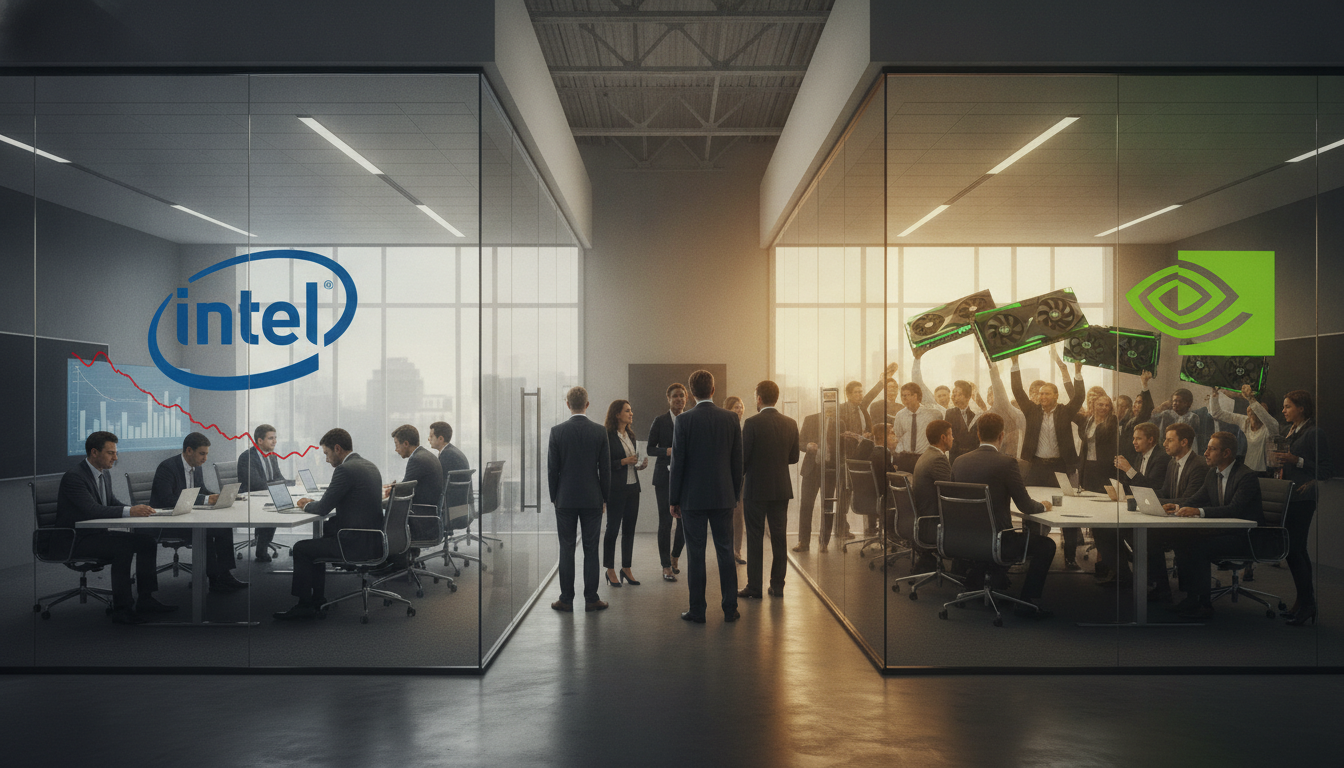
Intel losses mount as GPU demand outpaces CPUs and lifts Nvidia
Intel losses mount as GPU demand worldwide outpaces CPUs, lifting Nvidia to the world’s most valuable public company and reshaping the semiconductor market.
Intel losses have deepened as market demand shifted from central processing units to graphics processing units, a trend that has rewarded Nvidia’s GPU-led strategy. The CPU maker has reported repeated deficits in recent years while rivals focused on accelerated computing have surged in value. Investors and industry observers say the divergence between CPU and GPU demand is a structural change that is forcing a strategic reassessment at legacy chipmakers.
GPU Demand Surpasses CPU Sales
Industry purchasing has increasingly favored GPUs for data center, AI and cloud workloads, squeezing traditional CPU sales and revenue growth. Customers running large-scale machine learning and inference workloads prioritize GPUs for their parallel processing capabilities, reducing the relative demand for general-purpose processors. That shift has created a sustained revenue gap between companies focused on graphics and AI accelerators and those whose business remains anchored in CPUs.
Financial Impact on Intel’s Results
The sustained tilt toward GPUs has translated into a string of quarterly shortfalls and write-downs for Intel, which has faced margin pressure and slower revenue growth. Analysts say Intel losses reflect not only weaker product demand but also rising R&D and capital expenditure as the company tries to catch up in manufacturing and AI-focused architectures. The financial strain has prompted management to re-evaluate cost structures and prioritize investments that could restore competitiveness over the medium term.
Nvidia’s Market Momentum
Nvidia’s GPU-centric roadmap and strong adoption among hyperscalers propelled the company to become one of the world’s most valuable listed firms, benefiting from a surge in investor interest in AI infrastructure. The firm’s chips have become central to training large language models and other generative AI applications, driving sales and premium valuation multiples. That market momentum has intensified scrutiny on competitors that historically led in CPUs but lagged in AI-specific silicon.
Supply Chain and Customer Shifts
Large cloud providers and enterprise customers have reallocated budgets toward systems optimized for GPU compute, changing procurement cycles and supplier relationships. OEMs and system integrators report growing demand for GPU-dense servers and custom accelerator boards, influencing component orders upstream. These procurement shifts have had ripple effects across packaging, memory and power subsystem suppliers, complicating planning for vendors more closely tied to traditional CPU-centric platforms.
Intel’s Strategic Response
In response to mounting losses and market share pressures, Intel has accelerated plans to diversify its product portfolio and invest in AI-centric chips and foundry capacity. Company statements outline efforts to expand design partnerships, pursue new accelerator offerings, and modernize manufacturing nodes to regain technology leadership. Executives have signaled a multi-year roadmap to transition the business mix, acknowledging that returning to sustained profitability will require structural change and successful execution.
Investor and Analyst Reactions
Shareholders and market analysts have reacted by pushing for clearer timelines and measurable milestones, while some institutional investors emphasize the need for disciplined capital allocation. Rating agencies and equity researchers point to a range of scenarios in which Intel either narrows the gap through investment and product wins or faces continued margin erosion if GPU demand persists at current growth rates. The company’s near-term outlook and guidance are now central to market sentiment and valuation.
Legacy CPU demand erosion and Nvidia’s ascent highlight the broader transformation taking place across the semiconductor industry. Companies are recalibrating product roadmaps, manufacturing investments and customer engagements to align with a landscape increasingly defined by AI workloads. The coming quarters will test whether Intel’s strategic shifts can translate into regained market momentum and stem the cycle of Intel losses.
