
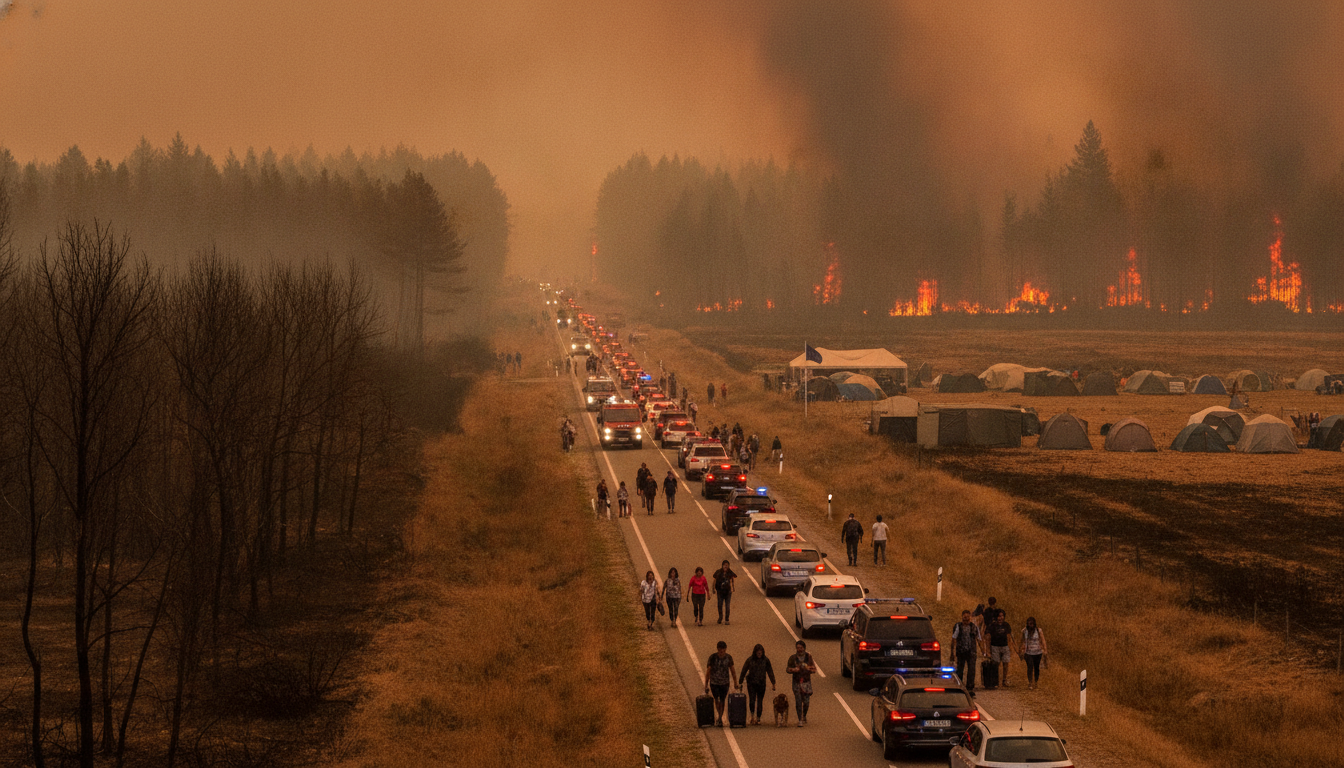
Wildfires in France and Spain Force Massive Evacuations as Flames Approach Bordeaux
Wildfires in France and Spain have forced over 325,000 people to flee as blazes raced across forests and coastal zones, with flames reported roughly 15 km from Bordeaux as of July 26, 2026. Firefighters and emergency services in both countries confronted intense heat, shifting winds and a rare pyrocumulonimbus “fire storm” that made containment unpredictable.
Mass evacuations around Bordeaux and Arcachon
More than 220,000 residents and visitors were evacuated from the Arcachon basin and surrounding communes after a blaze in Gironde expanded rapidly. Local authorities described the operation as likely the largest civilian evacuation carried out in France outside a conflict, with thousands taking shelter in reception centres and exhibition halls.
Communities nearer to Bordeaux reported an orange sky and thick smoke at dawn, while some residents refused to leave their homes for personal reasons or to care for animals. Officials said they record names and contacts for those who remain and will return to remove non-compliant residents if conditions become critical.
‘Fire storm’ pyrocumulonimbus drives erratic behavior
Fire services warned that a pyrocumulonimbus, a phenomenon sometimes called a “fire storm,” produced powerful updrafts and its own lightning that ignited new spot fires. Lieutenant-colonel Éric Brocardi, speaking for French firefighters, said the column of intense heat met cooler air aloft, creating violent, unpredictable fire activity that can renew blazes even after apparent containment.
That meteorological behaviour, more typical of extreme fires in Canada and Australia, complicates aerial and ground suppression efforts. Pilots and crews faced safety limits when embers and winds made drops less effective and direct access too dangerous.
Scale of destruction and proximity to the city
Authorities in Gironde reported the main fire had burned roughly 42,000 hectares by late July 25, 2026 — an area about four times the size of Paris. The blaze advanced toward the Bordeaux metropolitan area, which has a population of approximately 850,000, though the city’s mayor said a full evacuation of the metropolis was not planned at this stage.
Images from within affected zones showed rows of destroyed homes and charred vehicles, and local officials warned that the tally of damaged properties would continue to rise. Fire analysts noted that the rapid night-time spread underlines how quickly conditions can deteriorate near populated zones.
Transport chaos and toll on tourism and campsites
The fires prompted major transport disruptions with a 60-kilometre section of the autoroute to Spain closed and rail traffic suspended south of Bordeaux until further notice. In a region that hosts a dense network of campgrounds, officials ordered the evacuation of 45 sites, affecting roughly 40,000 campers and disrupting a peak summer season.
The surrounding vineyards and tourist infrastructure around Arcachon faced immediate economic and logistical impacts, with growers and operators assessing smoke damage and access problems. Local authorities also appealed for calm and coordination as road closures and sheltering stretched municipal services.
Spain battles simultaneous mega-fires across regions
Across the border, Spain faced multiple large fires, including a major outbreak west of Madrid that officials said devastated up to 25,000 hectares. Spanish authorities reported roughly 60,000 people evacuated in the Madrid region and another 15,000 in the Valencia region, where a first fatality was confirmed near Valencia city.
Prime Minister Pedro Sánchez warned of “difficult hours” ahead and renewed calls for a national pact to address climate impacts, while the King of Spain lamented the loss of invaluable natural heritage. Emergency crews in central Spain concentrated efforts to hold perimeters and prevent renewed spread as water-bombing aircraft continued operations.
Military and emergency services scaled up response
France mobilized additional forces to support firefighting and evacuation operations, with about 1,500 military personnel deployed to assist civil authorities from Saturday evening. Fire departments, gendarmerie units and civil protection teams coordinated evacuations, logistics, and ground containment efforts under challenging weather forecasts.
In both countries, shortages of rested crews and the sheer scale of the blazes forced prioritization of the most at-risk communities. Officials emphasized rotating teams, securing relief centres and conserving aerial resources as temperatures and wind shifts remained a threat.
Scientists link extreme dryness and heat to climate change
Climatologists point to prolonged drought and successive heat waves in June and July as key factors that left vegetation and soils critically dry across southwestern Europe. Experts from the World Weather Attribution group stated that human-caused climate change — driven mostly by fossil fuel combustion — has intensified the drought conditions that made these fires more likely and more severe.
The combination of record heat, low humidity and strong solar heating created tinderbox conditions, increasing the likelihood of large, hard-to-control wildfires. Researchers and public officials called for strengthened prevention, adapted forest management and long-term climate mitigation measures.
As firefighters work to hold lines and authorities manage reception and relief, officials warned the situation remains volatile and could worsen with renewed heat and wind. Residents are urged to follow evacuation orders, register with local reception services if displaced, and prepare for continued disruption as crews focus on protecting lives, homes and critical infrastructure.
