
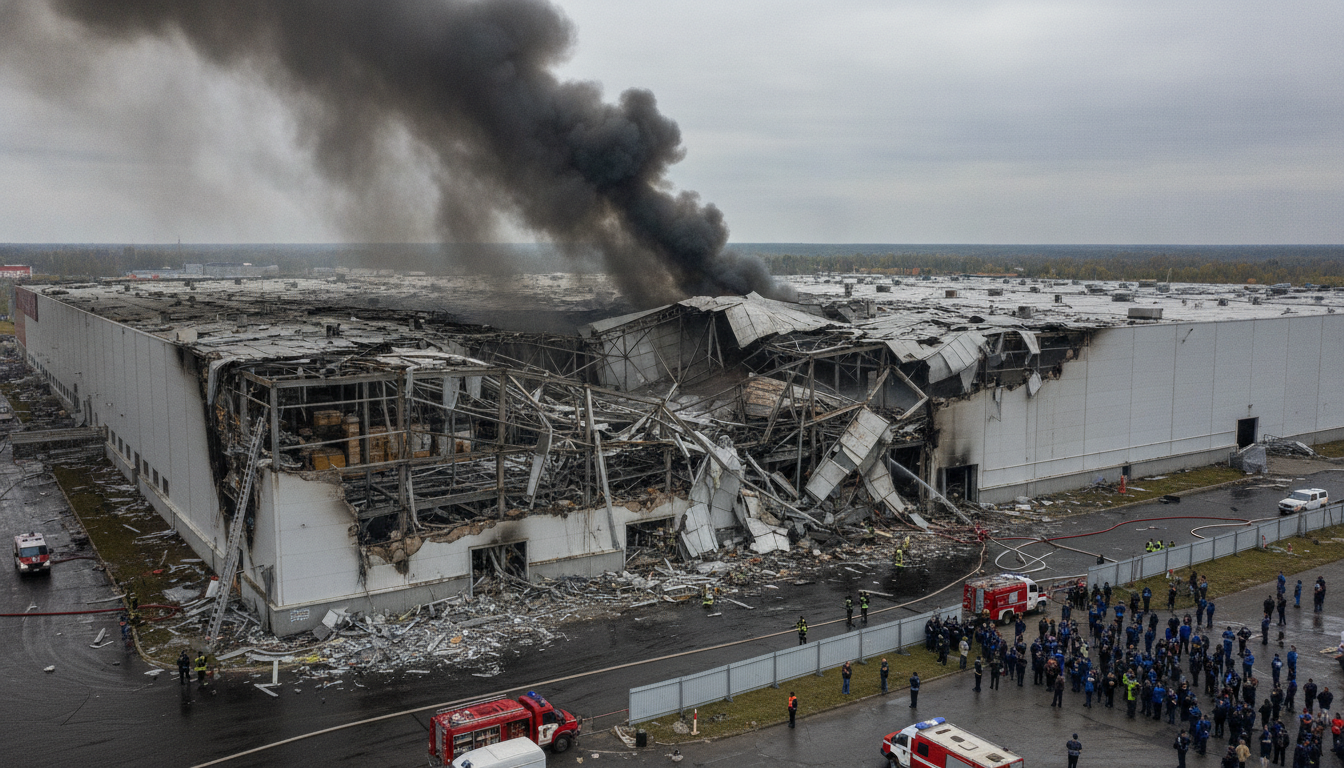
Wildberries warehouse hit by overnight drone strike in Vladimir region, company says
Ukrainian drones struck a Wildberries warehouse in Russia’s Vladimir region, causing a fire and evacuation, part of a recent series of attacks on the e‑commerce giant’s logistics sites.
A Wildberries warehouse in the Sobinski district of Vladimir region was hit overnight in what local authorities described as a drone attack, the governor and the company said. The facility, located roughly 180 kilometres east of Moscow, caught fire and personnel were evacuated, according to the e‑commerce operator’s statement and regional officials. Authorities reported one young man injured as emergency services responded to the blaze, while investigations into the cause and extent of the damage are under way.
Location and immediate effects
The strike targeted a logistics site near the town of Sobinka, in the Vladimir region east of the capital. Local governor Alexander Avdeyev reported damage at the site and confirmed that emergency services were on scene to tackle an active fire.
Wildberries said staff were evacuated from the warehouse and that the company had opened an internal review into the incident. There was no immediate word from federal Russian authorities on wider casualty figures or potential disruptions to regional transport networks.
Company statement and evacuation measures
In a brief communiqué, Wildberries said its employees were led to safety and that firefighting teams had been deployed to control flames at the logistics complex. The company described the event as an attack and said it was working to assess property losses and the operational impact.
Wildberries has repeatedly been a focal point in recent weeks for strikes affecting its distribution network, and the company faces mounting logistical challenges as it seeks to secure facilities and protect personnel. The firm is one of Russia’s largest online retailers and has acknowledged the need for heightened security at several of its sites.
Pattern of strikes on Wildberries facilities
Since mid‑July, authorities and the company say roughly twenty Wildberries sites across Russia and annexed Crimea have been targeted in separate incidents. The first wave, on the night of July 17–18, produced the most severe casualties, with multiple deaths and scores injured at logistics centres in the Moscow region and Tambov.
Subsequent attacks have struck facilities or nearby infrastructure in locations including the Saint Petersburg area, Simferopol in Crimea, Krasnodar, Volgograd and Samara. The distribution of incidents has underscored vulnerabilities in national supply chains that rely on a network of large regional warehouses.
Strategic context and Kyiv’s stated objectives
Russian officials have described the incidents as acts of sabotage, while Ukrainian authorities have framed a broader campaign of long‑range strikes on infrastructure inside Russia as intended to pressure Moscow to negotiate an end to the war. Kyiv has publicly linked such operations to military objectives, saying they target logistics and transport that sustain the Russian offensive.
The strikes on warehouses, including the Wildberries facilities, form part of a contentious tactical shift that sees commercial logistics centres labelled as part of the supply chain supporting Russia’s military efforts. Western analysts note the legal and political questions that arise when civilian commercial infrastructure becomes a theatre of conflict.
Impact on e‑commerce logistics and consumers
Wildberries is widely regarded inside Russia as a dominant online marketplace with nationwide delivery networks, earning it comparisons to Western platforms for the breadth of goods and speed of fulfillment. Damage to warehousing and transport hubs risks delayed deliveries, inventory losses and higher costs for rerouting goods around affected regions.
For consumers, interruptions could show up as slower shipments and temporary product shortages, particularly for customers in regions served by the struck facilities. Retail analysts warn that repeated hits to distribution nodes may force companies to decentralize storage or invest in additional security, increasing operating expenses.
Authorities’ response and investigation status
Regional emergency services and local law enforcement are leading an on‑site response and investigation, with investigators expected to determine the origin and method of the attack. Officials have said they will collect evidence at the scene and review surveillance and forensic data to piece together the sequence of events.
The Vladimir regional administration has not released a full damage assessment, and federal investigative bodies may become involved if the inquiry points to cross‑regional elements. Wildberries officials said they would cooperate with investigators and update the public as new information becomes available.
The strike on the Wildberries warehouse in Vladimir region extends a recent pattern of attacks on logistics infrastructure inside Russia and highlights the growing operational and political complications that arise when commercial distribution nodes become part of broader military strategies. Further details, including a full accounting of damage and any additional casualties, are likely to emerge as emergency teams and investigators complete their work.
