
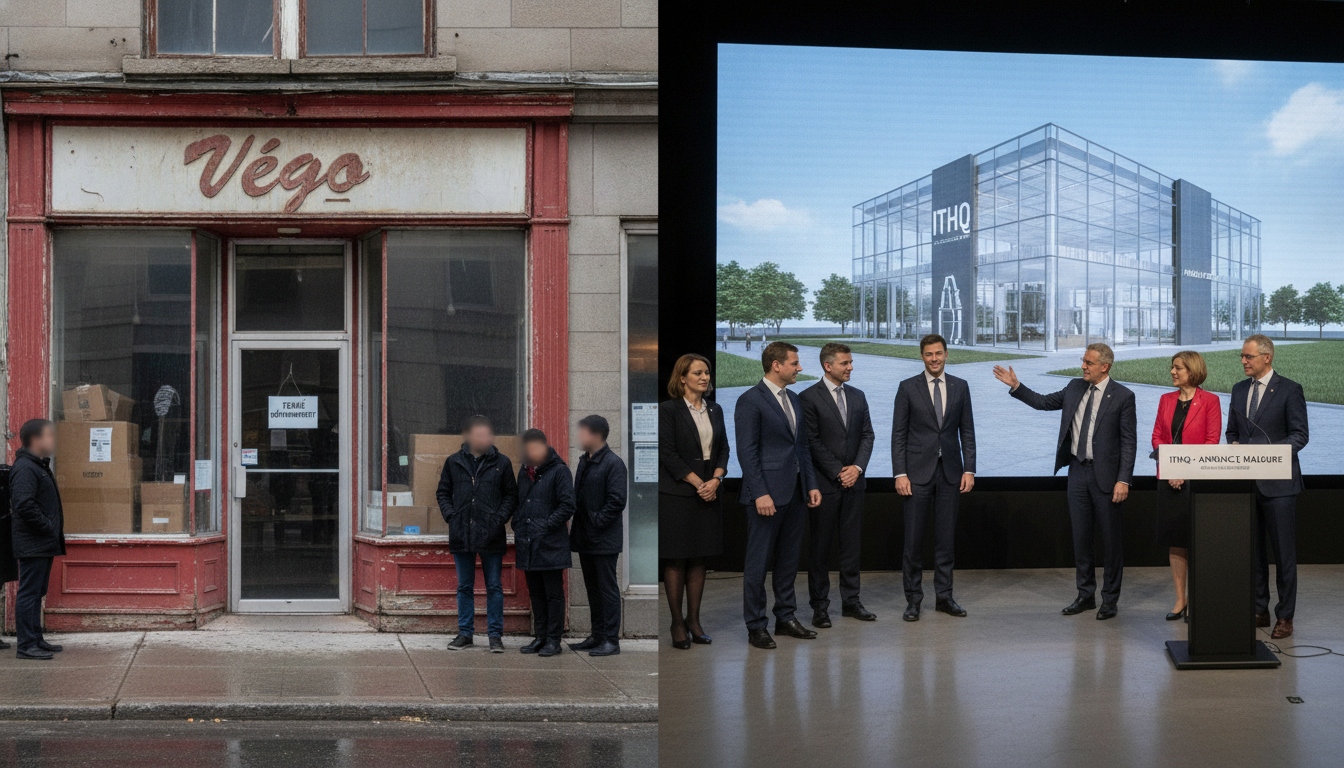
Saint-Denis Street shifts as iconic Végo closes and ITHQ pavilion slated for fall 2028
Closure of Végo on Saint-Denis Street highlights commercial shifts in Montreal’s Quartier latin as ITHQ announces a new pavilion for fall 2028.
Saint-Denis Street in Montreal’s Quartier latin is entering a new phase after the long‑running vegetarian restaurant Végo closed its doors on July 12, 2026, and the Institut de tourisme et d’hôtellerie du Québec (ITHQ) confirmed a plan to install a new pavilion on the site in fall 2028. The closure and the forthcoming institutional investment crystallize broader tensions between longtime cultural identities and recent development and construction in the area. Local business owners, the Société de développement commercial (SDC) of the Quartier latin and municipal officials describe a neighbourhood negotiating decline, renewal and competing visions for its future.
Végo closes after decades on Saint-Denis
Owner Guylaine Duchesne said her decision to shutter the restaurant followed years of mounting pressures, including tax changes, pandemic fallout and prolonged construction nearby. Végo will maintain its catering arm and the Espace Végo at the Montreal Biodôme, but the flagship Saint‑Denis dining room ceased operations on July 12, 2026. The closure joins a list of familiar local names that have folded in recent years, underscoring the fragility of independent hospitality businesses on the street.
ITHQ pavilion to occupy former Végo site in fall 2028
The ITHQ’s announcement that a new pavilion will open on the former Végo lot in fall 2028 has been offered as both a response to and an accelerator of change on Saint‑Denis. Municipal and cultural planners say the ITHQ project, alongside the planned Maison de la chanson and Maison de la musique du Québec, could draw steady daytime activity and student traffic to the corridor. Those developments come as the École nationale de l’humour prepares to take up new classrooms on Saint‑Denis and ADISQ has recently relocated offices to the area.
Longtime merchants recall a different Saint-Denis
Several business owners remember a period when Saint‑Denis pulsed with grassroots cultural life and nightlife, and they contrast that era with today’s more institutional and student‑oriented scene. Entrepreneurs such as Sergio Da Silva have described earlier decades of street performances and underground venues; others note that some of the street’s defining festivals and clubs originated here before migrating to other districts. The loss of venues like the Saint‑Sulpice in 2023 and Café Chaos in 2014 is frequently cited as emblematic of the neighbourhood’s changing character.
SDC says occupancy is improving, but challenges persist
Julien Vaillancourt Laliberté, general director of the SDC of the Quartier latin, reports a measurable uptick in commercial occupancy and points to recent renovations and new openings as signs of recovery. He credits a more pragmatic approach by the municipal administration for supporting some businesses and facilitating revitalization of vacant units. At the same time, Vaillancourt Laliberté acknowledges unresolved problems — from construction disruptions to public‑space maintenance and rodent control — that continue to complicate daily operations for merchants.
Debate over the impact of the Quartier des spectacles
Local stakeholders and SDC representatives trace part of Saint‑Denis’s decline to the centralization of cultural money and attention in the Quartier des spectacles, where festivals and major venues have grown in prominence. Critics say the shift redirected funding and political energy away from the street’s grassroots cultural ecosystem, leaving gaps that were not adequately replaced. City officials argue that new investments and a forthcoming municipal strategy aim to rebalance attention and support for the Quartier latin.
Merchants pivot toward destination strategies and events
Some shop owners point to examples of adaptation that could sustain Saint‑Denis in a transformed market: strong customer service, product knowledge, event programming and community building. Independent operators such as the proprietor of the nearby pub L’Île Noire stress the importance of becoming a "destination" — a venue people specifically seek out — rather than relying on incidental foot traffic. Decisions such as cancelling street pedestrianizations this year because of construction illustrate the trade‑offs that businesses face between short‑term disruption and long‑term neighborhood projects.
The city says it will publish a structuring plan for the Quartier latin this autumn 2026 to coordinate public works, cultural programming and development of municipal assets, including the Îlot Voyageur and Parc Émilie‑Gamelin. Officials describe that plan as a multi‑year effort intended to restore commercial vitality while preserving the area’s francophone and cultural heritage. For many merchants and residents, however, the return to a familiar Saint‑Denis will require patience, sustained public investment and a willingness by businesses to adjust to new demographics and uses of the street.
Saint‑Denis Street’s immediate horizon now combines the loss of an emblematic independent restaurant with sizable institutional commitments: Végo closed on July 12, 2026, while the ITHQ pavilion is scheduled to open in fall 2028 and a municipal plan is expected in autumn 2026. The coming months will test whether coordination between city hall, cultural organizations and local entrepreneurs can convert construction and change into renewed, lasting street life.
