
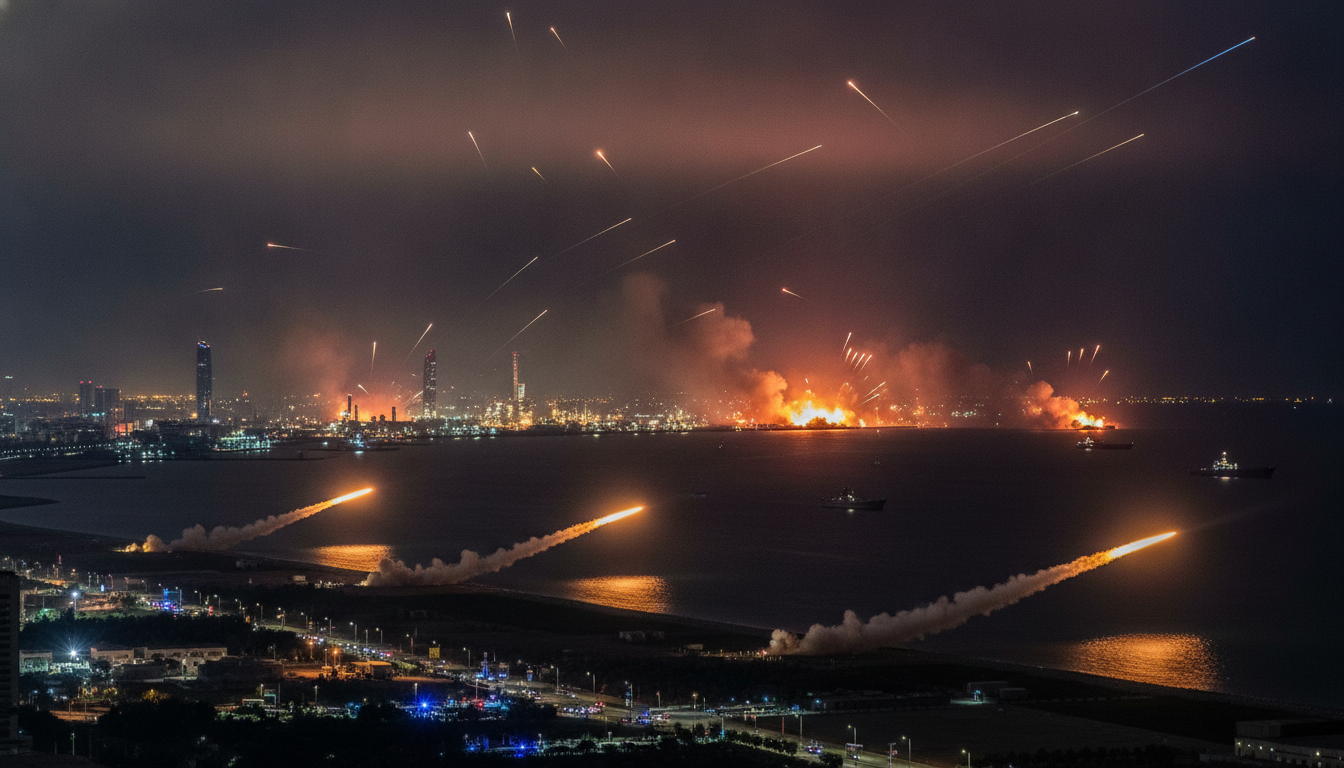
US bombs Iran for seventh night as Tehran strikes bases in Jordan, Kuwait and Bahrain
US forces carried out a seventh consecutive night of strikes on Iranian targets, and Iran responded by attacking U.S. facilities in Jordan, Kuwait and Bahrain while warning of a possible “total offensive.” (investing.com)
U.S. strikes and CENTCOM account
CENTCOM said the latest operations used fighter aircraft, drones and naval forces to hit Iranian surveillance sites, military logistics infrastructure, underground weapons storage and maritime capabilities.
The U.S. military described the strikes as limited to military objectives aimed at degrading Tehran’s ability to threaten freedom of navigation in the Strait of Hormuz. (aljazeera.com)
U.S. officials said the waves of strikes were ordered to counter repeated Iranian attacks on shipping and on U.S. forces in the region.
Pentagon statements emphasized that operations were intended to preserve maritime traffic and pressure Iran’s military networks rather than target civilians. (investing.com)
Iran reports civilian casualties and infrastructure damage
Iranian state media and provincial authorities reported casualties and damage after U.S. strikes on southern provinces, particularly Hormozgan, where officials said bridges and other transport links were hit.
State outlets cited local authorities reporting several dead and wounded, and showed images of damaged bridges and fires in coastal towns. (dawn.com)
Tehran’s health and provincial offices provided differing tallies as the fighting continued to produce conflicting claims and limited independent verification on the ground.
Humanitarian and logistical damage to ports and roads in southern Iran has contributed to growing concern about civilian access to essential services. (dawn.com)
Iranian retaliation across the Gulf
Iran’s Islamic Revolutionary Guard Corps said it struck U.S. bases and facilities in neighboring Gulf states, naming targets that included military installations in Kuwait, Jordan and Bahrain.
Regional militaries reported intercepting missiles and drones; Jordan said its air defenses shot down incoming projectiles and Bahrain activated civil defense sirens. (investing.com)
Kuwait and Bahrain acknowledged hostile drone and missile incidents and reported damage to some infrastructure, while U.S. regional commands said their forces were taking defensive measures to protect personnel and assets.
The exchanges have raised alarm among Gulf states about spillover and the safety of bases that host U.S. forces. (investing.com)
Disputed claims over the Strait of Hormuz
Iran’s Revolutionary Guard announced it had “stopped” four ships attempting to transit the Strait of Hormuz and said two tankers had exploded after hitting mines south of the waterway.
Tehran framed the actions as enforcement of its control over the strait amid what it described as unlawful U.S. interference and an American naval blockade of Iranian ports. (gulfnews.com)
The U.S. Central Command disputed Tehran’s account of the tanker explosions and the broader maritime claims, describing some of the Iranian statements as inaccurate.
Independent confirmation of the incidents in the busy international waterway remained limited, and maritime tracking data showed a marked drop in transits as insurers and ship operators rerouted or paused movements. (gulfnews.com)
Impact on shipping and global energy markets
Shipping through the Strait of Hormuz, a conduit for a significant share of the world’s oil exports, has fallen sharply since the resumption of strikes, with many commercial operators avoiding the route.
Market responses have been immediate at times, with oil and freight rates reacting to the threat of further closures and to the possibility of an extended maritime blockade. (investing.com)
Governments and private-sector actors are scrambling to find alternative routes and contingency measures, but the geographic realities mean replacements are costly and slower to scale.
Analysts warn that sustained disruption could push energy prices higher and strain already fragile global supply chains. (investing.com)
Analysts warn of escalation risk and regional contagion
Policy analysts caution that the back-and-forth pattern of strikes and counterstrikes increases the risk of a wider regional confrontation that could draw in allied states and militia proxies.
Observers say the situation has moved from episodic incidents into sustained attritional exchanges that are harder to de-escalate through diplomacy alone. (investing.com)
Diplomatic channels remain active but fragile, and calls for restraint from mediators have so far been overwhelmed by on-the-ground military dynamics.
With bases and shipping lanes now targets, analysts say avoiding unintended escalation will require clear, credible mechanisms for verification and restraint that neither side has fully accepted. (investing.com)
The overnight operations extended a weeklong cycle of strikes and reprisals that began after renewed attacks in the Gulf this month, and both Washington and Tehran say they remain prepared to continue military pressure while positioning for political leverage at the negotiating table.
