
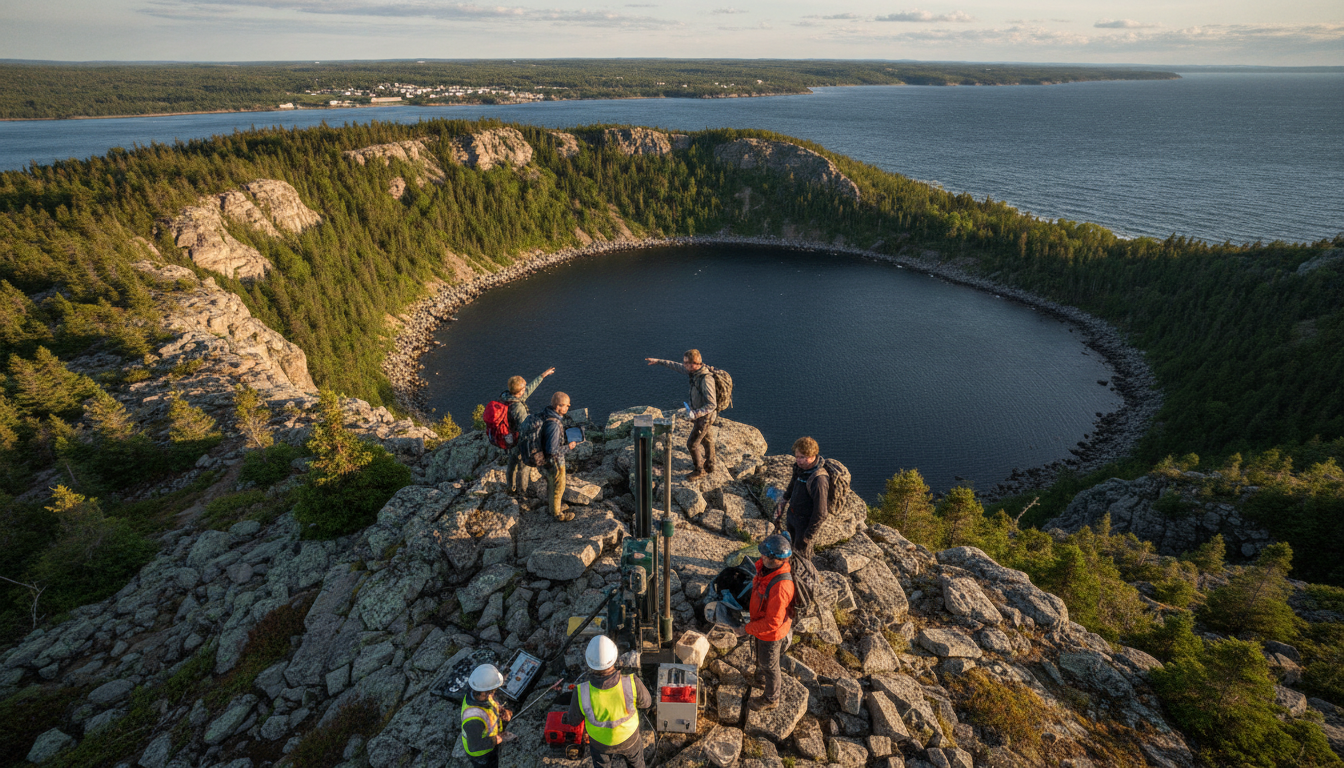
Uhackatik crater confirmed: 390‑million‑year‑old meteorite impact found on Quebec’s Côte‑Nord
Researchers confirm the Uhackatik crater on Quebec’s Côte‑Nord as a 390‑million‑year‑old meteorite impact after fieldwork and geologic sampling following a citizen discovery.
Citizen discovery led scientists to the site
In 2024, amateur astronomer Joël Lapointe noticed a large, faintly circular feature on Google Maps along the Côte‑Nord and reported it to experts, setting a scientific investigation in motion. The formation, originally visible as a shallow, round depression from satellite imagery, prompted speculation that it could be an impact structure. Lapointe’s tip reached researchers through professional networks, who then prioritized a field survey to confirm whether the shape was of extraterrestrial origin. That local observation is now credited with directing formal research that identified the structure as a bona fide impact crater.
Field expedition found diagnostic shock features
A research team led by geologist Jérôme Gattacceca carried out field investigations in October 2025 to test the impact hypothesis on the ground. Their work focused on locating shock‑metamorphic indicators, including percussion cones and other deformation features produced by high‑pressure shock waves. The team reported finding those diagnostic traces within days of beginning the survey, evidence that such structures are rarely produced by terrestrial processes other than impacts or nuclear tests. Those on‑site observations were pivotal in confirming the structure as an impact crater.
Samples yielded an age of about 390 million years
During the field campaign researchers collected and analyzed rock samples that record the physical and thermal effects of the event. Radiometric and petrographic analyses returned an age of roughly 390 million years for the impact event, placing it in the late Devonian period. That date makes the Uhackatik crater significantly older than some of Quebec’s better known impact structures, such as the Manicouagan crater, which is commonly dated at about 215 million years. Establishing the crater’s age contributes to global datasets used to study variations in impact frequency through Earth’s history.
Size and preservation indicate an ancient, eroded basin
From air imagery and ground mapping, the feature measures on the order of tens of kilometres across, appearing as a subdued circular depression in a landscape shaped by long‑term erosion and glacial processes. Although older impact structures often lose their classic bowl shape, subtle geomorphological cues and central uplift remnants remain visible and were documented by the team. Gattacceca described the site as relatively flat at surface level because of its great age and the erosive forces that have acted on it since formation. Despite that erosion, preserved shock signatures and sample chemistry are sufficient to distinguish it from volcanic or tectonic features.
Researchers to present findings to international community
The discovery and the supporting data will be presented to the Meteoritical Society at its upcoming annual meeting, giving the broader planetary science community an opportunity to review the evidence. The presentation marks the formal introduction of the feature to the curated list of terrestrial impact structures and invites independent confirmation and further study. Researchers expect follow‑up work to include more detailed sampling, geophysical surveys, and regional mapping to refine the crater’s dimensions and structure. Such peer engagement is standard practice before an impact site is fully integrated into global impact databases.
Cultural consultation and the crater’s name
The crater has been named Uhackatik following consultation with local Indigenous representatives, including the Council of Innus of Ekuanitshit. Both the research team and the citizen discoverer acknowledged the role of that consultation in selecting a name that recognizes local heritage and stewardship. Joël Lapointe expressed pleasure at the confirmation and praised the collaborative naming process, noting the discovery as an example of how public curiosity can contribute to science. The involvement of Indigenous partners underscores evolving practices in field research that respect local rights and knowledge.
Scientific context and broader significance
Impact craters of this scale are relatively uncommon on Earth because surface processes tend to remove or mask them over geologic time. Each newly confirmed and dated crater adds important data that help scientists track episodes of increased impact flux and evaluate potential links to environmental or biological changes. At roughly 390 million years old, the Uhackatik crater offers a data point within the Devonian, a period of significant ecological and evolutionary developments. Continued study of the structure may shed light on regional geology and contribute to models of how large impacts influence planetary environments.
The confirmation of the Uhackatik crater on Quebec’s Côte‑Nord illustrates how a mixture of modern tools, professional fieldwork and community involvement can lead to significant geological discoveries, even in landscapes that have been mapped for decades. The finding will now undergo broader scientific scrutiny and additional surveys aimed at better constraining the crater’s size, structure and the precise timing of the impact.
