
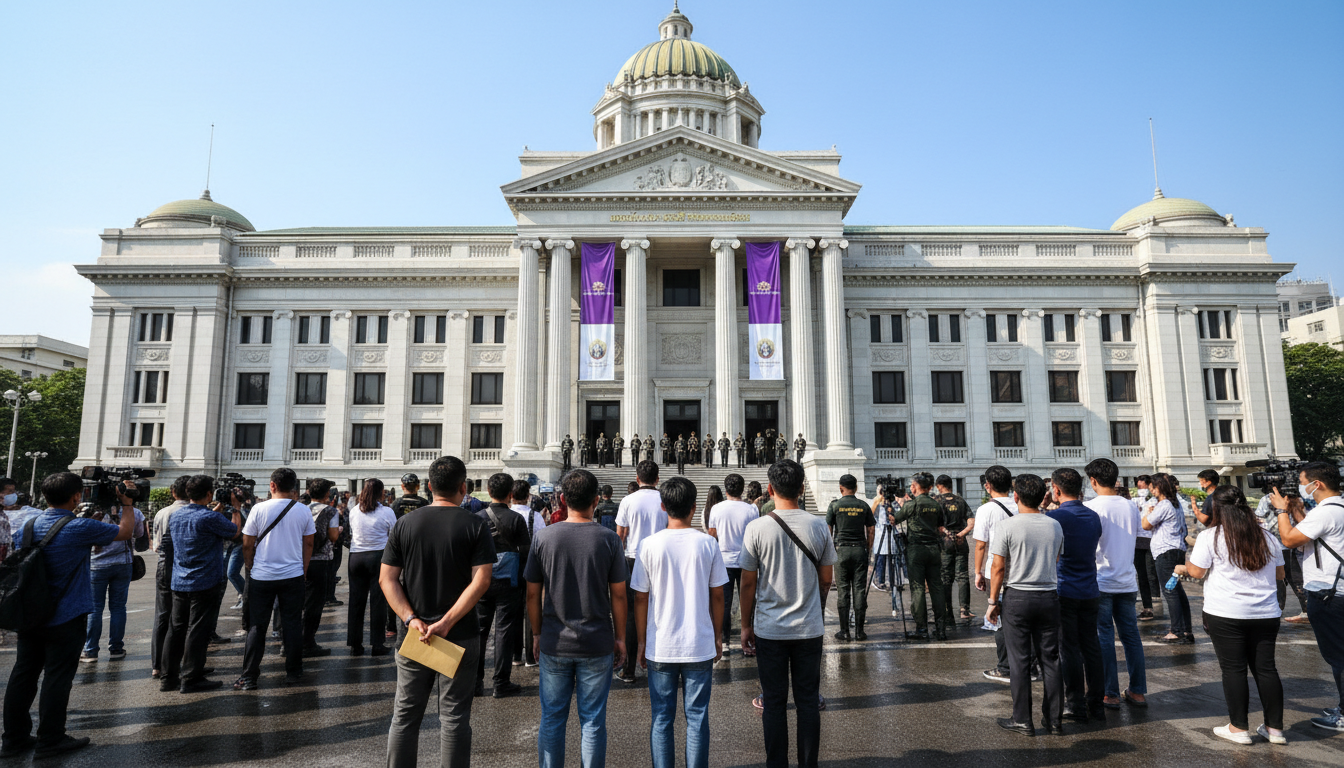
Thailand conscription lottery faces Constitutional Court decision
Thailand conscription lottery to be reviewed by the Constitutional Court on May 12, 2026, as annual draft draws spark debate over fairness and military policy.
Every April, thousands of young Thai men attend a public draw where a single card determines whether they will serve two years in the military or return home; that system — the Thailand conscription lottery — is now under judicial scrutiny. The country’s top court is scheduled to rule on Tuesday, May 12, 2026, on whether the lottery practice should continue, a decision that could reshape how conscription is administered. The impending ruling follows renewed legal challenges and heightened public attention after recent draws produced scenes of both celebration and distress.
Court to Rule on Constitutionality of Draft Lottery
Thailand’s Constitutional Court will hear final arguments and issue a ruling on May 12, 2026, on whether the lottery method used in the conscription process complies with constitutional guarantees. Petitioners argue the system is arbitrary and violates equality provisions, while government and military officials defend it as an efficient administrative practice. Legal observers say the court’s decision could set a precedent for how broad administrative procedures are tested against the constitution.
How the draft lottery operates in practice
Under the current system, eligible men appear at local military offices in April and draw one card from a container; a marked card requires immediate military service for two years, while an unmarked card exempts the individual. The process is conducted publicly and is intended to be simple and transparent, but critics contend that simplicity does not equal fairness. The lottery has long been a fixed feature of Thai civic life, producing both emotional scenes and practical consequences for families and communities.
Public reaction and demonstrations around the draws
Recent draws have produced widely circulated images and videos of jubilant young men celebrating alongside those who reacted with shock and tears, underscoring the profound personal stakes of the lottery. Civil society groups and students have staged protests calling for reforms or an end to compulsory service by lottery, framing the issue as one of equal treatment and civil rights. At the same time, some community leaders and veterans argue that conscription plays a vital role in national defense and social cohesion.
Legal challenges and arguments presented to the court
Challengers to the lottery contend that the method amounts to an arbitrary allocation of civic duty and may infringe constitutional protections that prohibit unequal treatment under the law. Their filings ask the court to require the government to adopt criteria based on capability, need, or other objective standards rather than chance. The defense, including representatives of the Royal Thai Armed Forces, has emphasized administrative practicality and the historical role of conscription, arguing that the lottery is a neutral mechanism applied uniformly across provinces.
Potential outcomes and implications for the military
If the court upholds the lottery, Thailand’s conscription practice will likely continue unchanged for the immediate future, but lawmakers and activists may press for legislative reforms to address perceived inequities. A ruling against the lottery could force the government and military to design a new selection system, potentially involving medical, educational, or other objective assessments, and would necessitate a transition plan for thousands of young men. Any change would also raise operational questions for recruitment planning, training schedules, and budget allocations within the armed forces.
Personal and societal consequences of the ruling
For many families, the court’s decision is deeply personal: a ruling that preserves the lottery means the same dramatic lottery events will recur each April, while a ruling against it could alter life plans for those about to be called up. Employers, educational institutions, and local economies also face uncertainty, since conscription timing affects workforce availability and student progression. Observers note that beyond immediate logistics, the debate touches on broader conversations about citizenship, shared responsibility, and how a modern state should balance fairness with national security needs.
The court’s May 12, 2026, ruling will not only determine the fate of an annual ritual but may also prompt lawmakers to reconsider the architecture of military service in Thailand. Whatever the outcome, both supporters and opponents of the lottery are preparing to respond rapidly, and the decision could trigger legislative proposals, administrative reforms, or renewed public demonstrations.
